



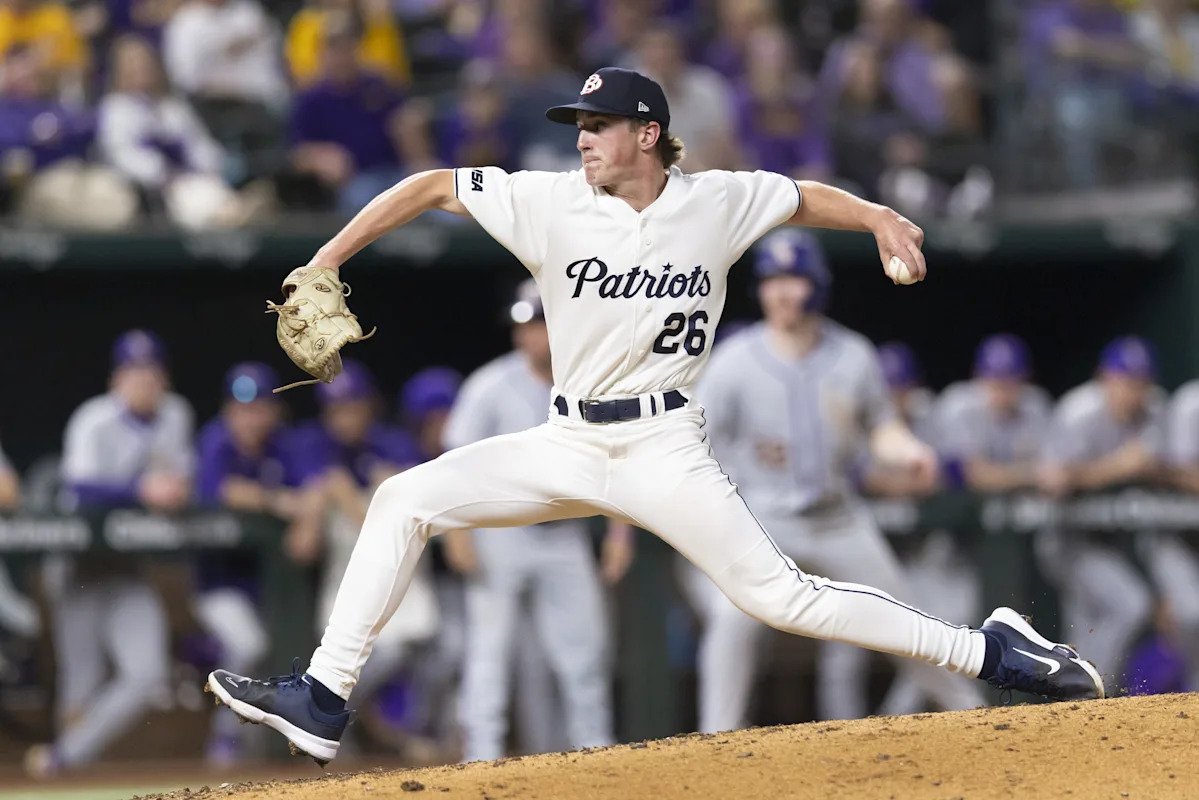
When Mason Peters was selected out of Dallas Baptist in last year’s draft, the young left-hander was (perhaps fairly) overshadowed by several players capable of headlining a draft class by themselves. Kade Anderson, Nick Becker, and Luke Stevenson were all given first round grades last season, so Seattle managing to land all three was a rather remarkable feat that had fans understandably excited. This, however, did force the Mariners to save a bit of cash with their subsequent picks, and at first glance, Peters looked like little more than a lower-round guy who the M’s cut a deal with. However, upon discovering he only received a minor pay cut from his allotted slot value (saving the team roughly $67,000), it became apparent the Mariners see something in this kid. Far from merely an afterthought in a loaded 2025 draft class, Mason Peters is a name you need to know for the 2026 season.
Kicking off Day 2 of the draft with a 5’11 college reliever looks strange on the surface, but what separates Peters as a pitcher is his excellent feel for spin. Featuring a fastball, slider, cutter, and curveball, his entire arsenal gets well above-average spin that helps his offerings play up immensely. Additionally, with a 5.6ft release height, Peters launches the ball several inches below the average MLB pitcher, yet still manages to get solid carry on his heater from the left side. The curveball and slider already look like potential plus offerings and had college hitters baffled more often than not, though some additional velocity progression would help both pitches play to their peak potential in the professional ranks.
Advertisement
The concerns here are relatively straightforward. Under the assumption they view him as a potential starter, the precedent for pitchers his size is not great. Very few pitchers under six feet tall can last in the rotation, let alone pitch a high volume of innings while doing it. He got some starts in college toward the back half of last season, but even then he only had one start go beyond four innings (a remarkable 6IP, 10K, no-hitter). There’s legitimate relief risk in the profile, and the spin-centric approach may or may not run into issues with opposite-handed hitters down the line. Certainly not a flawless profile, but there’s plenty to get excited about for a player that lands in the latter half of the organizational top thirty.
If everything works out for Peters, the 93 mph heater he had last year ticks up with added weight (he was just 175 lbs last season) and he’s able to get closer to his peak of 97 mph more consistently, even if it’s just for shorter stints. A low-launch lefty with solid extension, mid-90’s heat, and big time spin is a valuable asset to invest in, and if there’s an organization that’s proven they can get the most out of those guys, it’s the Seattle Mariners. A good athlete that’s already proven he can throw strikes, the M’s are calculating that they can help get Peters up a level in the “stuff” department. Should that be the case, Peters will follow just behind his classmate Kade Anderson atop the organization’s left-handed starting pitching depth chart, potentially filling an area of relative weakness that’s gone underaddressed for years.
Read the full article here