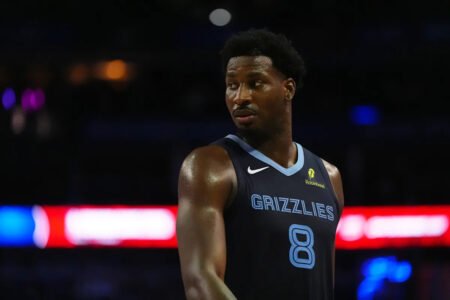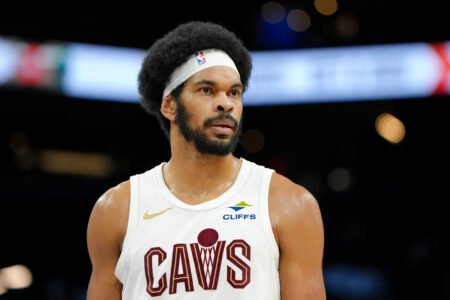

It was never the headline item among Memphis Grizzlies trade chatter, not with the ongoing saga surrounding Ja Morant taking up the oxygen and airtime. But it was notable, if you were paying attention, that Jaren Jackson Jr.’s name would keep popping up here and there — that smart teams were “registering interest” in him; that smart analysts were noting that JJJ, rather than Ja, would be the Grizzly most likely to demand a haul that could kickstart a full-tilt rebuild on Beale Street; and that rival executives were curious whether Grizzlies general manager Zach Kleiman would find a package he liked enough to part ways with his longest-tenured player.
On Tuesday, Kleiman found one.
It’s notable that the list of first-round picks the Grizzlies will receive in exchange for their big man does not include Utah’s own 2026 first-rounder. The Jazz have already dealt the rights to that pick — all the way back in 2021, as part of a deal to dump the salary of Derrick Favors, to the Thunder. The defending NBA champs will get Utah’s first-round selection in this year’s draft … but only if it lands outside the top eight in the 2026 NBA Draft Lottery.
Advertisement
The Jazz enter Tuesday’s action at 15-35, the NBA’s sixth-worst record. Adding Jackson — a two-time All-Star and former Defensive Player of the Year, a very good player averaging 19.2 points per game — would in theory put Utah in position to win a few more games down the stretch, potentially putting the fate of that draft pick in jeopardy.
Y’know: in theory.
In the short term, it’ll be interesting to see how precisely the Jazz — who, lest we forget, said they were all done with tanking, sir, nothing to see here — navigate the league’s tighter injury reporting guidelines to avoid racking up even more six-figure fines for roster-management chicanery. In the bigger picture, though? The Jazz could wind up being pretty damn interesting, pretty damn soon.
Advertisement
Longtime NBA insider Marc Stein previously reported Utah was projecting confidence they’d be able to hold onto center Walker Kessler — currently rehabilitating following season-ending shoulder injury — when he hit restricted free agency this summer. According to Tony Jones of The Athletic, the Jazz still plan to retain him, and by effectively acting in “pre-agency” to use their cap space on Jackson, they put themselves in position to start a supersized front line next season: the 7-foot-2 Kessler at the 5, the 6-foot-10 Jackson at power forward and the 7-foot-1 Lauri Markkanen (reportedly quite pleased by the JJJ deal) at small forward, with the 6-foot-11 Kyle Filipowski checking in off the bench to fit in at any of the three spots.
Dating back to his partnerships with Jonas Valančiūnas, Steven Adams and Zach Edey, Jackson has tended to play his best ball alongside a proper big man, allowing him to kick out and wreak havoc as a weak-side rim protector. The Jazz have been terrible defensively for four years. With Kessler and JJJ roaming the back line, they immediately profile as something significantly better than that, even with young and poor point-of-attack defenders in front of them; the fit of JJJ operating as a stretch-4 attacking from the perimeter and Kessler working as a screen-and-dive lob finisher feels pretty clean, too.
Sliding down the positional spectrum shouldn’t be a problem for Markkanen, either. He has plenty of experience and comfort working as a big wing; there’s a world where this looks like the jumbo outfit that Markkanen briefly lined up with in Cleveland, only with more offensive firepower and shooting touch. (We know head coach Will Hardy digs his big-to-big passing.)
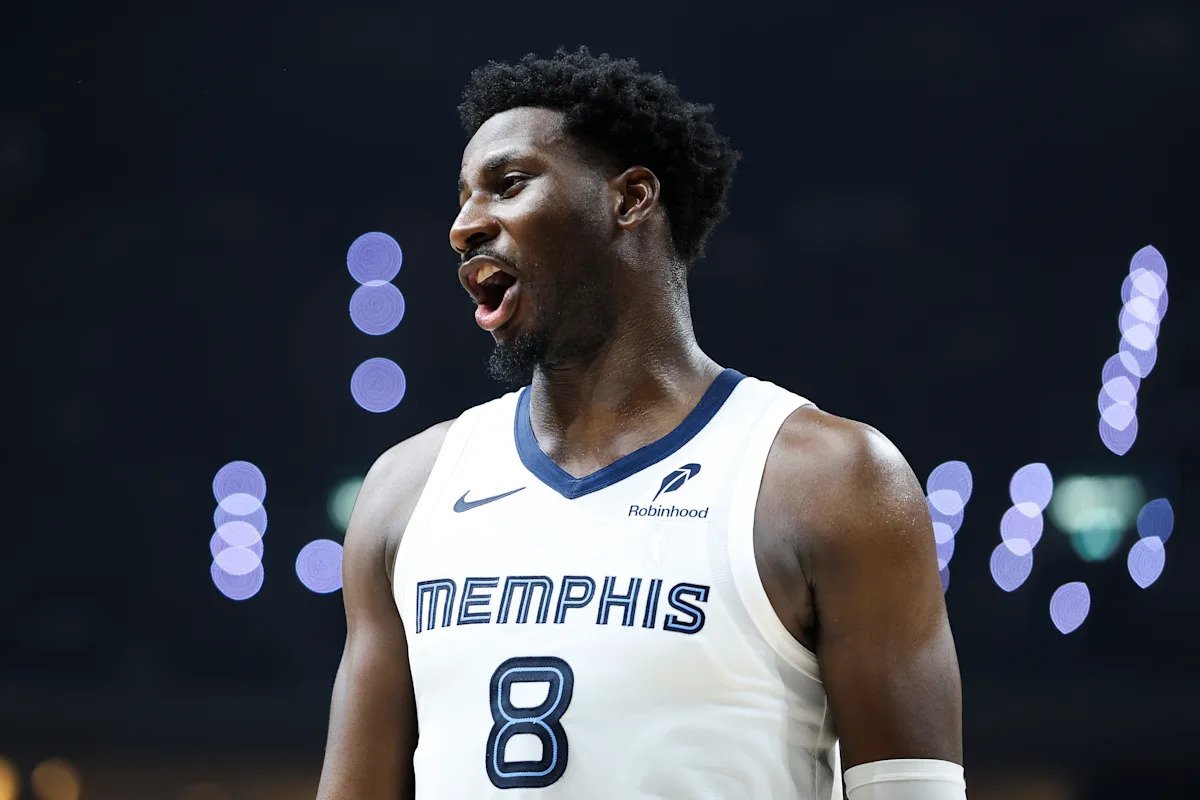
Jaren Jackson Jr.’s tenure in Memphis came to an end Tuesday. (Photo by Bradley Collyer/PA Images via Getty Images)
(Bradley Collyer – PA Images via Getty Images)
If Jackson returns to form after an occasionally sluggish 2025-26 season, if the bigs stay healthy, and you add in a dynamic downhill creator and pull-up shooter in Most Improved Player candidate Keyonte George alongside gifted offensive swingmen Ace Bailey — a 6-foot-9 starting two-guard seems to make perfect sense in this super-sized lineup structure — and Brice Sensabaugh, prospective growth from the likes of Cody Williams and Isaiah Collier, and a top-half-of-the-lottery pick in what’s profiling as one of the most talent-laden drafts in years … suddenly, the Jazz look less like a rebuilding also-ran, and more like a team that could harbor realistic optimism about pushing for a return to postseason play as soon as next season.
Advertisement
The Grizzlies, on the other hand, have opted to take the scenic route back to meaningful springtime basketball.
Kleiman told us exactly what he thought of his team last spring, after the eventual champion Thunder swept the Grizz in the first round: “There’s a level that I think everyone has to embrace and be willing to get to reach the ultimate goal here … I don’t think we can look back at this series and this season and say, ‘Oh, we’re close.’ No, we’re not. We’re not close. There’s a lot of work to be done. I need to be open-minded in multiple respects.”
On Tuesday, with the once-again-decimated Grizzlies — only Portland has lost more player games due to injury this season, according to Spotrac — sitting at 19-29, three games south of the final play-in spot in the West, that open-mindedness has brought about the end of an era. Just over nine months after that sweep at the hands of OKC, Kleiman has turned Jackson and Desmond Bane into Kentavious Caldwell-Pope (who holds a $21.6 million player option for next season), rookies Cedric Coward and Walter Clayton Jr., third-year forward Taylor Hendricks, five future first-round draft picks (plus a top-two-protected 2029 pick swap with Orlando), about $17.4 million in expiring contracts in the form of old pal Kyle Anderson (who played in Memphis from 2018 through 2022) and Georges Niang — and, through some creative deal-structuring, what is evidently the largest trade exception in NBA history.
All told, the Grizzlies now control 12 first-round picks in the next seven NBA drafts — more than any team outside of Oklahoma City and Brooklyn — including a top-four-protected Lakers pick in 2027, and unprotected firsts from Orlando in 2030 and Phoenix in 2031. With Jackson and Bane now elsewhere, the only guaranteed non-rookie-scale salary remaining on the balance sheet beyond the end of next season belongs to Morant; with Memphis reportedly “continuing to field offers and interest” on him, it’s possible that the books might wind up well and truly cleared by Thursday afternoon.
Advertisement
From a cold, sober, analytical perspective, this is what you do when you’ve decided you’re not holding a winning hand — especially if you’re a small-market team without much history of success in free agency. You fold it, shuffle up the deck and see what the next deal turns up.
You see what Coward, who’s averaging just under 19 points, 8.5 rebounds and four assists per-36 minutes on league-average shooting efficiency as a rookie, can do with the ball in his hands more often. (Provided the finally healthy and instantly balling Ty Jerome gives it up.) You give a roster now heavily tilted toward 25-and-under players — newcomers Clayton and Hendricks, holdovers Jaylen Wells, GG Jackson and Cam Spencer, and, if and when they can get healthy, Zach Edey and Scotty Pippen Jr. — chances to earn a spot in whatever comes next in Memphis.
You head into the next 48 hours about $34 million under the luxury tax line, with a ton of flexibility to act as a facilitator in other teams’ trades, renting out that cap space in exchange for even more draft picks and/or young players to test drive. You give yourself as many bites at the apple as possible, and you hope that the next pack of picks and prospects proves at least as successful as the dudes you just jettisoned.
Advertisement
It’s worth remembering that that’s a really high bar. Morant, Jackson and Bane were the linchpins of teams that produced two of the six 50-win seasons in franchise history, and one of just five Grizzlies playoff series victories. They never reached the heights for which they seemed destined back in the spring of 2022, and they didn’t get as far as the Z-Bo/Gasol/Conley/Allen Grit ’n’ Grind-era teams whose mantle they took up. But they won a lot of regular-season games, and they were fan favorites with whom the city fell in love — reasons to show up at FedEx Forum and tune in night after night.
That, as much as on-court production, is what Kleiman will have to replace. Overflowing pick coffers don’t put asses in seats or wins on the board. Players do. After the last era’s best-laid plans turned to ash, Kleiman and his front office had better go find some damn good ones if they want to still be presiding over the next competitive iteration of the Grizzlies whenever it’s ready to roll.
Read the full article here