

In 2022, the “It’s Not My Moneyball” series was created in response to the lockout imposed by the owners that disrupted Spring Training and arguably cost Clayton Kershaw a perfect game in Minneapolis (I had fun). As the season starts, the World Baseball Classic concludes, we must revive this series as trouble looms in the distance, hanging in the air, exactly in the way a brick does not.
Introducing the Dirty Dozen
The current playoff system is allowing more teams than ever to play in postseason ball, with 23 of 30 teams making the playoffs at least once, and 12 of 30 have won their division. While I was initially skeptical, this state of affairs is an unalloyed good. The fact that MLB did not have a repeat champion for 25 years clearly demonstrates the randomness of the postseason tournament.
Advertisement
Those crying for “parity” point to the National Football League as a prime example, seemingly forgetting that dynasties can and do happen in a hard-salary-cap league. For all the NFL’s alleged parity, one has to go back to 2010 for a conference championship weekend without either the New England Patriots or the Kansas City Chiefs participating.
If the owners (and to a lesser extent, Hollywood) had their way, the famous line about “rich teams, poor teams, fifty feet of excrement, and then the Athletics” from the venerated film Moneyball would be true. I love the film, but it completely ignores Miguel Tejada’s MVP campaign and the young stellar rotation of Barry Zito, Mark Mulder, and Tim Hudson. But sure, let’s focus on pre-Parks and Recreation Chris Pratt, while cementing a slightly askew version of baseball economics.
If we are being entirely honest, while using the film’s framing for reference, there are the Dodgers, then teams that can feasibly keep up them on a pure spending basis in the Mets, Yankees, Phillies, and Blue Jays, then teams that are either barely going over or hovering at the 2026 luxury tax threshold of $244 million in the San Diego Padres, Boston Red Sox, Atlanta Braves, and Chicago Cubs.
Advertisement
Then we have teams at least within 60 million of the luxury tax threshold: Houston Astros, San Francisco Giants, Detroit Tigers, Arizona Diamondbacks, Texas Rangers, Baltimore Orioles, Anaheim Angels, Seattle Mariners, and Kansas City Royals.
Then we have the teams bringing up the rear, with projected luxury tax payrolls from FanGraphs and threshold amounts. It’s not pretty because we are talking about over a third of the league — twelve teams, a dirty dozen of billionaire paupers.
-
Cincinnati Reds ($151 million, 93 million from threshold)
-
(West) Sacramento Athletics ($146 million, 98 million)
-
Colorado Rockies ($140 million, 104 million)
-
Milwaukee Brewers ($135 million, 109 million)
-
Minnesota Twins ($129 million, 115 million)
-
Pittsburgh Pirates ($127 million, 117 million)
-
Washington Nationals ($122 million, 122 million)
-
St. Louis Cardinals ($115 million, 129 million)
-
Tampa Bay Rays ($109 million, 135 million)
-
Chicago White Sox ($108 million, 136 million)
-
Cleveland Guardians ($98 million, 146 million), and
-
Miami Marlins ($84 million, 160 million).
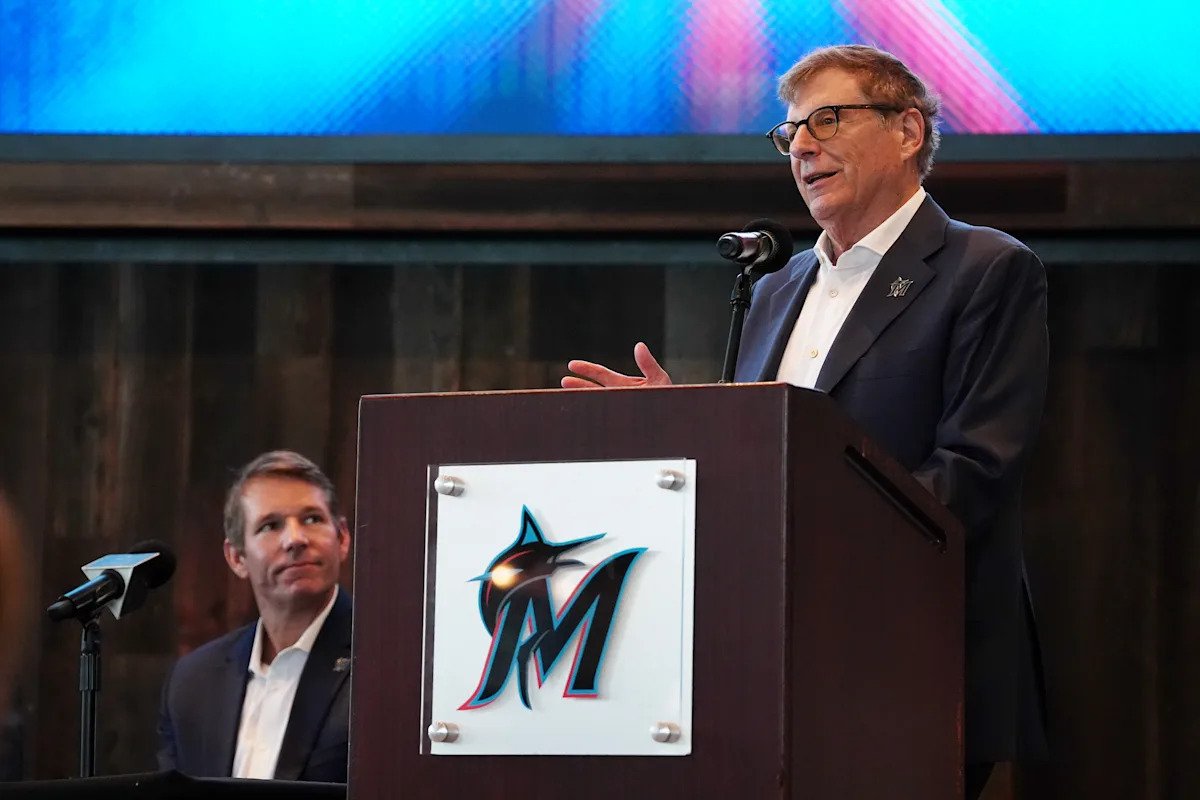
It’s kind of funny, and a little pathetic, that the owners are going to pretend that Miami is not a viable baseball market during negotiations. That statement is true during the regular MLB season, as loanDepot Park is a factory of contemporary sadness. However, one would not have known that state of affairs during the recently concluded World Baseball Classic. Loud fans, who are actually allowed to sit in the upper deck in a packed house? In this economy?!? At loanDepot Park?!?
The fact that loanDepot Park is unlikely to get that full again for at least three years is a damning indictment of the incompetence of the current ownership group down there. There is a high cost to being poor or playing at being poor, in baseball’s case, in the United States.
Advertisement
Cheap ain’t free
When the Dodgers’ luxury tax bill exceeds a team’s literal payroll, a few truths become painfully clear.
First, these teams are not trying. While one would expect teams that just started rebuilding (like St. Louis and Minnesota) to have lower payrolls, there are teams in this pauper’s brigade who are clearly being subsidized by the Dodgers’ largesse.
A rebuild that never ends is just sanctioned mediocrity.
When the Brewers started announcing that they would trade star pitcher Freddie Peralta, I became incensed because, for all of the Brewers’ and manager Pat Murphy’s whingeing that they are a bunch of regular guys that have no business going against the mighty Dodgers, faux humility rings false when you do it to yourself.
Advertisement
The Brewers rely on a model of self-imposed austerity in which they either draft and develop well or suffer perpetual mediocrity. This essay is not arguing that the Brewers must spend like the Dodgers, as most teams cannot. However, if a team cannot spend within the completely arbitrary yet somehow respectable $160 to $190 million range of the Diamondbacks, Mariners, Royals, and Angels (all that money wasted in Anaheim), and make itself look like a pauper compared to the San Francisco Giants, what are you doing?
To play Devil’s Advocate for a moment, there is far less margin for error when operating on a pauper’s budget.
Tampa plays in the Dinky Ice Rink that God (Usually) Forgets, and Cleveland plays in a nice ballpark, somehow won their division last year, and planned to follow up that campaign by literally doing almost nothing apart from running it back, much to the annoyance of anyone who noticed. If one were forced to find a theme in what I will call the Dirty Dozen, most members are from the Central Divisions of both leagues.
But Michael, these teams cannot possibly spend on the level of the Dodgers and other markets. Therefore, they cannot possibly retain their stars.
If such a fact were true, it would be time to strip away the league’s antitrust exemption, consider dividing the league into a Premier League and a Champions League, and introduce relegation in Major League Baseball.
Advertisement
[Author’s Note: Expand to 32 teams, split between 16 teams — talk about a thought experiment! The bottom two teams play a playoff series to avoid relegation. The top four teams in the lower division play in a playoff tournament, with the winner promoted. Thoughts for later.]
Capitalism is alive and well in MLB
This fact is not true, so I shall continue. One does not have to think very hard in order to come up with examples.
Bobby Witt is inarguably the best player produced by the Kansas City Royals organization in the past twenty years, although just how good is a question for our colleagues at our sister site, Royals Review. If the naysayers were correct, Witt would have hit free agency with aplomb, likely leaving the City of Fountains.
Advertisement
There is an unacknowledged truth about the market as it is now: there’s nothing stopping teams from spending money to lock up homegrown talent during the team control years, at the expense of buying years of arbitration (which owners generally hate) and early free agency. Witt signed for 11 years and $288 million, both franchise records.
Now, there are instances where players price themselves out of the market. Everyone seems to forget that the Dodgers let star shortstop Corey Seager depart for the Texas Rangers in a 10-year, $325 million deal. Yes, this deal occurred in the pre-Ohtani era. I would have gone 7 years at $275 million, which is the type of higher Average Annual Value deal the Dodgers could not make work with Bryce Harper et al., but one that finally worked for Kyle Tucker.
Yet most view it as a fait accompli that Paul Skenes will depart Pittsburgh and Tarik Skubal will depart Detroit at their earliest respective opportunities. Yet Skenes is only in his second year, and Skubal and the Tigers did not discuss a long-term extension this offseason, which is his last year under his current contract.
If the Tigers are just going to shrug and feign helplessness, I hope they make use of the compensatory draft pick when Skubal signs elsewhere. If an organization is going to try to embarrassingly lowball Skubal in his final year of arbitration — and what a blunder that fiasco was — one cannot be shocked when Skubal suits up for more money next year. I saw Skubal be somewhat mortal against the Dodgers in Detroit in 2024, which was the only game the Dodgers prevailed in that weekend.
Advertisement
If Skubal ends up in Los Angeles, the Tigers will likely only have themselves to blame. The Dodgers have both benefited from other teams’ failures (Boston re: Mookie Betts, Atlanta re: Freddie Freeman, San Francisco re: Blake Snell, Tampa re: Tyler Glasnow, Toronto re: Ohtani, Yamamoto, Sasaki, etc., etc.) and invested in infrastructure and drafting, even finding value in down-year drafts.
Stars will continue to get paid. The underlying gripe in the naysayers’ complaints, as I see it, is that these cheapskates, rather than haranguing and hectoring their own skinflint ownership into acting, would rather not follow up on the good fortune of having a star come up through the ranks in order to be paid like one.
Juan Soto’s latest contract, a 15-year, $765 million deal, is a boneheadedly stupid contract for someone with mediocre-to-awful defense and someone who is not a two-way player. If a team wants to spend stupidly, see the Mets, see the late 2000s Dodgers, etc., the market is going to allow it, and generally pay the baseball and monetary costs for it.
A loser with a checkbook is still a loser
The lazy, borderline stupid take is that imposing a salary cap and floor would improve parity in MLB and make talent more available throughout the league. Brodie Brazil argued as such recently, when a proposed $260-280 million cap and a $140-160 million floor entered the discussion, likely in an attempt to prime public opinion.
Mr. Brazil makes the dubious argument that, if the hypothetical floor and cap were imposed using this year’s payrolls, the players would end up with more money under this system than they do under the current system, and that things would not change all that dramatically, as under the proffered numbers for hard cap and floor, players would get more money overall.
Advertisement
While the arithmetic is technically correct, it’s an argument missing context, like confidently arguing a lump of metal falls faster than a feather when dropped from the same height (gravity is the same on both objects; wind resistance is the missing variable).
If he truly believes that last part of his argument, I have an overextended, teetering Bay Area mass transit system to sell him. I could even do a little song about it, even though it’s technically not a monorail. Rather than asking how the boot leather tastes, it is worth noting that MLB already operates under a soft cap system.
If penalties for going over or being too far under need more teeth, that discussion might be worth having. Maybe the parties will get there after setting all the goodwill generated by the 2025 World Series and the 2026 World Baseball Classic on fire.
Imagine making an extra $100 million dollars available to the owners of the Dirty Dozen right now. Does anyone honestly believe that they are going to spend this extra money on payroll rather than pocket it as they have been doing? The flip side to the Dodgers being forced to spend less money on payroll in a hardcap system is the unexpected consequence of the organization keeping more money, which they will undoubtedly use creatively to maintain their current dominance.
Advertisement
If anything, the Dodgers have been operating with a chip on their shoulders for a while. Years of playoff frustration and mockery, combined with unlimited money, tend to do that.
Do the naysayers really want to create additional variables for people smarter than the average front-office person to overcome? The Dodgers responded to the league’s apparent indifference toward the 2017 Trashtros’ misdeeds by transforming from a perceived squad of talented homegrown goobers into a faux-mercenary brigade that challenges the league to beat them when it counts.
Get better or get angry
The Dodgers are benefiting from mastery of the current economic system. When I now hear the lamentations of those who complain, it is the frustrated wish of those saddled with being fans of teams that are fundamentally lacking.
Advertisement
Shohei Ohtani was never, under any circumstances, going to be a Sacramento/Oakland/Las Vegas Athletic or Milwaukee Brewer or a Miami Marlin, 50/50 heroics aside. One can chart out the same path for Freeman, Betts, Glasnow, Snell, or just about any of the Dodgers’ current constellation of stars.
Fabian Ardaya of The Athletic published an excellent essay on March 26 (paywalled), about the cohesive, constructive culture the Dodgers have created over the last few years, thanks in no small part to the example of recently-retired Clayton Kershaw:
“There’s a legacy that’s already in here, and you just try to carry that [legacy] on,” said Max Muncy, now the team’s longest-tenured player after Kershaw’s departure. “You’re not trying to change it, you’re trying to keep it going.”
Baseball’s richest payroll means plenty of well-compensated stars. Which means egos and players wanting to maximize their place in a lineup that resembles the Walk of Fame. Which, in theory, breeds simmering chaos.
Except in Los Angeles, it seems.
“We don’t have the narcissistic superstar,” president of baseball operations Andrew Friedman explained.
Mookie Betts put it less delicately.
“Nobody’s being a d— in here,” he said….
…“Because we all love each other, we all trust each other,” Betts said. “We’re all very comfortable going up and telling one another our opinions. And it’s never in a derogatory (way), a tearing someone down way. It’s always in a positive manner, and it’s never like, ‘This is the end of the world.’”
There is a reason that even veteran role players like Miguel Rojas have bought into what the Dodgers are selling on the field.
Yes, the money helps, but the Dodgers’ current run is something truly unique.
Advertisement
The Smoking Gun
Yes, there are multiple non-exclusive ways to build a roster: through the draft, through trades, through the open market of free agency, and through international posting. It is not one exclusive approach that works, as the Dodgers have shown excellence in all of these areas.
Per Jon Heyman and Joel Sherman of the New York Post, who reported on February 19, the owners have assembled an approximately $2 billion war chest as a rainy-day fund, with about $75 million from each team.
If one wants a smoking gun as to how intellectually dishonest the owners are and are about to be, with that fund in mind, refer to the spending chart on free agent contracts in 2026 as of this essay:
Advertisement
-
Toronto Blue Jays – $339,999,999 (27 contracts)
-
Dodgers – $330,950,000 (21)
-
New York Mets – $249,770,000 (35)
-
Chicago Cubs – $236,625,000 (32)
-
Philadelphia Phillies – $227,900,000 (27)
-
Baltimore Orioles – $213,500,000 (18)
-
New York Yankees – $200,875,000 (31)
-
Detroit Tigers – $195,772,000 (30)
-
Boston Red Sox – $140,399,998 (18)
-
Atlanta Braves – $118,064,997 (37)
-
San Diego Padres – $104,579,998 (42)
-
Seattle Mariners – $101,999,999 (31)
-
Arizona Diamondbacks – $81,575,000 (25)
-
Chicago White Sox – $79,199,996 (20)
-
San Francisco Giants – $71,804,999 (22)
-
Houston Astros – $58,850,000 (21)
-
Cincinnati Reds – $51,499,999 (28)
-
Pittsburgh Pirates – $51,099,998 (19)
-
Tampa Bay Rays – $38,000,000 (14)
-
Colorado Rockies – $31,900,000 (17)
-
Milwaukee Brewers – $28,525,000 (15)
-
Texas Rangers – $27,124,999 (42)
-
Minnesota Twins – $24,999,999 (17)
-
Anaheim Angels – $22,330,000 (34)
-
Miami Marlins – $20,500,000 (18)
-
Washington Nationals – $18,399,998 (20)
-
St. Louis Cardinals – $18,000,000 (13)
-
Sacramento Athletics – $11,850,000 (21)
-
Cleveland Guardians – $9,400,000 (14)
-
Kansas City Royals – $8,650,000 (19)
As of this essay, 15 teams have spent more on this lockout fund than on the open market. It is not a perfect one-to-one match, but it is no surprise that ten teams of the Dirty Dozen spent more on the fund than in the open market. The White Sox spent barely more than their contribution. The Giants did not, somehow, which explains a lot of the agita from San Francisco this winter.
The Players Union will never agree to a salary cap. These Dirty Dozen owners do not want to spend cash now while existing in a more forgiving system. Stars will continue to get paid, especially while deferred money is still a thing. The people caught in the crossfire of a hardcap are the mid-tier guys and the overvalued bullpen guys: your Michael Confortos, Chris Taylors, Kirby Yates, Tanner Scotts, et al, etc.
If that view is what the naysayer truly believes and is oblivious to the fact that dynasties can and do happen in a hard-cap system, I only have one thing to say: good luck. After all, a loser with a checkbook is still a loser. As long as the Dodgers remain a destination, players will continue to gravitate toward them.
Read the full article here