



He’s been an outspoken PGA Tour critic. Now he’s joining its boardGetty Images
Only the nerdiest golf fans know what the acronym PAC stands for, and that’s probably for the best. (It’s Player Advisory Council, a low-hanging branch of PGA Tour government.) The meetings and decisions of the Tour’s player-focused operations are only occasionally interesting, but more often are cumbersome and conservative.
Advertisement
Frankly, that’s how they’re supposed to be.
Sports leagues with 50-plus years of history should have a sustainable (if not profitable) baseline. And the Tour very much did . . . until LIV Golf came along. When LIV stole away a number of players from the Tour — including a few on the Advisory Council! — everything changed, including those PAC meetings.
Golf fans know the history well now. The Tour immediately began shifting its competitive structures to maintain dominance in the pro-golf ecosystem. Not everyone was pleased about the changes. One way of doing something about it has always been to air out those grievances with the 16 members of the PAC, a group that changes every year, which essentially works as a congress for the PGA Tour.
On 10 different occasions, Lucas Glover was voted to be one of those 16 representatives; he declined every time. The 11th time around, he agreed, and soon after was elected the committee’s chairman. In 2026, unlike most years, that actually means something.
Advertisement
Glover ran against the sitting chairman, Adam Scott, for that role atop the PAC, and the Tour announced this week that he won the race. The main reason it matters is not because Glover will oversee the PAC in 2026, but rather because the PAC chairman graduates at the end of his term to not only hold a spot on the PGA Tour Policy Board for 2027-2030 but also the board of PGA Tour Enterprises, the for-profit arm of the Tour that will determine the league’s future.
Glover may sound reserved on his account of his Southern drawl, but in reality he is one of the Tour’s most outspoken voices, and recently has been one of the most ardent critics of the Tour’s direction (i.e., fewer members, elevated events, no-cut tournaments, etc.).
In less than a year, Glover will join those boards and own one of their precious votes. On the Enterprises side, he’ll be one of 13, joining six other players directors (Tiger Woods, Patrick Cantlay, Maverick McNealy, Keith Mitchell, Camilo Villegas and Joe Ogilvie), along with Joe Gorder, Jay Monahan and four investor directors (John Henry, Sam Kennedy, Arthur Blank, Steve Cohen).
In one sense, Glover, who is 46, is arriving to the party a bit late, because the Tour already has hired a new CEO (who is interested in making change) and taken on massive investment from others who are similarly minded. Also, the board has been reviewing models of a future Tour schedule for months, a process that is a locomotive with only a few more stops on its journey.
Advertisement
Putters

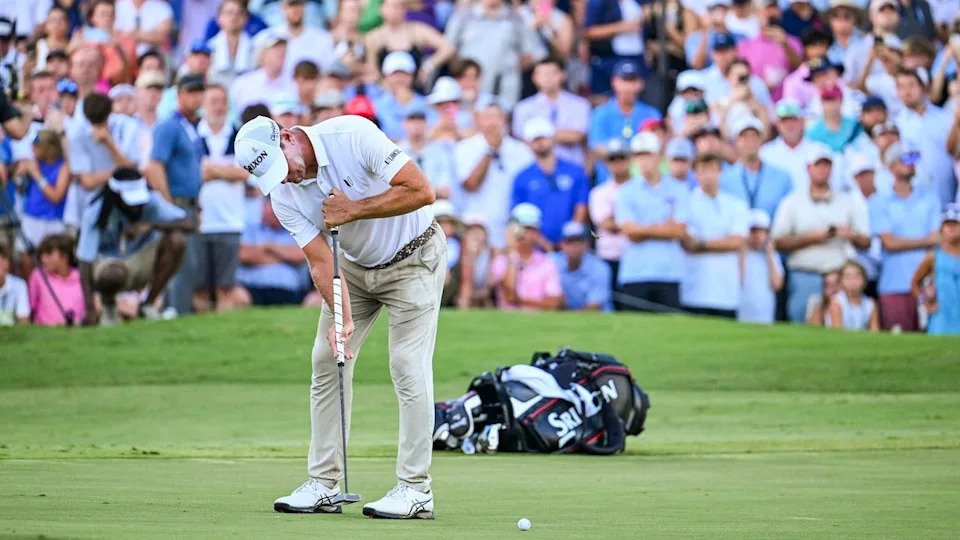
lucas glover lab golf putter
In another sense, Glover stands as a new voice representing the center of the bell curve. In his career, he’s spanned both sides of it, accomplishing something few ever will — win a major — while also battling the absolute depths of a yippy putter. Few players have that kind of range. He has struggled woefully at times, leading him to lose his status, and he’s risen above all those challenges to redefine his game and win in his mid-40s. More than anything, Glover will be the only pro golfer this year to win an election voted on by the membership, and that means something. On the surface, he seems to represent something a lot of pros care about.
But it’s also not hard to wonder what mindset Glover will bring to Tour governance. He sees the pro golf world in a certain way — and isn’t afraid to say so, evidenced by his musings on his Sirius XM Radio show — and that doesn’t always align with how other board members see the pro golf world.
Advertisement
One easy point of criticism is that Glover has, at times, talked loudly while acknowledging he doesn’t know all the facts. Sixteen months ago he suggested you need a “Nobel math scholar” to understand the FedEx Cup Fall. While we can respect the call for simplicity, you don’t need to master calculus, trigonometry or anything above Algebra 101 to understand FedEx Cup points, particularly if they hold the importance of retaining your job.
In August 2023, in an interview with Golfweek, Glover called the PAC “useless” and said the Tour’s slimming down of its playoff positions was a “contrived” and “silly” move. He was open with his opinions, and plenty of his peers loved him for it, but at times showed a lack of commitment to understanding the fine print.
He said the Tour “couldn’t continue down the road” it was going financially and needed to make changes as it tried to compete with the well-bankrolled and “inevitable” LIV Golf. But then, just a few months later, speaking with Golfweek again, he said, “I’ve yet to figure out what’s so bad out here that we had to do all the things we’ve done”; he was referring to limited-field Signature Events. Glover’s interviews, while revealing, often suggested problems without offering solutions.
A month after investors wrote a $1.5 billion check to the Tour and formed the entity known as PGA Tour Enterprises, immediately granting players like Glover multi-million-dollar ownership equity in its future, Glover had yet to watch any of the informational videos the Tour made for players to better understand the program.
Advertisement
At that time (and often since) he has begrudged the idea of LIV players returning to the Tour, starting one such rant with, “Now that we have a second entity, PGA Tour Enterprises or whatever it’s called…”
That was 2024, and this is now, when LIV golfers have come back, a decision green-lit by members of PGA Tour Enterprises. Over that time, it would appear Glover has warmed, if only slightly, to the Tour’s new path. This week, in yet another interview with Golfweek, Glover said he’s now inspired to represent his fellow pros. He says he’s matured and admitted, “I don’t know how any of this stuff works yet. I’m picking guys’ brains and trying to figure out what’s what. Before I form any opinions, I want to get as much info as I can.”
News
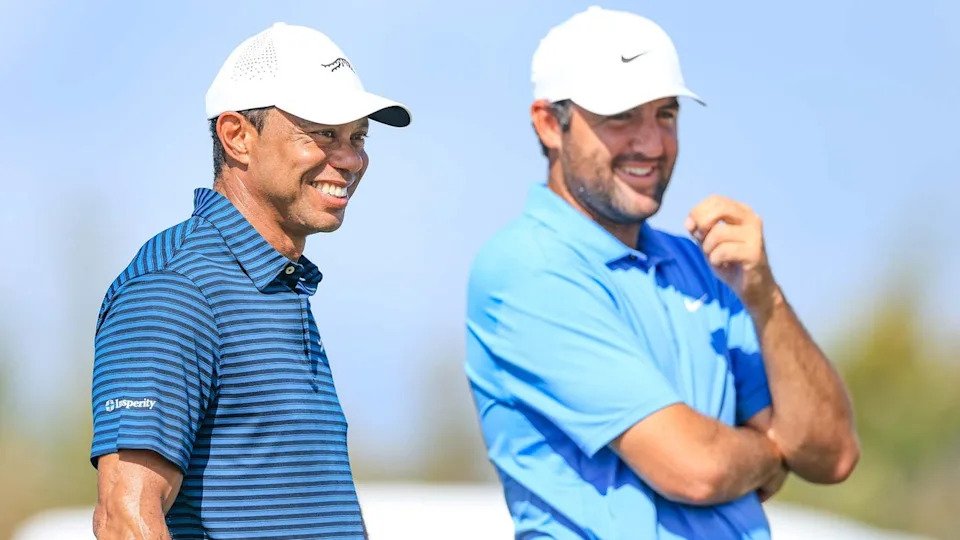
Tiger Woods and Scottie Scheffler at the 2025 Hero World Challenge.
The PAC chairman often gets to observe the Tour’s boards in the year before he assumes a seat, but, in Glover’s case, plenty of what he stands for already has been displayed in interviews and radio hits from recent years: an affection for the Tour’s traditional structures and rituals.
Advertisement
He loves Innisbrook, for example, the course that hosts the Valspar, which isn’t exactly a course (or tournament) of preference for the Tour’s future schedule. Glover called it the best Tour course in Florida.
Glover’s last few years have allowed him to, at times, plan his playing schedule with certainty months in advance. He knows how valuable that can be, and how uncomfortable life can get without those assurances. A mistake, at this point, would be suggesting alterations to the Tour wouldn’t guarantee that predictability. If anything, a trimmed-down Tour — in regards to membership and events — would bifurcate a true PGA Tour and PG(B) Tour, creating more predictable schedules for all.
Glover’s schedule — and press conferences at the John Deere Classic, for example — suggests he believes in a sense of loyalty between player and tournament, and he clearly believes in the value of winner’s exemptions. That issue is one of the trickiest corners of the Tour’s future. Tournament winners receive a lot of benefits, some that extend for years, regardless of a player’s form. Can those benefits live forever on a Tour examining every piece of its competitive model? Probably not at the going rate.
Then there are the sponsor exemptions that seem to unfairly benefit the same few players, and the case of 62-year-old Vijay Singh, who raised eyebrows when he used a career exemption to compete in the Sony Open — and made the cut. Other sports simply don’t allow for a pro twice the age of its core membership to punch in when he or she pleases. Pro golf is different, but that doesn’t always make it edge-of-your-seat compelling or commercially viable. Pro golfers largely respect tradition, but business minds, including the Tour’s new CEO, rarely bind themselves to it.
Advertisement
Which group will Glover fall into? We’ll find out soon enough. He just has some homework to do first.
The post He’s been an outspoken PGA Tour critic. Now he’s joining its board appeared first on Golf.
Read the full article here