
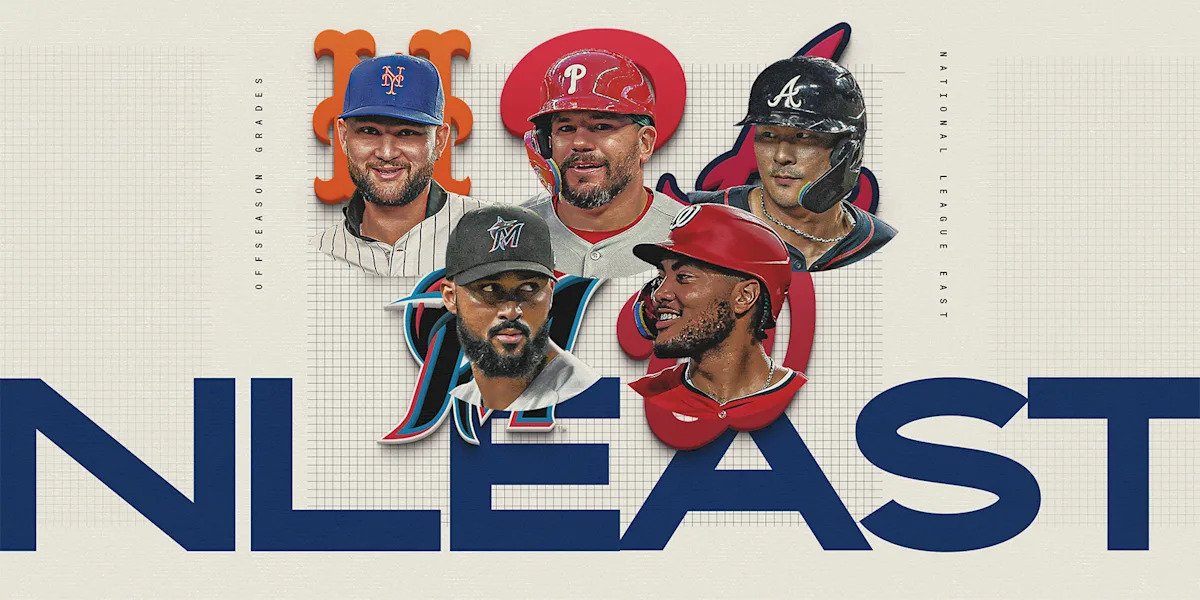
When pitchers and catchers begin reporting on Feb. 10, it will mark the official start of spring training and the unofficial end of the MLB offseason. That means that even though a few free agents remain unsigned, it’s time to grade the offseasons of every team in baseball, looking at which players they lost, which players they added and whether they got better heading into Opening Day 2026.
We begin with the National Least East.
Philadelphia Phillies
Significant outgoing free agents: SP Ranger Suárez, OF Harrison Bader, OF Max Kepler, RP David Robertson
Advertisement
Major moves:
-
Retained free agent DH Kyle Schwarber on a 5-year deal
-
Retained free agent C J.T. Realmuto on a 3-year deal
-
Signed OF Adolis García to a 1-year deal
-
Signed RP Brad Keller to a 2-year deal
-
Traded RP Matt Strahm to the Kansas City Royals for Jonathan Bowlan
-
Signed RP Zach Pop to a 1-year deal
Offseason grade: C
Philadelphia’s offseason will likely be remembered, fairly or not, by the move they failed to make. Bo Bichette and the Phils were at the 1-yard line on a long-term deal when the Mets, jilted by Kyle Tucker, swooped in from the treetops to poach the free-agent infielder. Rarely does a baseball executive publicly express frustration over a missed target the way president of baseball operations Dave Dombrowski did after losing out on Bichette, referring to the result as a “gut punch.”
The Phillies didn’t enter the winter expecting to pursue Bichette, but when a contract standoff emerged with catcher J.T. Realmuto, the club saw an opportunity. So when all things Bichette fell to pieces, Dombrowski and Co. simply reverted to their original plan and paid Realmuto what he wanted. It was a sequence that concluded a reasonable and rational, if overly safe, offseason.
Advertisement
That’s by no means a knock on Schwarber, whose return to Philadelphia should have hoagie-mouthers climbing light poles. Reuniting with the stout slugger was priority No. 1, 2 and 3 for the club at winter’s outset. To get it done, the Phillies paid a hefty price — five years and $150 million is a sturdy sum for a 33-year-old DH — but Schwarber was simply too important to the entire operation, both between the lines and in the clubhouse.
Dombrowski’s decision to let Suárez waltz up to Boston was curious. The pudgy southpaw was a rotation stalwart the past few seasons and left a void in the staff that the Phillies have yet to fill externally. That route puts a world of pressure on (1) injured ace Zack Wheeler to return swiftly and effectively, (2) yet-to-debut top prospect Andrew Painter, who struggled in Triple-A last season and (3) back-end hurler Taijuan Walker. For all its offensive starpower, this era of Phillies baseball has been made possible by impact starting pitching. Will the team have enough of it in 2026?
With all due respect to García ($10 million is a lot for a bounce-back candidate) and Brad Keller (his arrival and Strahm’s departure effectively cancel each other out), the Phillies have clearly opted to stay the course. Handing top prospect Justin Crawford the every-day center-field job and jettisoning Nick Castellanos to Narnia qualify as a new path, for sure, but the 2026 Phillies are primed to look a lot like the 2022-25 Phillies.
Advertisement
New York Mets
Significant outgoing free agents: 1B Pete Alonso, RP Edwin Díaz
Major moves:
-
Acquired SP Freddy Peralta and P Tobias Myers for two top-100 prospects
-
Acquired 2B Marcus Semien from the Texas Rangers for OF Brandon Nimmo
-
Signed IF Bo Bichette to a 3-year deal
-
Acquired CF Luis Robert Jr. from the Chicago White Sox for UT Luisangel Acuña and a pitching prospect
-
Signed IF Jorge Polanco to a 2-year deal
-
Signed RP Devin Williams to a 3-year deal
-
Signed RP Luke Weaver to a 2-year deal
-
Traded UT Jeff McNeil to the Athletics for a pitching prospect
-
Signed RP Luis García to a 1-year deal
Offseason grade: B+
*Exhale*
We could sit here and debate the merits of the Mets’ offseason until the sun explodes and our memories become memories. Undeniably, it was a dramatic, bold course of action by POBO David Stearns, who ripped up the club’s core in the wake of a historically calamitous 2025. Four cornerstones — Alonso, Díaz, McNeil, Nimmo — left via free agency or trade. While manager Carlos Mendoza survived the purge, most of his coaching staff was overhauled.
But this is certainly not a rebuild, nor should it have been with Juan Soto and Francisco Lindor purring at their peaks. Instead, Stearns assembled a golden stopgap, a short-term solution that makes the Mets better in 2026 without sacrificing the future. Few of the players added this winter are under contract for the long haul. Most are on one- or two-year deals. Bichette, the flashiest new name, can opt-out next winter if he has a strong 2026. Peralta, the team’s new ace, will hit free agency after the season. It’s a strategy that allows New York to leave a handful of opportunities open for the slew of talented prospects funneling up from the farm.
Advertisement
Stearns was honest from the jump about wanting to improve his team’s run-prevention unit. Peralta will help that cause, as will Semien’s and Robert’s defensive chops in the middle of the diamond. Teaching Polanco and Bichette to play new positions won’t be a breeze, but both former shortstops are more than capable.
Díaz, who signed with those plucky Los Angeles Dodgers, was probably the one that got away, the only regret of an otherwise prudent offseason. The Mets should have matched what L.A. paid (3 years, $69 million). Díaz wasn’t blocking anybody else from pitching in the ninth, he’s still an elite closer, and his return would’ve been a reasonable bit of fan service.
And besides, money to Steve Cohen is just a concept. But at least this Mets team should make the playoffs, right?
Bo Bichette’s three-year, $126 million deal with the Mets represents the flashiest addition to the NL East in 2026.
(Grant Thomas/Yahoo Sports)
Miami Marlins
Significant outgoing free agents: None
Advertisement
Major moves:
-
Traded SP Edward Cabrera to the Chicago Cubs for OF Owen Caissie and two prospects
-
Traded SP Ryan Weathers to the New York Yankees for four prospects
-
Signed RP Pete Fairbanks to a 1-year deal
-
Signed UT Christopher Morel to a 1-year deal
-
Traded CF Dane Myers to the Cincinnati Reds
-
Acquired SP Bradley Blalock from the Colorado Rockies
-
Acquired OF Esteury Ruiz from the Los Angeles Dodgers
Offseason grade: C-
The 2025 Marlins were much, much better than expected. But instead of amplifying that momentum with a flurry of offseason moves, the Fish spent this winter treading winter. Miami’s projected $69 million payroll is an utter embarrassment, the lowest in baseball. Of the $15 million they committed this winter, $13 million belongs to Pete Fairbanks, who will be dealt at the deadline if the Marlins are out of it. Of course, not every club needs to or can spend $60 million per year on Kyle Tucker, but Miami’s passivity in free agency was nonetheless disappointing.
Trading away Cabrera and Weathers was rational, considering the organization’s surplus of highly regarded arms in the upper minors. But the returns on both were somewhat underwhelming. Caissie, the best player acquired this winter, is a boom-or-bust type with big whiff issues. Nobody else who was added this winter seems primed to help the club in the short term.
Advertisement
Somewhere, a timeline exists in which the Marlins acted aggressively this offseason to reinforce a compelling core of young pieces and enter 2026 as a cheeky wild-card pick. Unfortunately for the hardball lovers of South Florida, that’s not the reality we’re living in.
Atlanta Braves
Significant outgoing free agents: DH Marcell Ozuna, SP Charlie Morton
Major moves:
-
Retained free agent RP Raisel Iglesias on a 1-year deal
-
Signed RP Robert Suarez to a 3-year deal
-
Acquired UTIL Mauricio Dubón from the Houston Astros for SS Nick Allen
-
Signed OF Mike Yastrzemski to a 2-year deal
-
Signed SS Ha-Seong Kim to a 1-year deal
-
Signed UTIL Jorge Mateo to a 1-year deal
-
Signed RP Danny Young to a 1-year deal
Offseason grade: B-
Solid, if unspectacular. Reassuring, if uninspiring. Generally speaking, this was a good winter for the Atlanta Braves — that is, except for the $20 million Korean ice tumble.
None of Atlanta’s moves was a franchise-altering wowzer, but considered together, they represent a doubling down on the club’s current core. The Braves crashed and burned in 2025, in part because their stars underperformed and in part because the supporting cast didn’t rise to the occasion. So instead of shaking things up, POBO Alex Anthopoulos sought to enhance Atlanta’s secondary pieces.
Advertisement
Yastrzemski and Dubón will become valuable bench bats and occasional starters, the type of depth a competitive team like the Braves should have. Kim would’ve represented a nice upgrade at shortstop, had the perils of winter not consumed him. Letting longtime DH Marcell Ozuna walk in free agency — Ozuna is still out there, but a reunion seems unlikely — will allow for greater roster flexibility. And unlike many MLB execs, Anthopoulos has always been willing to spend on relievers. Keeping Iglesias and snatching Suárez should help a bullpen that was bottom-10 in ERA last season, though committing to three years with the 34-year-old Suárez is definitely a gamble.
In the end, none of these supplementary transactions will matter one iota if Atlanta’s franchise players don’t stay healthy and produce. The Braves will live and die on the exploits of Ronald Acuña Jr., Austin Riley, Ozzie Albies, Spencer Strider, Chris Sale and Spencer Schwellenbach. Anthopoulos’ winter was a bet on that core bouncing back.
Washington Nationals
Significant outgoing free agents: 1B Josh Bell, IF Paul De Jong
Advertisement
Major moves:
-
Traded SP MacKenzie Gore to the Texas Rangers for five prospects
-
Acquired C Harry Ford from the Seattle Mariners
-
Signed SP Foster Griffin to a 1-year deal
Offseason grade: B+
A new day has dawned in the district.
After 16 seasons with GM Mike Rizzo — the last few an aimless slog — the Nationals finally changed course and cleared house. In is former Red Sox exec Paul Toboni as president of baseball operations, whose hiring is more significant than any single transaction this club has made since the Juan Soto trade. Toboni, just 35 years old, spent most of the winter infusing the club’s baseball operations department with some much-needed youth.
In the span of a few months, Toboni brought in 33-year-old Blake Butera as manager, 30-year-old Simon Mathews as pitching coach, 32-year-old Anirudh Kilambi as GM and 31-year-old Devin Pearson and 34-year-old Justin Horowitz as assistant GMs. It’s a bold direction, a fresh start and a fascinating science experiment about the limits of modern baseball thinking.
Advertisement
It’s also a sign that the Nationals don’t expect to compete for a World Series title in 2026, and their moves this winter told the same story. Dealing Gore, a flawed but effective pitcher two years from free agency, for a quintet of prospects does not scream “win-now.” And that was to be expected. Toboni inherited an operation well behind the times. Modernizing the club’s processes, principles and priorities is the right place to start, frustrating as it might be for Nats fans.
Read the full article here