

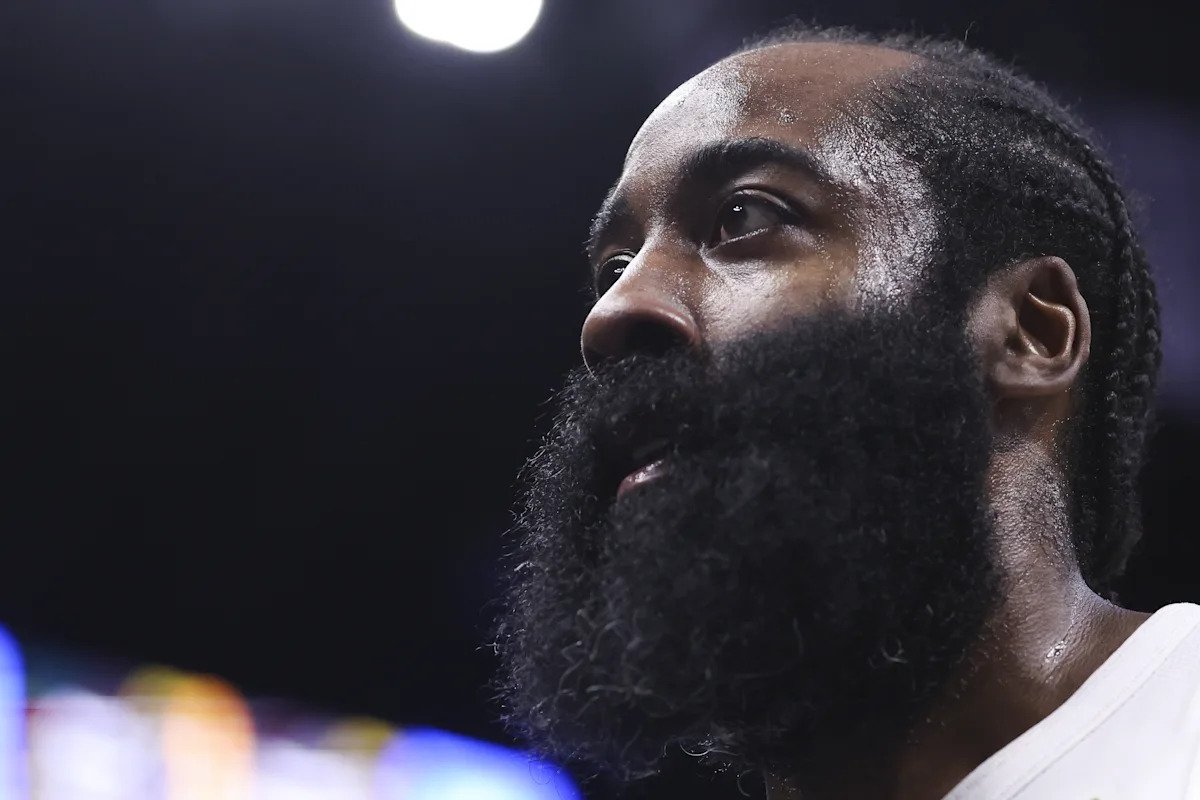
The Cleveland Cavaliers took a big swing at the trade deadline by swapping Darius Garland for James Harden. Initial returns are positive.
Harden showed up and blended in faster than anybody could have reasonably expected. His gifts in the pick-and-roll are obvious, and with them, Jarrett Allen is flourishing. Donovan Mitchell and Harden already have a burgeoning chemistry and have found each other in key moments. But the team is incomplete, and the regular season does not always resemble the playoffs.
Advertisement
Let’s dive into the details of what to watch as we evaluate the integration of James Harden down the stretch with an eye on playoff scenarios.
On offense
Offense is not just where James Harden excels, it is where the Cavaliers have struggled in the playoff series they have lost. Where could Harden help or hurt them?
One system or two?
We know Harden can run a pick-and-roll and will feed the bigs. We know he can get to the line. The greater question is how he will impact the overall flow of the offense.
In the Core Four era, the Cavaliers’ offense has looked its best when it was in continuous motion. They initiate, create advantages, the ball pops, and the defense never catches up. They’ve looked their worst when the ball sticks and the defense catches up and resets itself, or when they fail to break the shell and put the defense in rotation in the first place. We have seen the Cavaliers respond to this truth time and time again over the last four years.
Advertisement
-
Secondary initiators who lean towards isolation, like Caris LeVert and De’Andre Hunter, stop the ball and let the defense reset. Even though they are capable initiators, it isn’t an elite skill for them, and it’s not efficient enough. The Cavaliers ask them to adapt their game to motion, but ultimately trade them away.
-
Role players are asked to be decisive the moment they touch the ball. When three-point shooters don’t shoot, it allows the defense to reset. Every Cavalier role player is asked to develop another option for when they don’t shoot. Sam Merrill’s leap this season is largely based on developing a more effective drive and dish game after not shooting. Both Dean Wade and Isaac Okoro struggled to develop the same skills along the baseline. When they would hesitate or be reluctant to shoot, they would fall out of the rotation. Both improved, but doing so in the playoffs is what matters.
-
Jaylon Tyson’s leap is the embodiment of this philosophy. His emergence is based on a do-it-all skillset and being one of the most decisive players on the roster. The moment the ball touches his hands, he already knows if he is shooting, driving, skip passing, or doing dribble-handoff right back to Mitchell. The defense never resets when the ball reaches him. They barely get to break stride.
-
Even Evan Mobley is not immune to this philosophy. The first third of this season saw the Cavaliers experiment with Mobley as an isolation scorer. They would throw him the ball and let him go to work. The results were poor, and the effort was abandoned. The old philosophy returned. Mobley is still a key offensive hub, but the Cavaliers know they need to get him the ball on-the-move with the defense in rotation.
This style of continuous motion is not the norm for Harden. As he once famously declared, he is not a system player, but is the system himself. How true this is on the Cavaliers remains to be seen. Harden plays slow and probes a defense. He is by far the most capable player at this slower, isolation-heavy style that the Cavs have ever had in the Core Four era.
Will Harden be asked to adapt and play Cavs ball? Or will he, at times, be the system?
We have already seen him play faster with the Cavs. But will he move more off-ball? Will he keep the defense in rotation, or will he let it reset and probe it himself when the ball returns to him? If he allows defensive resets, will this mute the impact of the motion-related leaps Jaylon Tyson and Merrill have made? These are all open questions.
The Cavs could attempt to exclusively play their motion-heavy style and fit James in. The man can do it if he chooses. They could also embrace Harden-ball and effectively run two systems, switching between them based on personnel and situation, especially when Harden is on the floor without Mitchell. One system or two? The correct answer to this question is unknown. Having a clear approach is critical though. The Cavs have the rest of the regular season to figure out what they believe is best.
Advertisement
Size matters
There are two truths of playoff basketball:
-
The intensity, physicality, and ball pressure will ratchet up
Whether it is because of a tighter whistle, specific gameplans, or a willingness to simply not guard certain players, these two truths play out every year.
The Cavs’ offense always looked best with Garland healthy because he is a gifted initiator and playmaker. Harden is too, albeit in a different manner. But there is one thing Harden is that Garland is not: He’s big.
At 6’5”, 220 lbs, Harden can seal off extra pressure and throw over and around double teams in a way that Garland and even Mitchell cannot. He does not especially need to Nash dribble his way out of the paint like Garland when the opportunity isn’t there. He can stop, wait for the collapse, and bruise his way to a passing angle or a foul. He can also punish and back down smaller guards who attempt to defend him. These are the key playoff elements to watch for as the regular season concludes. Can teams blitz and double well beyond the three-point line with Harden handling? Can Harden better navigate a crowded paint with both Mobley and Allen on the court or when defenses ignore the corner shooter?
Advertisement
An extra Cavs-specific size-related item to watch is whether or not James can draw the strongest perimeter defender with Mitchell on the court. There are very few defenders with both the size and strength to stop Mitchell at the point-of-attack. There aren’t many guys built like Lou Dort. If Harden can use his size to force defenses into using their physically strongest perimeter defender on him instead of Mitchell, then defenses all over the league should be concerned.
On defense
James Harden is not known for his defense, and that isn’t where he is expected to impact the game. That said, there are two important items to watch.
Advertisement
Cross-matching
While Harden is not a great defender, he is better on-ball than you might think. It is actually off-ball where he is weaker.
One of the lessons of the playoffs two and three years ago was that constantly hiding Garland and cross-matching his assignment was hurting the overall defensive shell as well as the rebounding effort. As a result, the focus of last season was on not helping Garland as much on defense. The Cavs asked him to step up with effort, if not ability, and take on his assignments and hold his own when defenses target him. Garland was even asked to hold up in isolation in detrimental matchups like one-on-one against elite wing players like Jayson Tatum.
What will the Cavs ask of Harden? Will they return to constantly cross-matching? Will they bring help early and often to tag him out? Or will they ask James to step up on defense in the same manner they asked Garland?
Advertisement
Off-ball attention
This is the big one and the one that takes specific effort to focus on during a game. Harden has looked lost on defense many times in his first few games with the Cavaliers. He’s been drifting and in locations completely unrelated to his assignment. This is understandable for a new player on a new team. It is also a hallmark of the James Harden experience.
The question is an easy but important one. When teams get wide-open three-point attempts and free runs to the rim for offensive rebounds, how often is it because Harden does not know where he is supposed to be or what rotation he was supposed to make? How often is he simply not there? And how quickly does he improve at this, if at all?
The James Harden experience in Cleveland is already looking like a year-one success. The question is how high the ceiling can be and how it all translates to playoff basketball. If we watch with a close eye, we should get glimpses at the answer down the stretch of the regular season.
Read the full article here