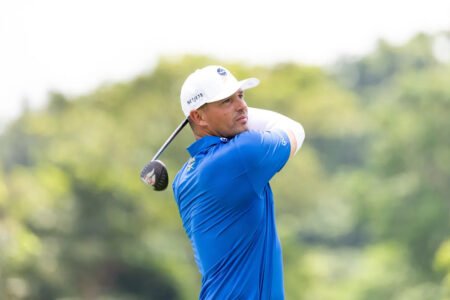


There could be limits to the guidance someone like Ian Poulter could provide about raising kids in golf. If it involves inside-the-ropes access to the Ryder Cup and having them watch you make eight miles of putts, it’s not really a model the rest of us can follow.
In other words, Poulter is not a normal Golf Dad—except for all the ways he is. Even after a decorated golf career, Poulter is like countless other parents who sought to introduce their kids to the game without jamming it down their throats, and wanted golf to be a vehicle for teaching them about growth and resilience. That his son Luke now plays Division I golf at Florida and was part of the Great Britain & Ireland Walker Cup team last September is only a narrow measure of his success.
In a series of interviews this winter, I spoke to five golf dads about their experience introducing the game to their kids, and what they’d recommend for everyone else. All could point to examples worth following, and like me, their missteps as well. If there’s one way golf and parenting are exactly alike, it’s that perfection is a myth.
Below are some of their takeaways.
Let them learn to love golf on their own
It’s natural to want our kids to appreciate golf in the same way we do. The mistake is in assuming they will gravitate toward it automatically, or worse, in suggesting there’s something wrong with them if they don’t.
“ I think for me it was to give Luke the life lessons and enjoyment of just playing sport in general,” Poulter said. “ Whether that was golf or any other sport, Katie and I have always been supportive of whatever the kids wanted to do.”
“You can’t push somebody to like the medical field just because you’re a doctor,” said Mike Thomas, Justin’s father, and a longtime PGA pro. “They either like it or they don’t. A parent is supposed to provide opportunities for them and see what sticks. It might be the piano, it might be gymnastics. It might be golf.”
Protect their passion
If your kid ends up loving to play golf, that’s already a victory, because now you have a shared passion. When Fried Egg editorial director Kevin Van Valkenburg’s daughter Keegan showed flashes of promise, he wasn’t thinking about trophies or college scholarships, but an activity the two could enjoy together for years. Even as Keegan has progressed, that remains the priority.
“This is a lifetime thing, and that’s why I really want to guard against the burnout stuff, because if she just played in high school, and then, like, you know, played occasionally here and there with friends and played for the next 40 years, that’s an awesome outcome, as opposed to her grinding so hard and calling me and was like, ‘Dad, I don’t want to do this anymore. I hate it,’” Van Valkenburg said. “I would so much rather have it so she comes to town and is like, ‘Hey, Dad, do you want to go tee it up?’”
Results are secondary
Experienced golfers know the game is an ongoing education in navigating disappointment and frustration. One way parents can help is by steering attention away from short-term results and toward developing the habits they’ll need long term. That means minimizing the significance of not just the bad scores, but the good ones, too.
“We’re big into the process,” Mike Thomas said. “I teach a lot of my students that you have to be proud that you stayed with the process and that’s what you want to base your success on. I stayed in my routine all 18 holes. The result is just what it is. It’s a result of you staying in the process.”
In an emotional game, work to project calm
An extension of bigger picture thinking is to remain steady even in the face of turbulence. When a junior golfer experiences emotional swings while practicing or competing, a parent can help by maintaining perspective.
“If he hits a bad shot and a parent hangs their head, the kid sees that,” PGA Tour winner turned CBS announcer Johnson Wagner said. “That body language that a parent presents is gonna go straight to the kid, and they’re gonna be like, ‘Oh man, mom or dad’s disappointed in me because I hit a bad shot.’ You can show it on the inside, you just can’t show it on the outside.”
Even after the round is over, how you respond matters. The instructor Erik Barzeski, whose stepdaughter Natalie Brosig is also a pro in the Met Section, arrived at one important revelation about giving Natalie time to process her emotions before diving into an analysis.
“The best advice I would give on that is just wait longer,” Barzeski said. “Decompress, just be a dad in that moment. And I didn’t always do that very well. I would sometimes just fall into coach mode because my daughter was asking for advice and opinions. But I probably would have been better off saying, ‘We’ll do that later. Let’s just enjoy the car ride home and listen to some music or something like that.’”
Read the full article here