



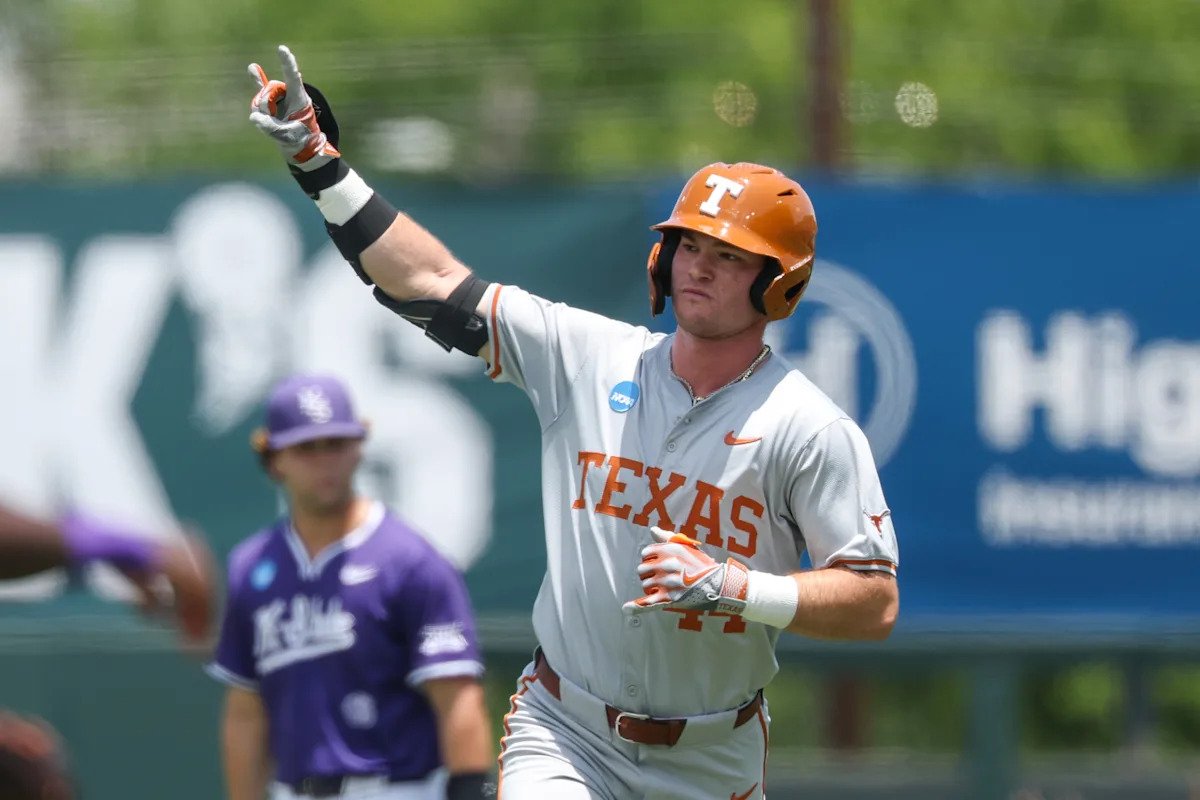
15. Max Belyeu (293 points, 19 ballots)
Belyeu (pronounced like the bear in The Jungle Book) was Colorado’s third pick of the 2025 draft, going 74th overall and signing for a slot bonus of $1.11 million. Rockies fans will naturally make comparisons between Belyeu and fellow Texas hit-over-power outfielder, Rockies draftee (in 2024’s second round), and PuRP Jared Thomas.
Advertisement
Mid-season 2025 Rank: 15
High Ballot: 8
Mode Ballot: 9
Future Value: 40, reserve outfielder
Contract Status: 2025 Second Round, University of Texas, Rule 5 Eligible After 2028, three options remaining
MLB ETA: 2028
The 6’2” 22-year-old lefty hitting, righty throwing Belyeu handled right field for Texas in 2024 while Thomas (who is only five months older than Belyeu but was old enough to be a draft eligible sophomore) took first base and center field. At Texas, Belyeu didn’t play much as a freshman (only 21 PA) but he broke out in a big way (along with Thomas) in 2024, winning the Big 12 Player of the Year award. That was on the back of a .329/.423/.667 batting line in 249 plate appearances which included 18 homers among his 34 extra-base hits (142 wRC+). Belyeu followed that up with a relatively punch-less .222/.306/.352 summer line in 63 PA in the Cape Cod League while striking out in a third of his plate appearances.
Advertisement
In 2025, Belyeu moved along with Texas to the tougher SEC as a potential first-round draft pick. He started the season pretty well, but suffered a fractured left thumb in March while diving for a ball in the outfield that limited him to only 156 plate appearances and likely impacted his power output. Belyeu’s .303/.410/.576 line with nine homers among his 17 extra-base hits was still good for a 117 wRC+, but he also struck out over a quarter of the time (up from 17% in 2024) and struggled with chasing out of the zone and spin. Those warts were enough to make him available for the Rockies between the second and third rounds of the draft.
The Rockies assigned Belyeu straight to High-A Spokane, where he was 1.3 years younger than league average age. Belyeu started strong (.318/.423/.727 with three homers in his first 26 plate appearances) but he went cold down the stretch, including a 1-20 mark with nine strikeouts in September. In 21 total games, Belyeu hit just .150/.244/.300 with four homers and three steals (42 wRC+) while striking out in 36% of plate appearances (and walking in 10% of them). He split time defensively between right and center field with three outfield assists and one error in 20 games. To read more about Belyeu’s first professional season, Evan Lang wrote about it in August.
And here are some highlights from Belyeu’s draft year with Texas:
Both Baseball America and MLB Pipeline were higher on Belyeu than every person in the PuRPs electorate.
Advertisement
BA recently ranked him 7th in the system and listed Belyeu as the 2029 Rockies right fielder:
Belyeu is a strong, physically developed 6-foot-2, 215-pound lefthanded hitter with a compact swing and quick hands. He has an aggressive approach at the plate and is prone to chasing pitches. Belyeu’s plate discipline showed steady improvement throughout his college career but it regressed dramatically in his pro debut. He possesses above-average raw power and projects to hit 20–25 home runs with further refinement.
Belyeu’s routes in the outfield can get scenic at times, but with reps he has a chance to be an above-average defender in an outfield corner. His arm is his loudest tool and is a plus weapon with great carry and accuracy that should leave baserunners questioning themselves when taking an extra bag.
MLB Pipeline also ranked Belyeu 7th in the system (he was 34th in their draft rankings), one spot and half a grade ahead of Thomas, as a 50 FV player with a 60 grade on the arm and a 55 on the power:
One of the best all-around offensive players in the college crop, Belyeu can hit for average and power while controlling the strike zone, though he was more aggressive than usual in 2025. He has a quick left-handed swing geared for hard contact, showing the ability to pull pitches for home runs or backspin them out of the park to the opposite field. His ability to put the bat on the ball cuts into his walk totals a bit, and he struggled against non-fastballs with the U.S. collegiate national team, in the Cape Cod League last summer and again with the Longhorns this spring.
Belyeu is a good athlete with average-to-solid speed but doesn’t stand out with his instincts on the bases or in the outfield. He’s inconsistent with his reads and routes, which precludes him from playing center field. His arm is both strong and accurate, so he fits nicely in right.
Keith Law of the Athletic ranked Belyeu 12th in the system this week:
Belyeu got a boost with the Rockies when one of his college coaches, a guy named Troy Tulowitzki, went to bat for him (pun intended), leading Colorado to take him in the second round in last year’s draft. He offers 25+ homer upside with the potential for plus defense in an outfield corner, but his approach is really suspect with a lot of chase and whiff, including too much of a tendency to give away at-bats entirely. He missed about 20 games of his college season with a thumb injury, and then missed fall instructional league with a hamstring injury. It’s a lot to ask of a player to overhaul his swing decisions, making Belyeu a very high-risk/high-reward prospect.
Eric Longenhagen of FanGraphs is less sanguine on Belyeu, grading him as a 40 FV and ranking him 28th in the system (he was 117th in the draft rankings) with a 60 raw power and 55 bat control grade:
Big 12 Player of the Year as a sophomore with .329/.423/.667 line. Had a spike in strikeouts as a junior. Missed half the year recovering from surgery to repair a fractured thumb, but most of his K’s came prior to the injury. Tough to reconcile 18% K% as soph and 25% as a junior. Didn’t perform on the Cape, so that looms, too. Swing has natural uppercut. Has some pronounced swing-and-miss against heaters elevated away from him. Chases spin.
I think it’s not too unreasonable to compare Thomas and Belyeu as prospects given the similarity in their provenance, age, and position. Thomas is faster, makes better swing decisions that gets his raw power into games more, and can play both center field and first base. Meanwhile, Belyeu has a better contact tool (though he didn’t display it in High-A), raw power, and outfield arm that is well suited for right field.
Advertisement
I prefer Thomas as a prospect because the profile has already worked against Double-A pitching and Belyeu’s issues with spin are concerning, but Belyeu is comfortably a 40 FV player who I ranked 22nd on my ballot. Scouts seem to be higher on Belyeu than the electorate, so hopefully he will show why in a bigger professional sample size this year. The Rockies will likely send Belyeu back to High-A to start the season, but like Thomas did in 2025, Belyeu could end the year at Double-A with good performance.
Please keep in mind our Purple Row Community Guidelines when you’re commenting. Thanks!
Read the full article here