

Looking back at the 2015 season, you can’t help but think of what was probably the greatest Cy Young battle in the modern era, as Clayton Kershaw, Zack Greinke, and Jake Arrieta delivered a memorable three-way race, with the award going to the Cubs’ ace. Greinke and Kershaw were the heart and soul of that Dodgers pitching staff, with Greinke making a run at the scoreless innings record still held by Orel Hershiser and Kershaw putting up his only 300-strikeout campaign, the first one baseball had seen since Randy Johnson and Curt Schilling both did it in 2002.
Across their tenure as a one-two punch at the top of the Dodgers’ rotation, Kershaw and Greinke had probably their worst supporting cast that year, with them combining to accumulate 16.1 of the 18.1 bWAR the Dodgers staff had as a whole. Those two and the Dodgers’ staff as a whole met their match in an exciting five-game NLDS against the young and exciting Mets, but in Game 4, Kershaw reminded everyone who was the best in the business.
Advertisement
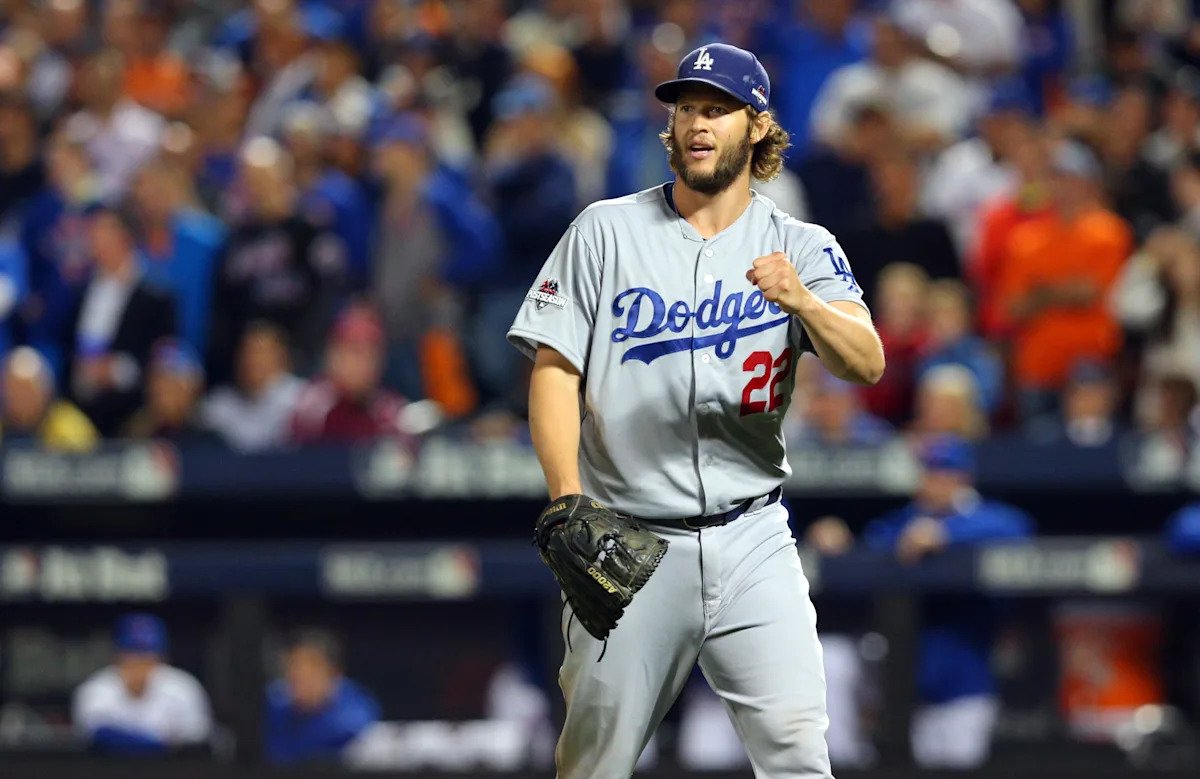
The upside of having two so dominant arms, particularly in the NLDS, was that if you showed the willingness to pitch one of them on short rest, you could have the two covering four out of the five starts of the series — that’s exactly what the Dodgers did. Finding themselves with their backs against the wall, trailing the series 2-1 and on the road, the Dodgers sent out Kershaw to start Game 4 in Queens, hoping to stay alive to give Greinke the ball back home.
A notorious Met killer in his career, Kershaw had fond memories of his last visit to New York, previously throwing a complete-game shutout against the Mets in 2015—part of an incredible run of form that saw him throw four straight scoreless appearances of eight innings or more. On the flip side, he had just been outdueled by Jacob deGrom in game 1 of this series, putting the Dodgers in this position of a must-win game just to stay alive. Kershaw’s Game 1 line was solid, as the sole blemish on his record through six frames had been a solo shot to Daniel Murphy. After a walk to Curtis Granderson loaded the bases with two outs in the seventh, his third walk of that frame, Pedro Báez replaced him only to give up a couple of runs in what turned out to be a 3-1 loss with deGrom dominating on the other side of it.
While the individual numbers and the subsequent loss were disappointing, Kershaw did pitch well that night, including securing 11 strikeouts, and with a little more efficiency, he’d be able to limit a Mets offense riding on the backs of a Daniel Murphy’s hot stretch that did go down in Mets history. More importantly, he faced Steven Matz in Game 4 and not deGrom, who alongside Kershaw became the first duo of starters to both strike out 11 or more batters in a postseason game.
If we can point to Báez, perhaps letting Kershaw down by allowing those two pivotal insurance runs to score in Game 1, for as dominant as Kershaw was on short rest in Game 4, the outlook might’ve been completely different if not for Justin Turner. The Dodgers’ starting third baseman not only got one of the biggest hits of the game in a 3-1 win, with a double that drove in two, but the final out came on a terrific defensive play from him. Wilmer Flores was up with one on and two out in the seventh, and grounded one to third base that was headed down the line if not for a terrific diving stop from Turner.
Advertisement
View Link
The storylines are written, and then the narrative gets put in to fit whatever happens. This opportunity for the Mets came about in large part because Kershaw mishandled what would’ve inevitably been a tough play to throw out Cespedes on a squibbler towards third. Had the Mets seized this chance, the idea that that play had rattled Kershaw would’ve been in everyone’s minds, true or otherwise, but it didn’t happen. Kershaw got Travis d’Arnaud and Lucas Duda before Turner helped him out with Flores, as we saw above.
Much like in Game 1, Murphy was the biggest problem for Kershaw, as the Mets’ second baseman, previously not known for his power output, was that October hitting like Chase Utley in the 2009 World Series. The Mets’ only run off Kershaw came on a Murphy solo blast in the fourth, turning on a high-heater that caught too much of the plate.
Murphy alone couldn’t beat Kershaw, who managed to keep Yoenis Cespedes and other dangerous Mets hitters quiet throughout the evening.
Advertisement
View Link
Already then, dealing with questions about his postseason performances, coming into that game having lost his last five postseason starts, four of them against the Cardinals, Kershaw completed seven magnificent frames on three days of rest, a little shy of 100 pitches. History doesn’t remember that performance too much because the Dodgers went on to lose Game 5 at home in a brutal fashion, but that doesn’t erase what was done—even back then, performances of that caliber on short rest had long stopped being a regular occurrence, further enhancing the magnitude of this accomplishment.
In fact, Kershaw’s ability and confidence to start on short rest played a role in the decision to have him start Game 1 over Zack Greinke, as the possibility of a short-rest start was acknowledged right from the get-go. One could argue that Kershaw would’ve started Game 1 regardless, as both he and Greinke put up massive seasons; that differentiator between the two certainly helped make the decision easier.
Read the full article here