

• Castrol and Brainbox found thrill needs three peaks at once: physical stimulation, cognitive engagement, and excitement winning out over fear.
  • A McLaren Artura GT4 session produced the strongest thrill signature.
  • Riding as a passenger in the JPLM produced fear signatures.

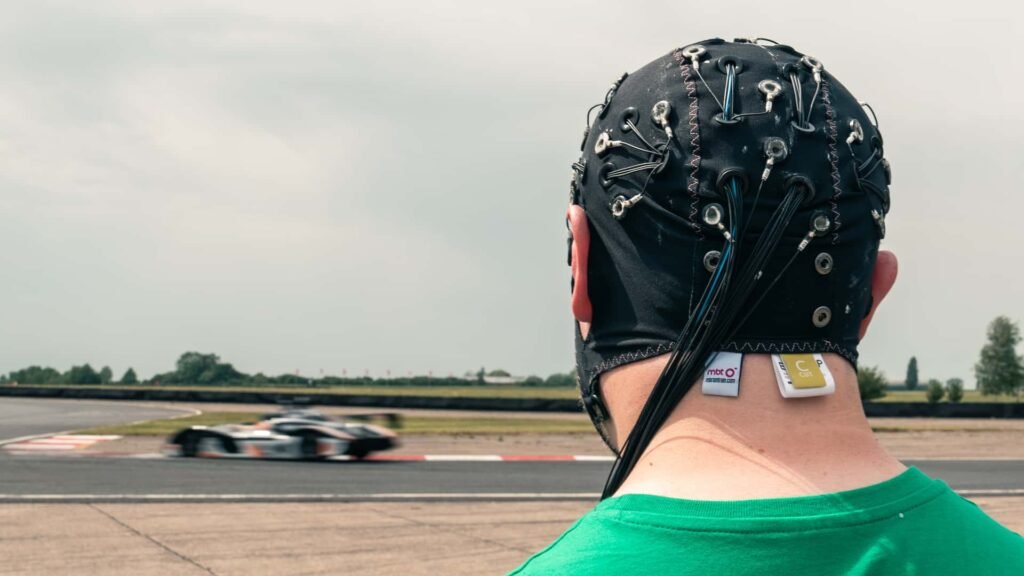
Castrol has published a brain-and-body study on driving that tries to pin down why some laps feel electric while others just feel quick. The company wired up drivers with brain, eye, heart, and skin sensors across five closed-course runs, then had UK-based neuroscience firm Brainbox sift the data to separate thrill from fear.

The main takeaway cuts across a common assumption in the car world: speed by itself does not guarantee a thrill. Castrol says the sweet spot comes when three things crest together: a jolt of physical stimulation, a demanding mental task, and an emotional state where excitement edges out fear.

How The Study Measured “Thrill”

Participants drove or rode through five scenarios at the PalmerSport facility in Bedfordshire, England, all with instructors and away from public roads. The lineup ran from slow off-roading in a Land Rover Defender to single-seat karts, a McLaren Artura GT4 race car, an open-wheel JPLM car, and a JPLM ride-along with a professional at the wheel.

Brainbox tracked four streams of data: 30-channel brain-wave readings, heart rate variability, skin conductance, and eye tracking that logged fixations, blink rate, and saccades. On their own, none of these signals cleanly separated excitement from anxiety, but cross-referenced together they did a better job of flagging true thrill states.

The McLaren Artura GT4 laps showed the clearest thrill pattern. Drivers locked their gaze on the racing line for an average of 70 apex-focused fixations per minute and blinked only 2.5 times per minute, compared with 15 to 20 blinks at rest. Average heart rate climbed by 43.8 beats per minute in the McLaren and 16 beats per minute on the off-road course.


Castrol Thrill of Driving - Subject in McLaren

Castrol Thrill of Driving – Subject in McLaren

Photo by: Castrol

Why The Passenger Seat Felt Like Fear, Not Fun

The sharpest split between thrill and fear came in the JPLM passenger test, where a professional pushed the car while participants rode along. Brain readings showed more fast beta waves linked with stress, while the focus-related theta and calming alpha activity that rose during the McLaren and karting sessions dropped away.

Eye tracking matched that story. In the JPLM ride-along, participants averaged 40 blinks and 190 fixations per minute while cornering, against the 2.5 blinks and 70 fixations logged in the McLaren. Karting at modest speeds on a tight circuit scored higher on thrill than the high-speed passenger run, and the 5 mph off-road course still outranked the ride-along.

Brainbox co-founder Dan Phillips argues that the most intense thrill shows up when arousal, control, and immersion spike together. In that reading, thrill is less about top speed and more about locking in on the task, which shows up across brain activity, heart rate, and eye behavior.

Head of Product and Communications for Castrol Europe, Vincent Panel, points to the results as evidence that drivers can find a similar sense of control at a karting track or on a favorite back road, not just in a supercar at triple-digit speeds. 


Motor1’s Take: Treat the results as a useful hint, not a final word. These were controlled tests with pros on private circuits, so they do not mirror daily commuting. The interesting next step is broader, real-world work or future experiments that use similar brain and body signals to shape safer, more engaging everyday driving.

Read the full article here

Leave A Reply