
Monterey is a gathering place for some of the world’s most expensive and beautiful classics every year. But amid the concours, auctions, and historic race cars, there’s also a strong focus on what comes next.
BMW M is using Car Week to bring the new M Concept Neue Klasse to North America for the first time, while also celebrating the M3’s 40th anniversary. It’s a fitting setting. In Monterey, the past and future are often separated by little more than a few steps.
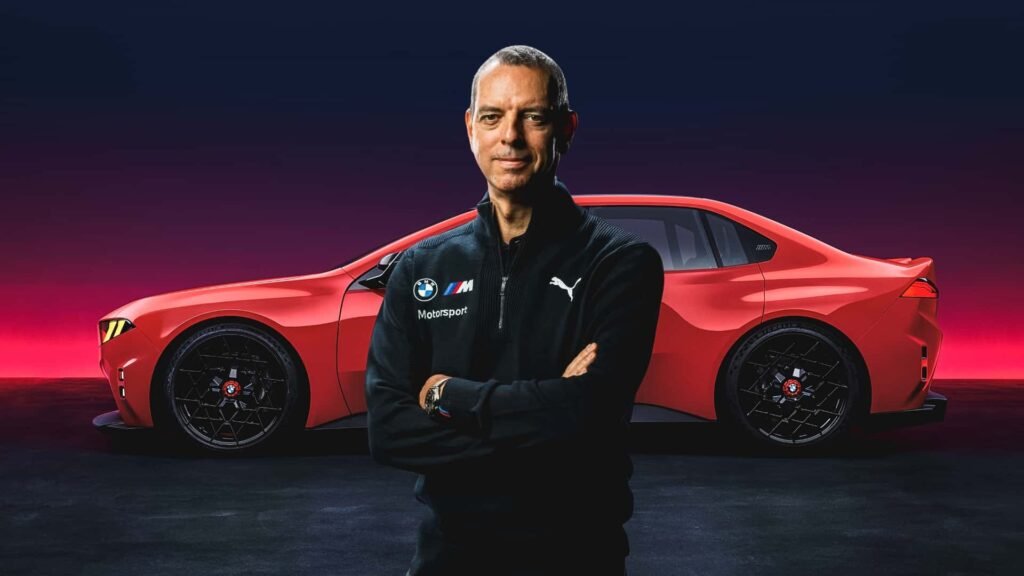
After making its world debut at the 24 Hours of Le Mans, the M Concept Neue Klasse headed to California for Monterey Car Week. BMW displayed the concept at the House of M, on the Concept Lawn at Pebble Beach, at The Quail, and during the Rolex Monterey Motorsports Reunion at Laguna Seca. Few automakers this year have tied a new vehicle so closely to their design, motorsport, and brand history.
This story originally appeared on Motor1 Germany
BMW M Concept Neue Klasse in Monterey
Photo by: Motor1.com Deutschland
Four Motors And A New Chapter For M
The concept offers a concrete preview of the first fully electric generation of BMW M high-performance models. At its core is a drivetrain with four electric motors and a new M-specific vehicle control system. BMW calls the central control unit the “Heart of Joy.” It is designed to coordinate the powertrain, brakes, and vehicle dynamics much faster and more precisely than previous systems. The concept therefore shows not just a new design language, but above all the technical direction of future M models.
At first, presenting this future at Laguna Seca seems unusual. The storied race weekend is built around roaring V8s, historic touring cars, and the smell of racing fuel. BMW M is clearly choosing to put itself in direct conversation with its own history, signaling that electric performance is also expected to meet the brand’s standards.

Photo by: BMW
40 Years Of The M3 As The Common Thread
At the same time, BMW is celebrating four decades of the M3. Since the E30 arrived in 1986, the model has been considered the heart of BMW M GmbH. The first M3 was originally created as a homologation model for touring car racing. From that came a model line that, to this day, connects road and track like few other performance cars.
That is why BMW showed more than just road cars from various generations in Monterey. At the Motorsports Reunion, legendary racing versions of the M3 also took to the track, from the E30 DTM to the E92 M3 GT. Even M boss Frank van Meel got behind the wheel of a historic race car himself. The message is clear: motorsport remains central to BMW M’s identity, even as the technology of the future turns electric.

Frank van Meel regularly gets behind the wheel of a race car himself, most recently at Laguna Seca
Photo by: Motor1.com Deutschland
Against this backdrop, Laguna Seca provided the right setting for our conversation with Frank van Meel. Surrounded by historic M3 race cars and the new M Concept Neue Klasse, we spoke with the BMW M boss about the future of the M3, the role of motorsport, and how driving fun can be carried into the age of electrification.
‘Form Follows Function Applies To Future M Cars, Too’
Motor1.com: The BMW M Concept Neue Klasse is one of the main topics here in Monterey. What message is this car meant to send? How clearly does it already show the future of BMW M?
Frank van Meel: This year we are celebrating 40 years of the M3. We started in motorsport. We had to build the first M3, the E30, in order to homologate the race car. That is really where the story of M began: bringing motorsport technology into production cars. You no longer had to choose between a sports car and a normal production car; you could have both in one.
We have continued that through every generation. The M Concept Neue Klasse shows that it will continue, and that it will also become electric. But that does not mean our world is changing completely. The heritage of M and the motorsport DNA remain.
You can see that in the car, too. We have the widebody stance, the yellow lights from our special models and motorsport, track lights like on the LMDh race car, and aero elements from the M4 GT3. Inside, there are bucket seats made from natural fiber. We have used this material for years in GT4 racing, and now it is ready for production.
So the message is: It continues, but don’t be afraid; everything is not suddenly becoming completely different. Form follows function applies one-to-one to future M vehicles as well. That is especially interesting here in Monterey, because this event is very much shaped by gearheads. We are deliberately showing where things are going, and we want to have that discussion.

2026 BMW M Concept Neue Klasse
Photo by: Motor1.com Deutschland
‘We Are Not Going Electric Because We Have To’
Motor1.com: The shift to electric mobility is being intensely debated among high-performance car fans. Some manufacturers are following their path fairly undeterred. With BMW M, however, it feels as if you are listening very carefully. How much influence does feedback from customers and fans actually have on your decisions?
Frank van Meel: A very large one. We are in close contact with our fan community, our dealers, customers, and car clubs. And we are no different from our fans. The questions they ask themselves are the same ones we ask ourselves, especially when it comes to electric mobility.
We are not doing this because it has to be done, but because we are convinced you can build a fast and even better car this way. The timing has to be right, though. It only works if we can do it 100 percent the way we want to do it.
The Neue Klasse gave us a clean-sheet platform for that. We said we could only make a high-performance M with four electric motors, torque vectoring, individual control, a central control unit, and our own software. The high-voltage battery and electric motors also have to feel M-like.
At the same time, we ourselves like our inline-six and our V8. That is why we are bringing these engines up to the Euro 7 emissions standard and continuing with combustion engines as well. There are customers who can’t charge their vehicles or who like the sound and want to keep driving internal combustion engines.
We follow the discussion in our community very closely, and we read the comments as well. Of course there are people who say nobody needs electric cars. But there are also many who are still skeptical and say they would at least like to drive one once.
We do not decide for our customers what they have to drive. We want to build cars that we ourselves love, whether electric or combustion-powered. Customers can choose what they like better.

Photo by: Chris Perkins / Motor1
‘Every Second M2 We Sell In The U.S. Has A Manual Gearbox’
Motor1.com: Is there a concrete example where this feedback has already influenced a product decision? Is the manual transmission one of those cases?
Frank van Meel: Yes. Especially in the U.S., the love for the manual transmission is enormous. Every second M2 we sell there has a manual gearbox. Rear-wheel drive and a manual transmission are the dream combination for many purists. That is why we also made a limited model with a manual transmission for the U.S. Demand was enormous; the car was practically sold out immediately.
Motor1.com: BMW M depends heavily on the feeling behind the wheel. In an electric car, sound and feedback partly have to be created in new ways. How far can you go with simulation? Where is the line for you?
Frank van Meel: For me, it becomes artificial when you simply copy what you have today and transfer it into an electric car. That would be copycat behavior.
We measured all the engines we have made at M, from four- and six-cylinders to V8s and the V10 from the M5. Our sound engineer once played the V10 at a constant 6,000 rpm. It is an iconic engine, but at a steady 6,000 rpm it sounds like a kitchen appliance.
Sound that feels authentic and emotional in a certain car cannot simply be copied into another car. Even a V8 sound would not automatically fit in today’s M3. In an electric car, we have to create the emotionality we had with six-, eight-, or ten-cylinder engines. But it has to suit the electric drivetrain and the specific car.
The sound is allowed to amplify what is actually happening. I have an electric drive system, and I have to take its characteristics into account. From there, I can develop a sound that moves me emotionally and gives me the feeling of being at one with the machine.

2027 BMW M3 CS Handschalter
Photo by: BMW
‘Yes To Simulated Gear Changes’
Motor1.com: And what about simulated gear changes?
Frank van Meel: The same applies to shifting. Of course, you could replicate the entire automatic or dual-clutch shifting process. But then you also take on the disadvantages of a mechanical drivetrain. Why would I artificially limit an electric drivetrain so it can imitate something a combustion engine can do?
What I want are different drive stages and different accelerator-pedal maps. On track, the driver should get a feeling for where they are, how the car responds to load changes, and how fast they are going, without constantly looking at the speedometer. The right acoustics and feedback are part of that.
That’s why, when it comes to simulated gear shifts, my answer is: yes to distinct gear changes. But imitating a traditional gear change with an interruption in power delivery just so you can feel a shift makes no sense to me. We want to make the new world more controllable and more emotional without copying the disadvantages of the old one.

Motor1.com: Let’s connect that to motorsport. BMW is heavily involved in WEC and IMSA. At the same time, Formula 1 is booming, and more manufacturers are getting involved there, including direct competitors. You have previously said that WEC and IMSA are more interesting for BMW M. Is that still true?
Frank van Meel: Yes. And for us it is not just about WEC, but equally about IMSA. The U.S. is the most important single market for BMW M, with around 40 percent of our volume. BMW grew in the U.S. through racing. That is why IMSA is extremely important to us.
WEC and IMSA also fit us because there is a direct transfer of technology. On the M Concept Neue Klasse, for example, you can see elements from the M4 GT3, such as the vented hood and the diffuser. The lighting signature comes from our LMDh race car.
There are also connections in the powertrain. We race a V8 hybrid in motorsport, and we have V8 hybrids in the M5 and XM. In some cases, the same engineers work on these drivetrains. Certain topics can be tested more closely to production and more quickly through these racing series.
‘Formula 1 Is Too Far Removed From The Production Series’
Motor1.com: And that kind of technology transfer is what you are missing in Formula 1?
Frank van Meel: Yes. For us, Formula 1 is too far away, too much laboratory and not transferable enough to production cars. In Formula 1, it would be a completely separate technology center, disconnected from the rest.
Our customers and fans certainly like Formula 1, but they also like motorsport that is more direct and closer to production. The history of M is that we transfer motorsport into production cars. Formula 1 simply does not fit into that for us.
Motor1.com: To wrap up, a personal question. If you could choose exactly one BMW M model to own, which would it be, and why?
Frank van Meel: For me it would be the M1, because it symbolizes the start of M. It is an iconic, beautiful car, and on the road it still looks as if it could have been built today. Ergonomically, you may not sit in it absolutely perfectly, but it represents the emotional beginning of the brand.
Although now I am already wavering. Maybe I would rather have the 3.0 CSL, but in that case, actually as a race car.
Read the full article here