

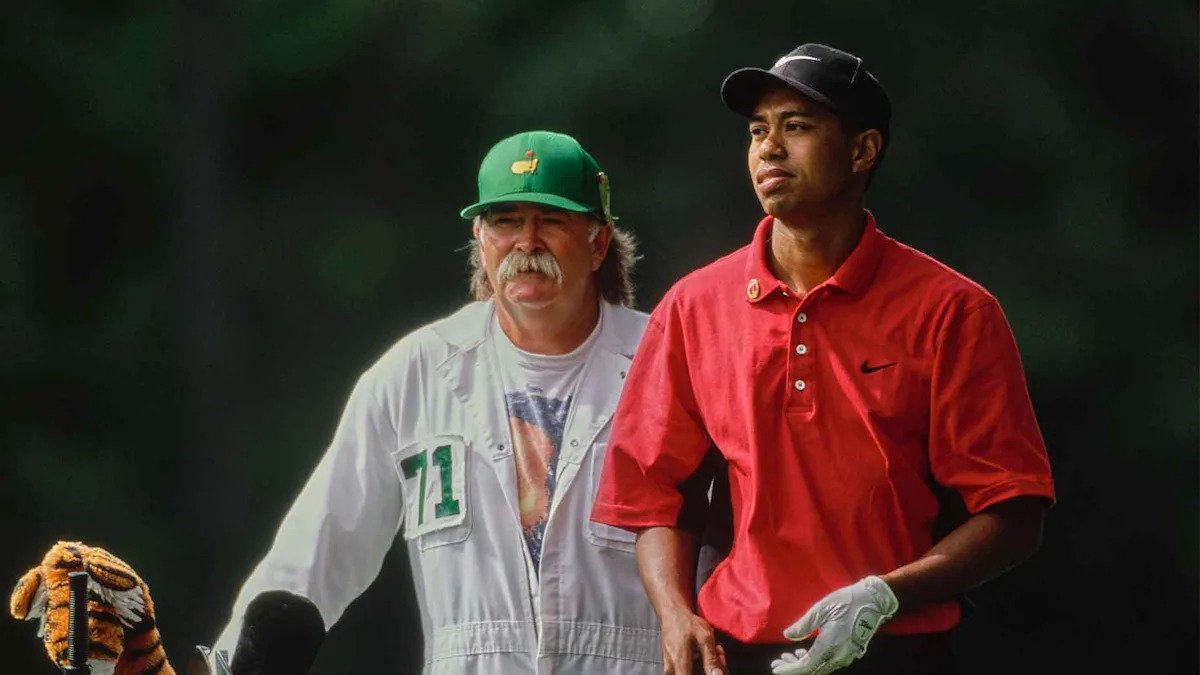
PEBBLE BEACH, Calif. — Eighteen months ago, on a golden Sunday evening at the Presidents Cup in Montreal, Fluff Cowan’s mustache curled.
“Oh, I don’t know,” the legendary caddie said, his New England accent curdling the trepidation he felt behind a tuft of snow-white facial hair.
Advertisement
He paused, turning the idea over in his head once more. He’d been asked some strange questions in 47 years as one of the most prolific caddies in golf history, but none quite like this one.
How could he capture the entirety of his caddying experience … in a single song?
“Well, I guess the first one that comes to mind is — in the ways that it ebbed and flowed…”
He paused once more, agonizing.
“I guess I’d have to go with “Truckin’,” he said.
The conversation progressed, but Cowan seemed to linger on that title, pleased with his selection. It captured his spirit, his story, and critically, his favorite band: the Grateful Dead. A few beats later, his face spread into a grin.
Advertisement
“I was just a drivin’ fool.“
Cowan turned 78 on Saturday, two days before the start of the golf tournament that has also come to feel like the beginning of a new year: the annual AT&T Pebble Beach Pro-Am. But the start of this golf high season in Northern California has lost some of its tie-dyed luminescence in 2026. In early-January, the world learned of the passing of one of Cowan’s heroes: Bob Weir, the legendary Grateful Dead frontman.
Weir’s death has cast a strange pall over Deadheads like Cowan, who often wore a Jerry Garcia t-shirt to caddie for Tiger Woods. To those whose lives centered around the rhythms of Grateful Dead concert schedules and retirement tours (plural), the band was more religion than music. And in the church of the Dead, Weir was the heartbeat.
“In my mind, Bobby embodied the whole culture of the Dead, there’s kindness and there’s love,” Gil Hanse, the golf course architect (and lifelong Deadhead) said. “Obviously Mickey and Billy are still here, but it feels like the leader of the band has left the stage.”
Advertisement
Interestingly, Weir’s passing has also cast a strange pall over the golf world, where the Dead has quietly infiltrated many of the sport’s highest chambers.
“The Dead has probably been the soundtrack of 70 percent of the holes I’ve shaped and worked on in my career,” Hanse said. “So yeah, there’s a nice legacy there.”
Perhaps no place speaks to both Deadheads and golf lovers quite like the Bay Area. Pebble Beach is just an hour down the road from Dana Morgan’s Music Shop in Palo Alto, where Garcia and Weir met for the first time as teenagers, and just two hours from Golden Gate Park, where Weir played his last three shows in the summer of 2025 (coincidentally just feet from one of America’s most celebrated muni revival projects). Consciously or subconsciously, golf’s visit to the region this week has presented the sport’s legion of Deadheads with an opportunity to mourn.
“I’ve been feeling pretty upset about it,” Hanse said. “I wasn’t expecting that. It’s been a lot harder than I thought.”
Advertisement
Of course, there is a deep irony in Weir’s legacy extending over the Monterey Peninsula’s most tidily manicured cliffs. Golf is a sport of well-coiffed stiffs and fetishized cloisteredness, the kind of place where even the appearance of countercultural impulses can cost you a seat at some of the sport’s most reputable tables; Dead concerts feature the kind of individuals who call into open question the timing of their last shower. (It should also be noted that if you were to scientifically engineer the diametric opposite of Shakedown Street — the popular Dead pre-concert tailgate where sun-beaten roadies trade tie-dye T-shirts and psychedelic drugs with startling nonchalance — you might wind up with a place that looks a lot like 17 Mile Drive.)
And yet, like a particularly stubborn case of lice, golf can’t rid itself of the Dead. A flourishing underbelly of rejects and hippies floods the caddie yards and maintenance crews (and, in many cases, membership rolls) of the greatest clubs in America with Dead iconography; while golf’s own (gentle) countercultural moment of the 2020s has helped some clubs bring Touch of Grey greenside.
“Love ’em, need ’em, can’t live without ’em,” Cowan said, capturing the spirit of devotion that promulgates caddie yards across the country with impressive brevity.
From a distance, the correlation might sound trivial, but spend time near golf’s true Deadhead contingent and you’ll realize the sport and the band share a heartbeat. For all of golf’s occasional stuffiness, the sport’s best traits might be lifted verbatim from the central themes of a Dead concert: empathy, tranquility, creativity, artistry. And, hell, is there a better place to discover the wonders of nature than on a particularly psychedelic golf course?
Advertisement
“Everybody in our band, the Cavemen, we all have a role to play — and there’s sort of a foundation — but then off of that foundation, we can take it in any different direction we want to,” says Hanse. “I think that’s sort of the ethos of the Dead. Every night was different in the way the music was performed and presented. We want creativity to manifest itself in improvisation.”
The core audience helps too. Many of the original Deadheads have now aged into boomerdom, where golf is a national pastime, while many of the diehards responsible for keeping the sport afloat — those deranged enough to pursue a career in golf — have done so precisely for the opportunity to break the shackles of a desk job and a nine-to-five. To this group, the Dead is a siren song.
“I’ve often said what we provide for people is music with a little adventure in it,” Weir said in 2016. “The people who like our music, come to our music, are drawn to our music — they’re people who require a little adventure in their lives.”
Ultimately, the same spirit of adventure carried Weir through to the end. He played his final shows with the Dead at Golden Gate Park in August — part of a 60th anniversary celebration for the band that drew more than 150,000 people to San Francisco. Hanse was among the crowds for all three nights, having hopped “back on the bus” with his wife, Tracey, in the last few years of Weir’s life. Nobody knew it then, but Weir was waving goodbye.
Advertisement
“The first show was pretty rough, Bobby was obviously not well,” Hanse said, briefly slipping into Deadhead vernacular. “But then Saturday and Sunday night was just … the magic.”
If an anti-establishment bent brought the Dead into golf, memories like these are what have kept them. Beneath the logos and the hippies and the music is a spirit of something much bigger: kindness.
“From the outside, people kind of can draw whatever conclusions they want about golf, but real golfers find the same peace and tranquility when they’re out on the golf course,” Hanse said. “I mean, you had three nights where you had 50,000 people – and there were no crimes, no violence, no nothing. Maybe some people were … chemically altered in the way that they were feeling, but they were there to celebrate something that was pure. And I think we celebrate the game of golf and in the landscapes we play it in for the very similar reasons.”
For many Deadheads, this idea was the hardest part of Weir’s death. If the leader of the band was no more, what would keep the spirit of the Dead from passing with him?
Advertisement
Thankfully, there have already been signs to the contrary. One arrived on the morning of January 10, the same day news of Weir’s passing reached Hanse at a golf course in New Zealand.
As Hanse found himself confronting an unexpected swell of grief, he received a surprise visitor: His five-year-old granddaughter, Peyton.
Peyton heard that her grandpa was upset, and she’d taken matters into her own hands. She approached Hanse bearing a gift.
“She went outside and picked me some flowers from the little meadow in the backyard,” Hanse said. “And she said, ‘I know you’re sad, so I just want to give you some flowers for your friend.’”
Advertisement
Hanse cried at the gift. He cried again sharing the story.
They were happy tears. The kind that come after an unusual act of kindness. His old friend Bobby would’ve liked that. He would’ve liked it a lot.
But he would’ve liked most what came after, when Gil Hanse fired up his tractor, and kept on truckin’.
You can reach the author at james.colgan@golf.com.
The post At Pebble Beach, golf mourns a legend from another world appeared first on Golf.
Read the full article here