


The wait is finally over. The Ferrari Luce—probably the most talked-about, clicked-on, and controversial car of the last few years (even before we saw it)—has finally been revealed. And honestly, it’s kind of mind-blowing.
There’s no middle ground here: you’re either going to love it or hate it. But the truth is, the Luce is so ambitious and unconventional that it almost feels unfair to judge it before really understanding what Ferrari was trying to do. You have to look at it differently.
The Luce rides on an entirely new platform, packing four electric motors and up to 1,050 horsepower. Its driving dynamics, Ferrari says, are unlike anything else out there. The styling is completely new too, created with help from an industrial design collective, and the cabin is finished to a level that might genuinely be unmatched in the automotive world.
And maybe importantly, this isn’t some limited-run halo project. The Luce is a regular production Ferrari, sitting alongside the rest of the lineup, with orders opening immediately and prices starting at €550,000—or about $640,000 at current conversion rates.
Photo by: Ferrari
A Design That’s Impossible To Ignore
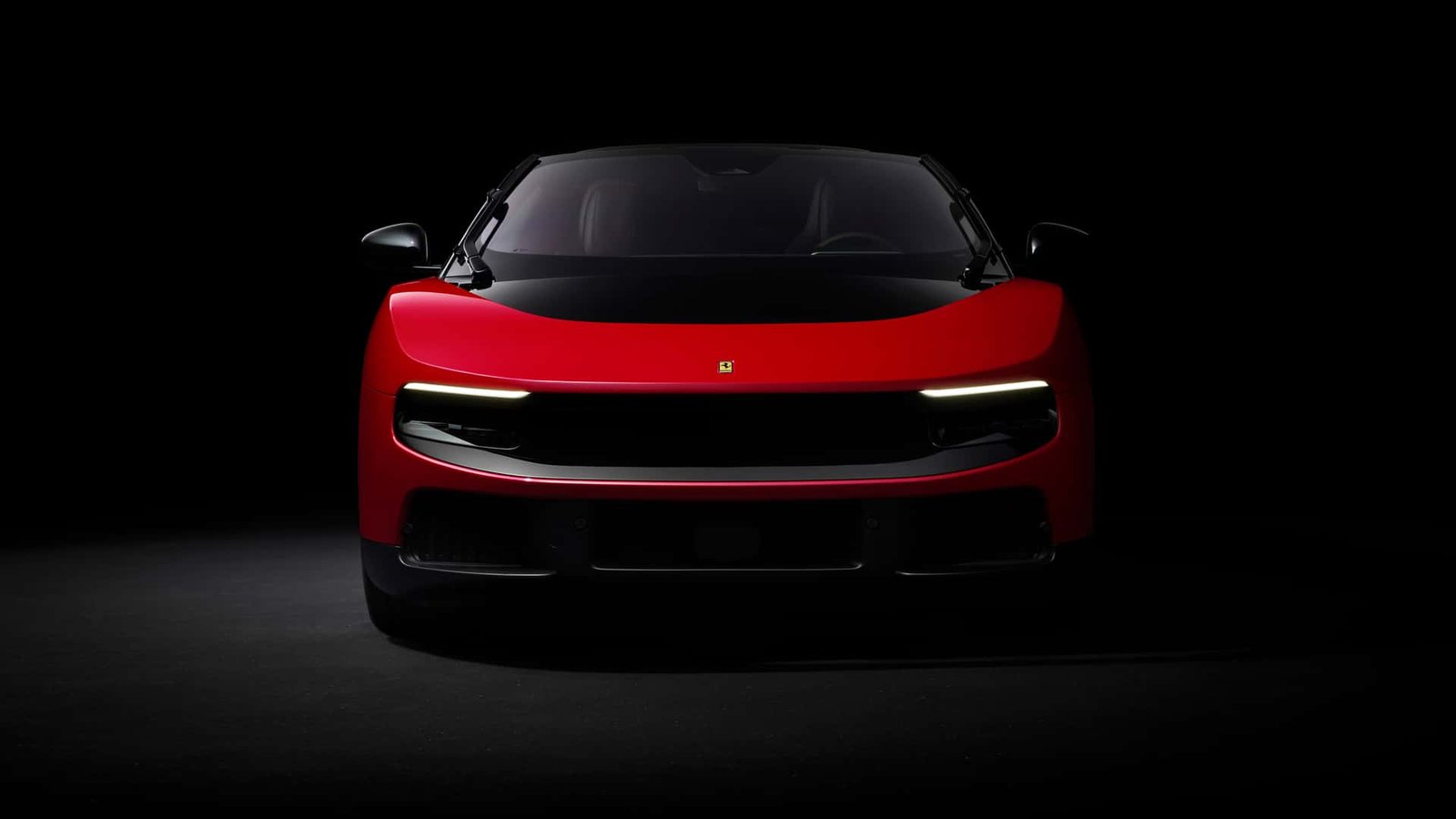
The Luce was designed jointly by Ferrari’s Centro Stile in Maranello and LoveFrom, the design firm founded by Jony Ive—the man behind the original iPhone’s iconic look. But Ferrari says this wasn’t just a styling exercise. Engineers shaped the surfaces around aerodynamic and functional needs first, and LoveFrom essentially came in afterward to “dress” the car.
The final result is a car that’s 197.6 inches long—or about as long as a Tesla Model S. It’s also 78.7 inches wide, 60.6 meters tall, and about 2.0 inches lower than the Purosangue. And it looks nothing like the renders people (including ourselves) have been circulating online. The shape is dramatic, unusual, and undoubtedly divisive.
Aerodynamics were clearly the top priority. Without a massive V12 up front, Ferrari no longer felt tied to classic supercar proportions. The result is an incredibly slippery drag coefficient of 0.254 cD, achieved without active aero—a deliberate choice meant to keep the car lighter and visually cleaner.
The black passenger cell has a teardrop-like shape, with the aluminum body wrapped around it almost like a shell. Up front, the bodywork forms a huge wing, while the hood and windshield flow together in one uninterrupted surface. Even the windshield wipers were redesigned and patented to create tiny air vortices without disturbing airflow.
And then there are the wheels: the biggest ever fitted to a production Ferrari. They measure 23 inches up front, 24 inches at the rear. The taillights are round too, which feels surprisingly refreshing on a modern Ferrari.
The Real Highlights Are Inside
We’d already seen glimpses of the interior, but this is where Jony Ive’s influence is most obvious. You can see it in the aluminum finishes, the glass details, and especially the graphics and animations on the displays.
Oddly enough, for Ferrari’s most comfort-focused car ever, there actually aren’t that many screens. The front passenger doesn’t even get a dedicated display—instead, they can rotate the center screen toward themselves.

Photo by: Ferrari
One of the biggest practical changes is that the Luce has five proper seats. Since there’s no transmission tunnel running through the center of the vehicle, a fifth passenger can actually sit comfortably in the back. The trunk is massive by Ferrari standards, too: 21.1 cubic feet. That’s about as much as a modern compact SUV, and the largest luggage capacity the company has ever offered.
But the most impressive thing is simply the quality. Every surface feels nice to touch. Everything looks beautiful, even parts you’d barely notice in most cars. The attention to detail sounds obsessive in the best possible way. Frankly, it might be one of the best interiors ever put into a modern production car.
Four Motors, Insane Performance
Each wheel gets its own dedicated electric motor, all developed and built by Ferrari in Maranello. The front motors spin to 30,000 rpm, while the rears hit 25,500 rpm. They’re permanent-magnet motors derived from Ferrari’s F80 program and built using technology and expertise from Formula 1 and endurance racing.
The rear motors produce 355 kilowatts each, while the front motors make 105 kilowatts each. But the really interesting part is how Ferrari manages all that power. The E-Manettino modes control how aggressive the car feels, changing torque delivery, drivetrain behavior, and overall performance depending on the mode:
- Range Mode: 320 kW (430 horsepower) and rear-wheel drive, with a top speed of 260 kilometers per hour.
- Tour Mode: 460 kW (617 hp) with all-wheel drive for everyday use.
- Performance Mode: 725 kW (986 hp), permanent AWD, and a 310 kmh top speed
- Launch Control: The full 1,050 hp. Ferrari claims 0–100 kmh in 2.5 seconds and 0–200 kmh in 6.8 seconds.
Pretty absurd numbers.
But one of the coolest ideas in the Luce is actually behind the steering wheel. The paddle shifters don’t change gears—because there aren’t any gears. Instead, Ferrari uses them to control something called Torque Shift Engagement.
The right paddle changes how aggressively torque is delivered, with five different levels. The left paddle adjusts regenerative braking intensity, again with five levels. So when entering a corner, you can fine-tune how much negative torque the car uses, while on corner exit, you can tailor power delivery based on grip and the shape of the turn.
Ferrari insists this isn’t some fake “simulated gearbox” gimmick. It’s supposed to be an entirely new way of interacting with an electric performance car.
Battery Tech Built For The Future
The 800-volt battery pack is designed and assembled in Maranello—and it’s actually a structural part of the chassis. Its placement lowers the center of gravity by almost 3.7 inches compared to the Purosangue. Ferrari says the effect feels like driving a car that’s 882 pounds lighter.
The independent motors also enable advanced torque vectoring, and the car gets rear-wheel steering as well. Ferrari engineers claim the handling is surprisingly close to a 296 GTB, despite the Luce’s size.
Photo by: Ferrari
The battery modules were developed in partnership with the Korean company SK On, and Ferrari is offering an eight-year, unlimited-mileage warranty on the powertrain. Interestingly, the battery architecture is already designed to support future-generation cells that don’t even exist commercially yet. Ferrari clearly wants this car to age well technologically.
Fast charging tops out at 350 kilowatts, which Ferrari says is more than enough for most owners, especially since many will charge at home anyway.
Yes, It Makes A Sound
Ferrari also tackled the issue everyone expected: what should an electric Ferrari sound like?
Instead of using fake engine noises or sampled audio, the car uses an accelerometer to capture real vibrations from the electric motors and rear chassis. An algorithm filters out unpleasant frequencies and amplifies only the more “musical” sounds. The effect can be heard both inside and outside the car.
Some driving modes include sound generation, others don’t, and you can turn it off completely if you want. Ferrari basically decided to let drivers choose for themselves.
15
Source: Ferrari
The Price? Completely Outrageous
The Ferrari Luce starts at €550,000—about $640,000 at current conversion rates. And that’s before customization options, which will probably be endless. Paints, materials, interior finishes, accessories… you could easily spend far, far more than the base MSRP.
At this point, the only thing left to do is mess around with Ferrari’s configurator and dream a little.
Read the full article here