



HOUSTON — A few hours after the dust had settled from a seismic Game 3 collapse, when the quiet consumed the halls of Toyota Center, disenchanted team governor Tilman Fertitta, surrounded by friends and family, trudged toward the loading dock.
A pair of hands calmly rested on Fertitta’s back, an attempt to lift the spirits of the typically cheerful 68-year-old as he embarked on the same gloomy path he had become all too familiar with. The previous instances, two separate Game 7 losses seven years apart, represented a franchise at different checkpoints but in the same underlying condition. And while Game 3 wasn’t the ultimate undoing of Houston’s season — a listless, languid effort in Friday’s 98-78 Game 6 loss to a Los Angeles Lakers team without Luka Doncic ended its season — it served as an inflection point; a crumbling at the season’s most critical juncture, a coaching chasm and fatal roster flaws.
Advertisement
“Everybody’s disappointed,” Rockets head coach Ime Udoka said following his team’s second consecutive first-round exit. “Not what we expected coming into the game tonight or the series in general. We all thought we’d be taking it back for Game 7. But to your point, a tough night for a lot of guys. It’s tough when a lot of guys are struggling like that, and we need somebody to step up.”
(Henry Russell/Yahoo Sports illustration)
What had begun as a season of optimism, excitement and expectations has ended in yet another embarrassing postseason defeat, one that has sparked even more questions about the flexibility and viability of a franchise that has oscillated between development and contention, a risky two-timeline approach that is rarely successful at basketball’s highest level.
“It feels like two years in a row in the playoffs getting behind the 8-ball a little bit,” Udoka said.
Advertisement
In the days leading up to the start of the playoffs, the mood around the team was upbeat and confident. Houston’s players, who had huddled together to watch the final day of the regular season — which included a Spurs win over the Nuggets, solidifying the Lakers as their first-round opponent — had expressed satisfaction with the outcome, embracing the prospect of facing an injury-ravaged team with only the 41-year-old LeBron James to realistically worry about on the scouting report.
Just two weeks later, the Rockets’ biggest internal fears were exposed. Superstar forward Kevin Durant, who had represented a beacon of efficiency and durability during the regular season (playing the most minutes since his 2013-14 season) missed all but one game in the series with knee and ankle ailments, an absence that thrust Houston’s young players into the spotlight once again. A team that had struggled in a number of key areas for months — crunchtime execution, halfcourt efficiency, 3-point frequency and overall shot making — suddenly looked like a group that was haphazardly put together, not one that had spent the better part of eight months together. Durant’s absence, coupled with season-ending injuries to both point guard Fred VanVleet and key reserve center Steven Adams, created a mishmash lacking a true shot creator, an organizer and one of the best offensive rebounders and possession extenders in basketball.
“It’s nights like this where guys are struggling, you want a 25-, 26-point scorer on the efficiency and the way he does it to avoid some of these nights,” Udoka said of Durant’s absence. “Myself and the coaches said that these are the nights you have [Durant] for. Throughout the season, he carried us on nights like this.”
Advertisement
(It certainly didn’t help that players like Reed Sheppard, who shot 4 for 19 from the field and 1 for 10 from 3 in Game 6, had clear issues creating separation at the point of attack and encountered frequent roadblocks on mismatches, as did starting center Alperen Şengün. Sprinkle in some inconsistent shot-making from Amen Thompson, Jabari Smith Jr. and Tari Eason, and a second unit that looked completely out of its depth, and the result is unsurprising.)
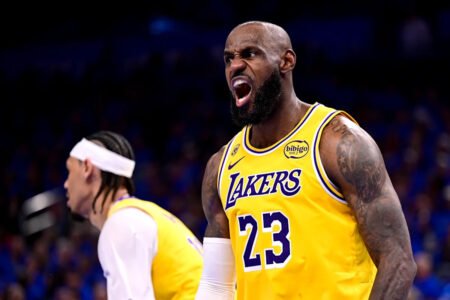
To add insult to injury, the bulk of damage was done at the hands of James, who looked and moved 10 years younger as he spearheaded the controls at both ends of the floor. The playoff chess match became a playground for Lakers head coach JJ Redick, who seemingly had an answer for Udoka at every turn. When Durant was on the floor, frequent doubles were sent his way, the timing and angles of which confused Houston. Without Durant, Los Angeles did well to introduce switching, further stagnating an already methodical Houston offense, controlling the tempo, boards and ultimately chaos the Rockets had thrived on over the past few days in attempts to wrestle back momentum after falling behind 3-0 in the series. That Houston was so anemic offensively in Game 6 — shooting 35% from the field and 17.9% from 3, turning the ball over 14 times and getting dominated on the glass — represented a microcosm of the entire series and a clear sign Redick had bested Udoka.
“We couldn’t generate any good offense,” Smith said. “Kudos to JJ and them over there. It was tough on the offensive end for us. The first game was easing into it, expecting it to happen and not working to get or sustain leads. I think it was the starts that really affected us. You can’t start off in a playoff series like that, lackadaisical. I think we waited too long to get into the series, honestly.”
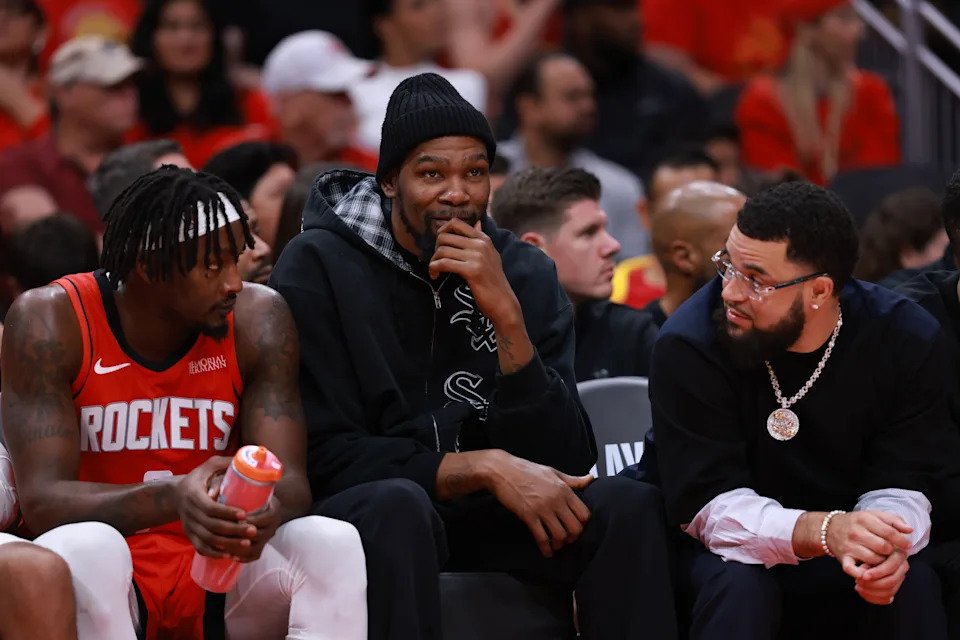
Kevin Durant (middle) and Fred VanVleet (right) watch Game 6 in street clothes on Friday night.
(Kenneth Richmond via Getty Images)
Over the next few weeks and months, as the Rockets braintrust attempts to turn the page and prepare for another run at a championship, clarity and cohesion must remain at the top of the to-do list. At this juncture, there are no plans to move on from either Udoka or general manager Rafael Stone, sources told Yahoo Sports. Ownership has remained steadfast in its belief in a three-pronged leadership sector because of a combination of the turnaround in recent years and consecutive 50-win seasons, the latter of which was marked by major injuries — resulting in confidence from the top down. One of the prevailing internal beliefs concerning this roster is assuming that VanVleet and Adams are healthy — along with Durant — the Rockets aren’t too far removed from Western Conference powers Oklahoma City and San Antonio.
Advertisement
Still, there is an understanding that the current roster, as constructed, is not a blue-chip contender, which is where Houston’s penchant for aggression comes in. As it stands, the Rockets should enter next season as a below-the-tax, below-the-apron franchise with about $15 million in wiggle room. Houston’s brass will congregate and emphasize improvement with a sliding scale of trades, free agency and internal growth. In that regard, nothing is off the table, sources said.
“Take an overall look at the group,” Udoka said. “Areas of improvement no doubt. Not just hoping Fred and Steven come back so it’s not like we’re basing everything on them coming back. Our young guys will take steps — I think they did that this year and will definitely come back better next year. But we do need to address needs. Lack of shooting at times, whether it’s a backup point guard or whether our young guys did enough this year to run that route with Fred back. Take a look at all those things and have some very interesting conversations on having a little more of a mix instead of some duplicates out there. … I’ll get to it ASAP.”
Last summer’s blockbuster acquisition of Durant — a win-now move that cost Houston two key members of its core — was an indication the organization is willing to make sizable changes when the opportunity arises and still operate under the same guise. Similar to Durant, the Rockets won’t necessarily pigeonhole or wed themselves to one type of star, but desired additions such as the Clippers’ Kawhi Leonard, the Cavaliers’ Donovan Mitchell, the Bucks’ Giannis Antetokounmpo and the 76ers’ Joel Embiid, among others, will be discussed, sources said, but fit, opportunity cost and price go hand in hand.
“I cannot do anything about those conversations,” Şengün said about being potentially brought up in trade talks. “It is what it is. That’s the front office’s job, I can’t do anything about it. Wherever I go or if I’m staying here, I’m going to do what I do.”
Advertisement
The second lever, keeping the bulk of the roster intact and adding around the margins, is also a possibility. The whispers of internal regret at the lack of movement around the trade deadline and buyout market only grew louder in Udoka’s postgame admissions — especially considering the relatively low cost of guards Coby White and Ayo Dosunmu. Team sources indicated a number of discussions were had around the trade deadline and the period before the expiration of buyout additions about a host of guards (and big men) that could have potentially been released but ended up staying put. Other possible targets, like free agent Lonzo Ball, who’s still unsigned, had red flags concerning durability and little to no market. The Rockets finished the year with the fourth-worst halfcourt efficiency in the playoffs and just outside the bottom 10 during the regular season.
“You don’t go into the season preparing to be without your starting point guard who averages 40 minutes a game,” Smith said about VanVleet. “It’s a tough adjustment in that sense. We tried to adjust around it, but it’s tough not having somebody who does so much for this team, leadership-wise, on the court. It’s just hard to replicate what he does on the floor as a shot-maker, facilitator and leader.”
Advertisement
The third, and perhaps the cleanest avenue, is internal growth. Eason, for example, will be a restricted free agent this offseason, but Houston plans to re-engage in conversations around a long-term deal following the conclusion of the Finals, team sources said, in hopes of striking an agreement ahead of July 1. In the event that both parties fail to reach a common middle ground — there’s an understanding the 24-year-old could change management ahead of a pivotal summer — and Eason signs an offer sheet elsewhere, Houston, which still values his two-way contributions, would be expected to match. The Rockets will also meet with Thompson in hopes of agreeing to an extension, team sources said. (The 23-year-old is eligible to sign a five-year, $252 million max extension, according to the CBA and salary-cap analysts.) VanVleet has a $25 million player option for the 2026-27 season, but the Rockets, who are confident the veteran guard wishes to remain in Houston, will speak with him about either picking up the option or declining it for a longer deal, sources said.
Ultimately, regardless of which route the Rockets take, multi-faceted improvement remains non-negotiable. Udoka and his coaching staff, after consecutive postseason exits marked by being outworked and outmaneuvered, must update their software. The players who return must diversify their offensive portfolios. And Stone, along with a front office that has leaned toward caution over aggression, must be better. It is now an inflection point, much like the one Fertitta found himself facing on his way out of the arena, which will determine the future for a franchise that is still searching for more.
Read the full article here