


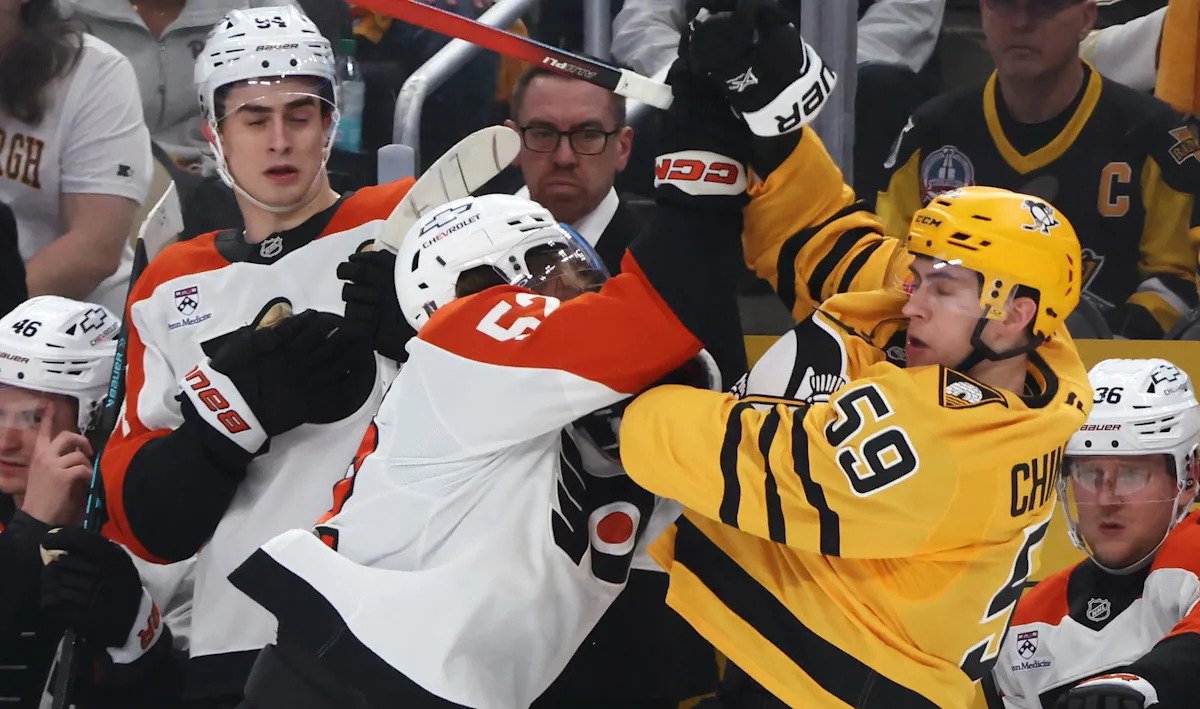
Pittsburgh Penguins v. Philadelphia Flyers – Game 2 (PPG Paints Arena in Pittsburgh, Pa.) | Monday, Apr. 20, 2026
Puck Drop: 7:10 p.m. ET
Penguins’ projected lines and pairings:
Forwards
Egor Chinakhov – Sidney Crosby – Bryan Rust
Tommy Novak – Rickard Rakell – Evgeni Malkin
Elmer Soderblom – Ben Kindel – Anthony Mantha
Connor Dewar – Blake Lizotte – Noel Acciari
Advertisement
Defensemen
Parker Wotherspoon – Erik Karlsson
Sam Girard – Kris Letang
Ryan Shea – Connor Clifton
Goaltenders
Stuart Skinner (starter)
Arturs Silovs (backup)
Flyers’ projected lines and pairings:
Per Siobhan Nolan of THN – Philadelphia Flyers:
Forwards
Travis Konecny – Christian Dvorak – Porter Martone
Matvei Michkov – Noah Cates – Denver Barkey
Tyson Foerster – Trevor Zegras – Owen Tippett
Luke Glendening – Sean Couturier – Garnet Hathaway
Defensemen
Travis Sanheim – Rasmus Ristolainen
Cam York – Jamie Drysdale
Nick Seeler – Emil Andrae
Goaltenders
Dan Vladar (starter)
Samuel Ersson (backup)
First period
– Gary Bettman held a press conference prior to the start of the game. Piece to come on that. But here is a bit of a highlight.
Advertisement
After a question from Taylor Haase of DK Pittsburgh Sports about the success rate of coach’s challenges on goaltender interference being low this season, I asked Bettman – who said that he met with NHL GMs last summer regarding the interpretation of goaltender interference – if part of those discussions involved any shift or deviation in the interpretation of goaltender interference that might help explain the low success rate. He said:
“No. I mean, I think… listen. When you have a rooting interest or you are, in the moment, very passionate or frustrated, you may challenge a call. But, in the final analysis, overwhelmingly, they get it right… and this final analysis, it’s a judgment call. You know, offsides – other than when it comes to control of the puck – but offsides in terms of where the skate is is a whole lot easier to do because it’s more black and white. It’s a fine line. Goaltender interference is, again, a judgment call, which is why you go with the call on the ice unless it’s conclusively wrong.
“You know, when it was first instituted, we had warned the coaches and managers that this isn’t going to be crystal-clear in every situation. It will be, sort of, a judgment. Whatever your view of the process is, I guarantee you it’s much better in terms of getting it right than if we didn’t have video replay. There’s no question. But the only difference (is) it was originally designed for the most simple case: Somebody skates by the goaltender and hits his glove, but the officials on the ice don’t see it. That would be something that’s clear-cut when you pick it up in video.
“I think Colin Campbell and his people have done a great job with more and more cameras in the net (behind) the crossbar and overhead. We’re going to get it right overwhelmingly. And we’ll get a few calls where people will debate them. Depending on your interest in the game, you may have a different view.”
Advertisement
– Penguins have been playing a bit more in the Flyers’ end during thie first period. Still only three shots on goal for each team – and their power play could not convert on three opportunities – but, overall, a much better start to this one than in Game 1.
– The fourth line of Connor Dewar, Blake Lizotte, and Noel Acciari, in particular, have had a nice start to this game. The Flyers are still frustrating the Pens in the neutral zone, but this line has had the most success in terms of zone entries and simplification.
Read the full article here