


A week ago, while researching a story on the best 25 final rounds in Masters history, I stumbled upon a bizarre piece of history that turned into an irresistible rabbit hole. In studying the final rounds, it became clear that the leaders weren’t always paired together. At the first Masters in 1934, Horton Smith (54-hole leader) did not play with Billy Burke (second) on Sunday. That wasn’t a huge surprise, because things were helter-skelter in the early days. It also stands to reason that TV played a role in bringing about “leaders off last” (more on that later). What was surprising is just how unpredictable, weird and even controversial pairings were at Augusta all the way into the 1980s.
As I was saying, it was a rabbit hole, but I heroically took it upon myself to sort through the chaos, with a massive assist from Newspapers.com, arguably the world’s greatest website. And so I present, as legibly as humanly possible and in the mildly entertaining Q&A format that brought you other oddities such as the Oakmont Turnpike, the political parade at Portrush and Tree Island at Sawgrass. Let’s do it!
Advertisement
More Masters stories
Payday at Augusta Masters 2026: Here’s the prize money payout for each golfer at Augusta National
Voices Masters 2026: The Masters is appealing to a broader audience. Is it losing its identity in the process?
Golf Digest Logo Masters 2026: Exclusive photos from Golf Digest
Can we start here: Why haven’t final-round pairings always been “leaders off last”? It’s clearly the best, most dramatic, most entertaining system.
Yes, I agree. But to understand why things didn’t work this way in golf history, you need to put yourself in a time and place before television. It’s not easy, but think about it—why would you pair the two leaders together? You could argue that it might be better for spectators, but that’s a marginal concern compared to how necessary it is for a television audience.
Advertisement
There’s also this: Match-play golf was so much more prominent in the sport’s early days, so some stroke-play innovations happened more slowly. And even format differences got in the way—the U.S. Open, for instance, held all 36 holes on the final day before 1965, so there was no chance to re-sort after 54 holes even if they wanted to.
So TV is the only reason “Leaders Off Last” became a thing?
It was overwhelmingly the driving force, yes, but it certainly wasn’t the only good reason. Think about playing conditions—if the two leaders are teeing off five hours apart, one could be hit with wind/rain while the other benefited from calm conditions. As more money flooded into the professional game, it became increasingly important to iron out these consistencies and create the fairest competitive conditions possible. But yes, jacking up TV ratings by putting the best players in the tournament together at the same time was far and away the biggest factor in bringing about the change.
But when did it actually happen? I want a date.
Advertisement
Unfortunately, this is tough. I couldn’t get any information on when it became common practice on the PGA Tour, and the best we can do at majors is look at newspaper clippings for pairings. But here’s what I’ve got:
OK, let’s talk about the Masters. I know it began in 1934. Was it always four days?
Yes. Augusta National is funny for being far behind the golf and sports world in some respects, but well ahead in others, and in this case they beat the U.S. Open by 31 years, the Open by 32 years and the PGA Championship by 22 years in holding a four-day, 72-hole event with 18 holes per day.
So what were the pairings like that first year? Were they also innovators in “Leaders Off Last”?
Advertisement
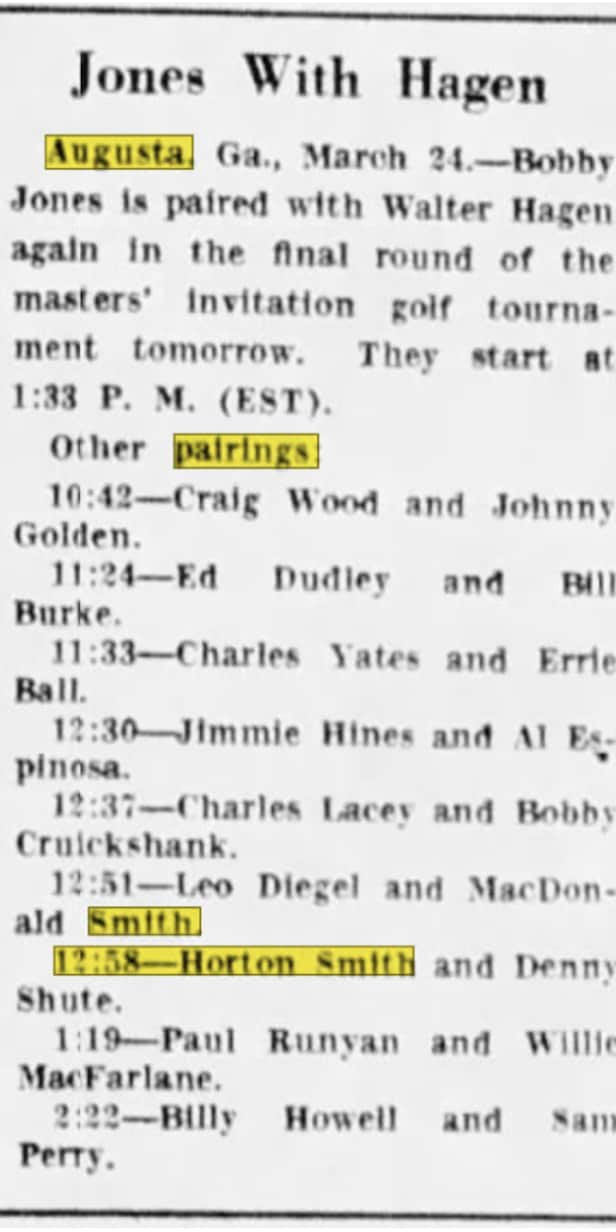
Goodness no. Horton Smith led after 54 holes, with Billy Burke second, but as you see below from The Charlotte News, the pairings were all over the place. Smith was with Denny Shute, who wasn’t in the top 10, while Burke was with Ed Dudley (T-3). Craig Wood, also tied for third was grouped with another player outside the top 10. And clearly, Augusta was sticking with a marquee star power group of Bobby Jones and Walter Hagen regardless of score:
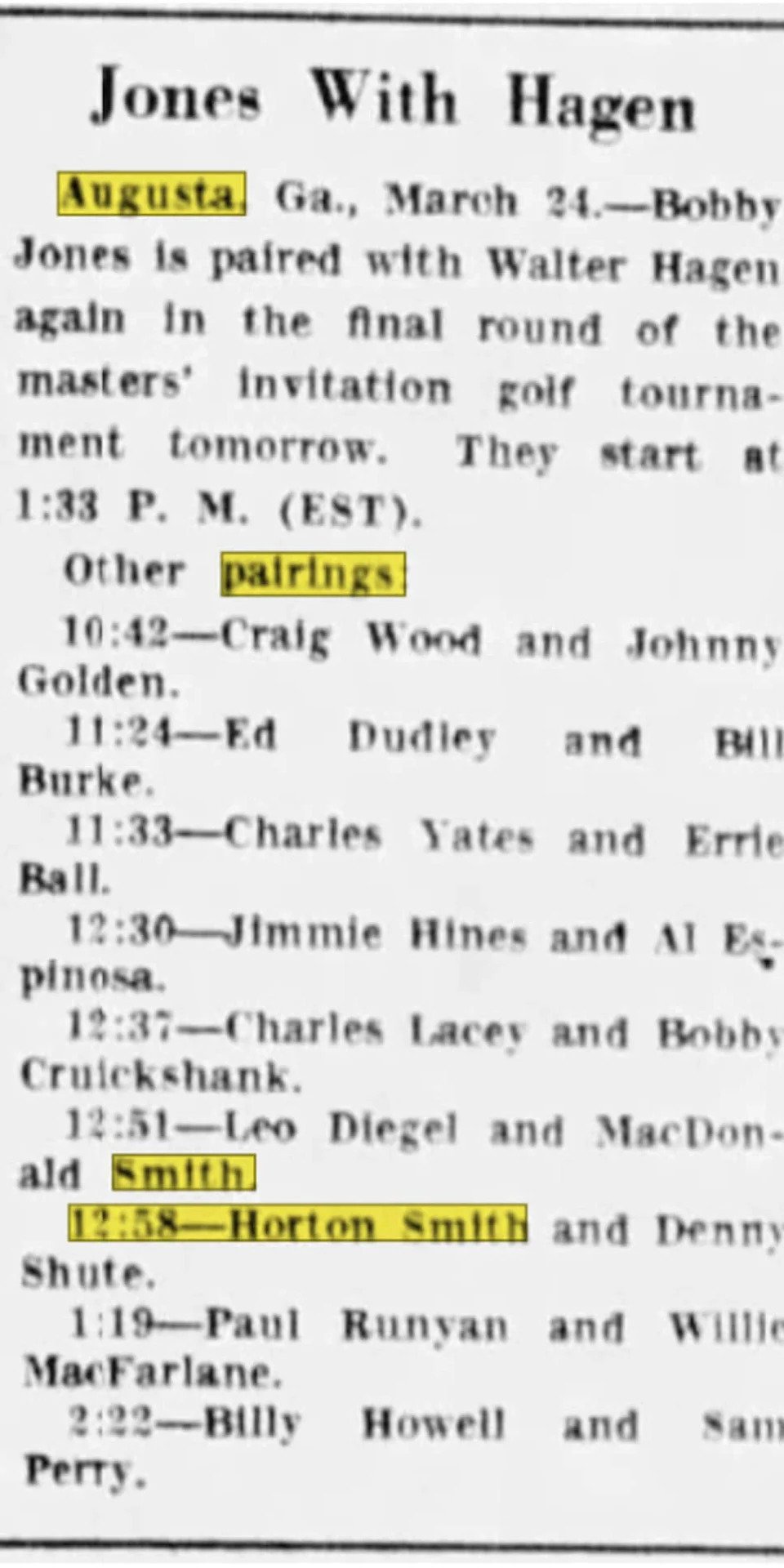
/content/dam/images/golfdigest/fullset/2026/4/masters-sunday-pairings-photo-1.jpg
In fact, a look at Saturday’s pairings show the exact same duos in different order, meaning Augusta just kept it the same. (They were different for Friday, so there was some change, but it was not based on scores.)
Was there any standard protocol in those early years?
There was a tradition for a while that Bobby Jones, and later Byron Nelson, would play with the 54-hole leader, like an honorary sherpa. Thanks to Golf Digest’s E. Michael Johnson, I learned that in 1956, they actually broke with tradition because Byron Nelson was actually a known mentor and friend of the leader, Ken Venturi. Augusta thought the pairing would be unfair, so they put Venturi with the not-always-friendly Sam Snead. Venturi collapsed, shooting 80, and legend has it that the pairing was to blame. Later accounts, however—including Venturi’s own—tell a different story, which is that he actually requested Snead as a substitute for Nelson, and that the alleged “silent treatment” Snead gave him was actually just Venturi being too nervous to talk. Anyway, bit of an odd system, right?
Advertisement
Very. Did anything change before the 1960s?
No. There doesn’t seem to be one place publicly to see final-round pairings, but skipping around year-to-year you can find newspaper clippings that show the situation remained largely static. For instance, at the famous 1942 Masters, the last before World War II stopped play for three years, Byron Nelson and Ben Hogan led after 54 holes. Researching to find Sunday’s final pairings led to this delightful headline from the Houston Chronicle: “LITTLE BEN HOGAN WITH 67 CLOSES IN ON TALL BYRON NELSON.” But reading accounts in Monday’s papers, before their playoff, shows that Hogan was at least two groups ahead:
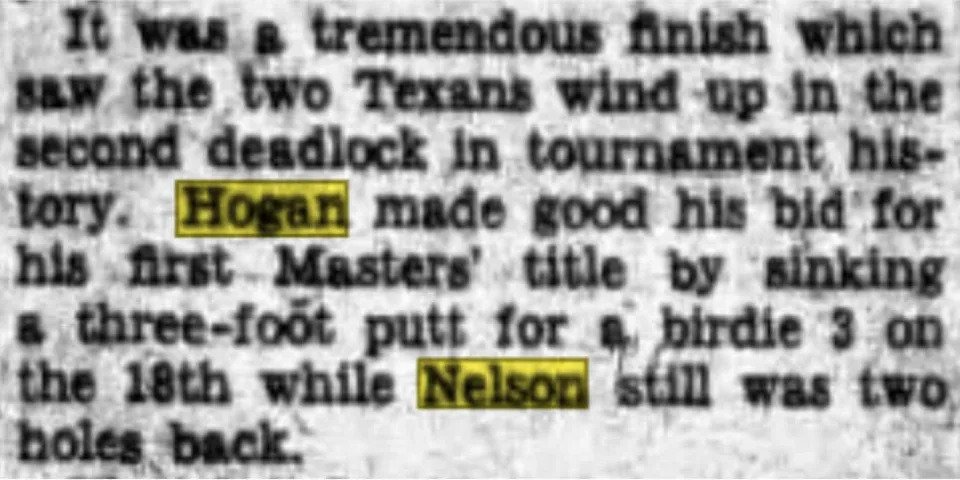
/content/dam/images/golfdigest/fullset/2026/4/masters-sunday-pairings-photo-2.jpg
Speed ahead 15 years to 1957, when Sam Snead at two under led a trio of chasers by one including Stan Leonard, Arnold Palmer and Harvie Ward. You can see Snead is paired with Jake Burke Jr. (T-6), Palmer with Jimmy Demaret (T-6), Harvie Ward with Doug Ward (T-6), and Leonard with Ed Furgol (T–5). That means the top eight are all in four twosomes, which may look like some kind of system if you soften your eyes a bit. However, the tee times are all over the place, and the players going off last are nowhere near the lead:
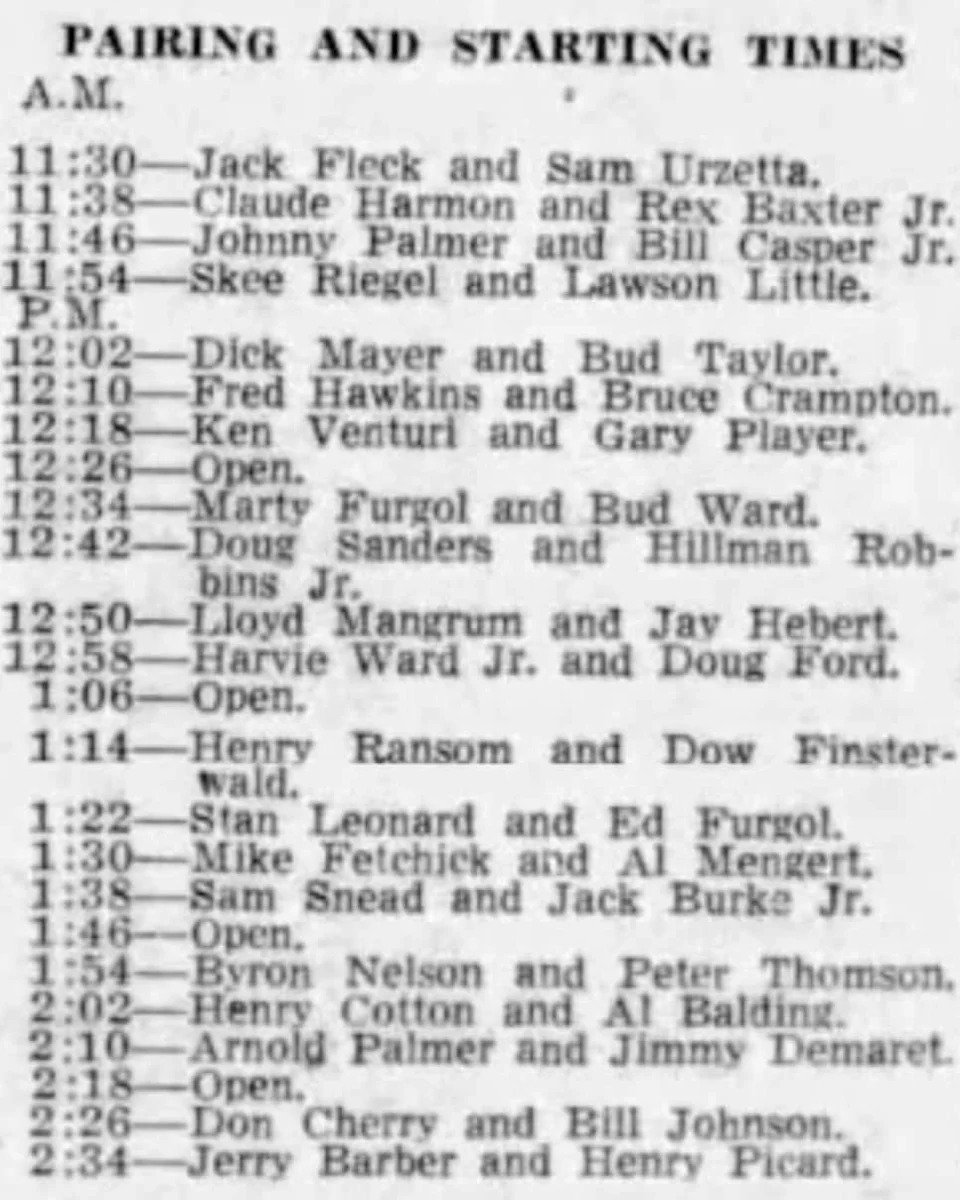
/content/dam/images/golfdigest/fullset/2026/4/masters-sunday-pairings-photo-3.jpg
I ran a few spot checks to make sure nothing changed in the early 1960s, and the pattern held. In 1960, Palmer and Ken Venturi didn’t play together on Sunday despite leading after 54 holes. In 1965, with Jack Nicklaus first and Gary Player second entering the final round, Nicklaus was playing with fifth-place Mason Rudolph in the third-to-last tee time.
Advertisement
Was Augusta more or less just making it up?
Yes. They would kinda/sorta keep the leaders together, albeit split up between different tee times, and although I couldn’t find any official documentation on the process, it’s easy to imagine Chairman Cliff Roberts or his competition committee just drawing it up together at close of play each day.
One interesting thing, though, is that per a David Owen piece at The Golfer’s Journal, Roberts wrote to Byron Nelson in 1956 saying that, “The people who drive great distances, ranging as high as 200 miles or more, are not going to be willing to make those long trips unless they can arrive at Augusta around noon, get a bite of lunch and then see the most interesting personalities perform in the afternoon.”
In other words, better for the stars to tee off a little earlier, although even that time fluctuated over the years, as we see with Smith teeing off at 12:58 in 1934, Snead at 1:38 in 1956, and Nicklaus at 1:18 in 1965.
Advertisement
How did they decide who to put in those afterthought late pairings, after the leaders were gone?
Hilariously, per Owen, they would put players there who were “notoriously slow” so they couldn’t hold up the leaders. Again, point for Augusta—wayyyy ahead of the game on pace of play.
At what point did they move to some kind of concrete system?
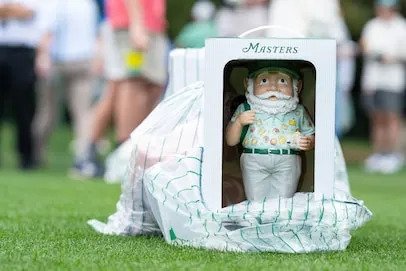
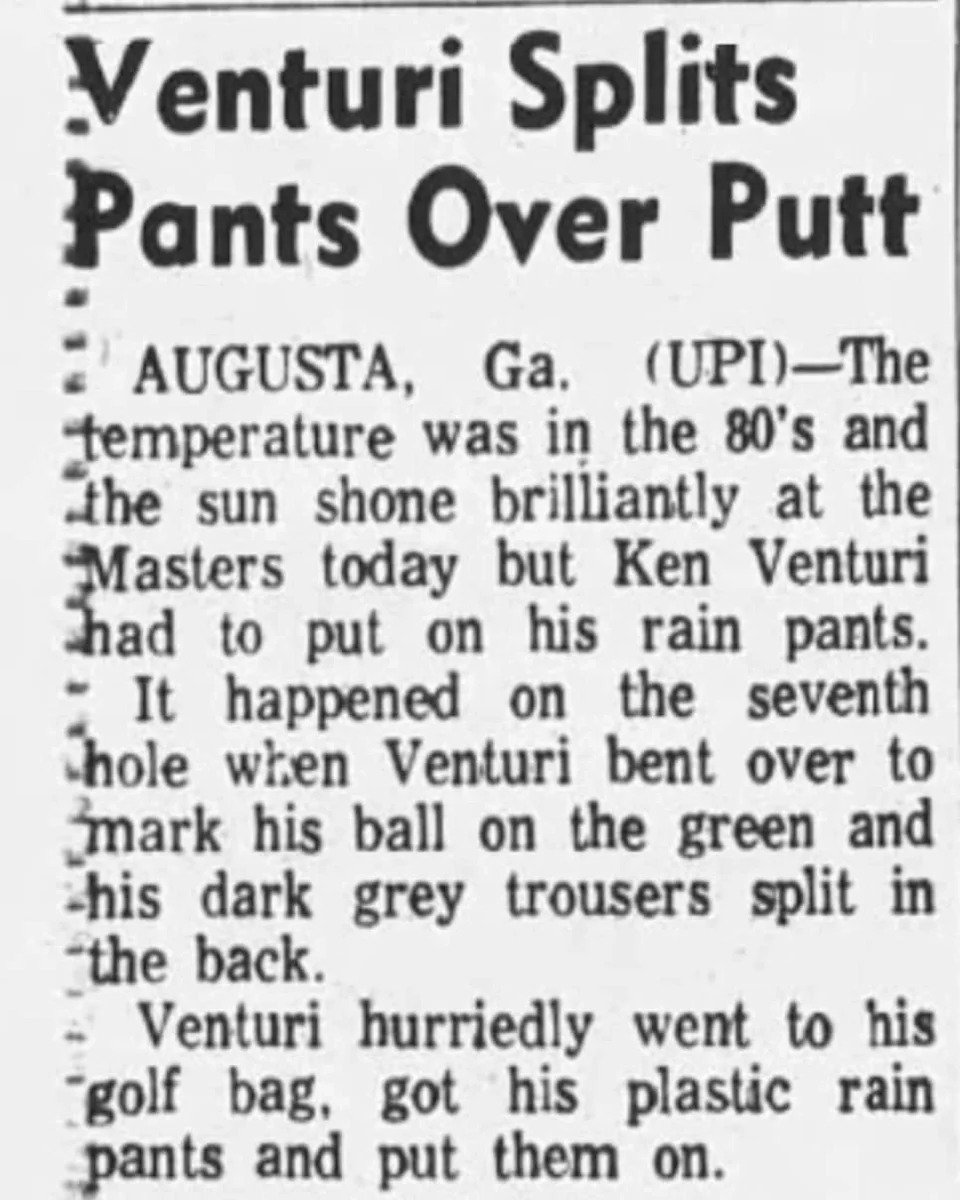
Can I first show you a story I found in 1968?
Does it have anything to do with final-round pairings?
Nope. Completely frivolous.
Fine.
/content/dam/images/golfdigest/fullset/2026/4/masters-sunday-pairings-photo-4.jpg
I hope you’re happy. Please focus now: When did they come up with a concrete system?
Well, here’s where it gets bizarre, so first I want to tell you what the system actually was: For about 15 years, the Masters went with a 1-3, 2-4 pairing style, meaning that the leader played with the golfer in third place, while second place played with fourth place.
Advertisement
That’s weird.
Completely weird.
Was anybody else doing this?
Yes! Spot checks of the PGA Championship showed that they were doing it in 1970, 1975 and 1977, though by 1980 the leaders were teeing off together last (albeit in groups of three back then). In 1971, the Open Championship was on what I’m calling the “weird” system, but by 1974 it was 1 and 2 together (with extra confirmation from the “Duel in the Sun” at Turnberry in 1977). The U.S. Open, on the other hand, was ahead of the game, already placing the best players together by 1969 (at least). I wish I had more precise dates here, but without archival access, we’re at the mercy of when newspapers decided to print the pairings. But basically, the U.S. Open was on the current system almost from the start, the Open got there by 1974, and the PGA by 1980.
Advertisement
Do we know why they were doing 1-3, 2-4 system?
I have no clue. I tried to dig, but while the answer might be in some archive somewhere, I certainly can’t find it. In terms of a specific rationale, maybe there was impetus to make sure that stroke play didn’t devolve into match play, but other than that I’ve got nothing for you. Keep in mind, though, that this was the era when Augusta National didn’t want to listen to anyone—including Joe Dey, USGA executive director and later the first PGA Tour commissioner, who told them their scoring system was all whacked out and would come back to bite them, which it did with the DiVicenzo madness in 1968. So we can’t say exactly what they were up to with this pairing business, but at least initially, they weren’t alone.
When did this start?
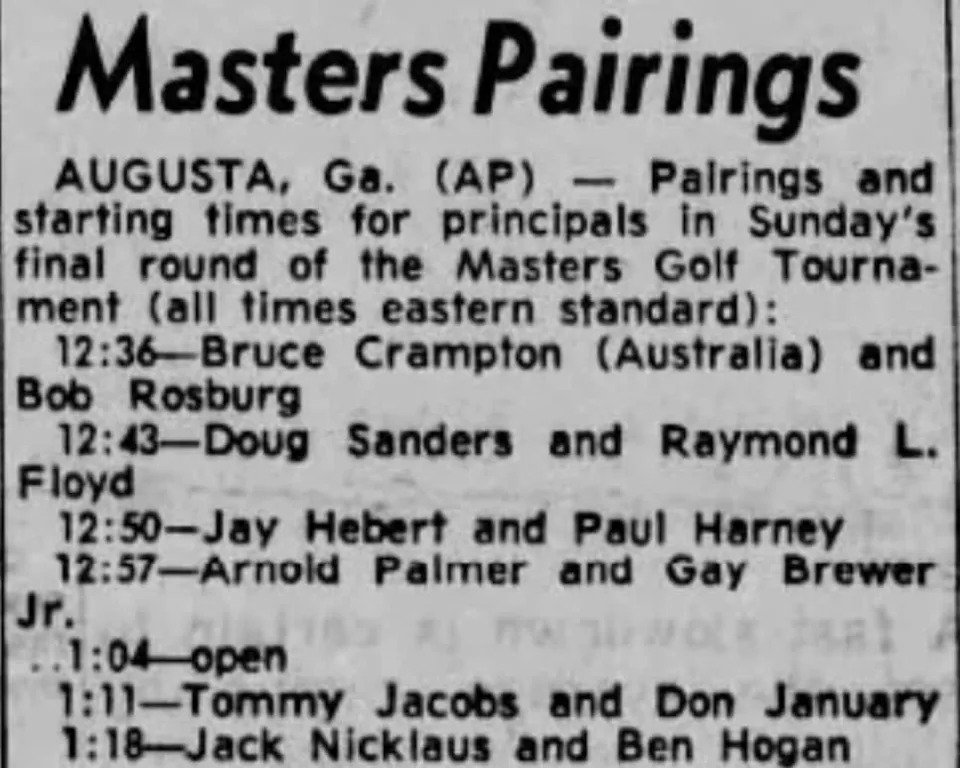
Officially, I’m not sure, but what I can tell you is that in 1966, for the first time, the final-round pairings kinda conform to this 1-3, 2-4 style. Nicklaus and Tommy Jacobs were tied for the lead after 54 holes, with Don January in third, and Gay Brewer, Ben Hogan and Arnold Palmer all tied for fourth. Here’s how the pairings looked that Sunday:
/content/dam/images/golfdigest/fullset/2026/4/masters-sunday-pairings-photo-5.jpg
Notice that these are only the “principals”—Nicklaus is not actually in the last spot. It’s the same in 1967, although they’re back to putting also-rans in the final few spots, and in 1968 it could be the same system, although the solo leader, Gary Player, is in the second-to-last group.
Advertisement
The problem with all this is that in the absence of committee meetings or actual policy, there are very few times when we have a clean 1-2-3-4 running order, so the various ties make it hard to know exactly what was happening.
Is there ever a point where we know what’s happening?
It appears 1969 is the key. That year, a couple things happened. First, there was a distinct 1-2-3 finish after 54 holes, with Billy Casper, George Archer and Miller Barber occupying those positions by themselves, and Charles Coody and Tom Weiskopf T-4. And newspaper accounts confirm that Casper played with Barber in the final tee time—the first time I can find where the 54-hole leader was in the last tee time—with Archer and Weiskopf going just before them. A year later, the same thing happened, except that in 1970, it became clear that after the 1-3 2-4 weirdness, it went “normally,” with 5 and 6 playing, 7 and 8, and so on.
At that point in history, we can pretty reliably say the 1-3, 2-4 system was entrenched at Augusta.
Advertisement
How did the players like this?
Well, I can tell you one man who hated it, and that man was pretty important and influential: Jack Nicklaus.
Nicklaus always had an eye on this structural stuff, didn’t he?
Yes, he sure did, and he had a ton of influence in various aspects of professional golf right around this time. He practically saved the Ryder Cup by pushing the British PGA to expand the field to all of Europe, on the positive side, and on the more ambiguous side, he tried to lead a revolution on the PGA Tour to protect player rights over what he saw as the encroaching reach of ever-more-capitalist PGA Tour—that failed when he got completely out-maneuvered by Deane Beman. But the larger point is that he had a hand in almost everything, and this is no exception.
Advertisement
So what happened?
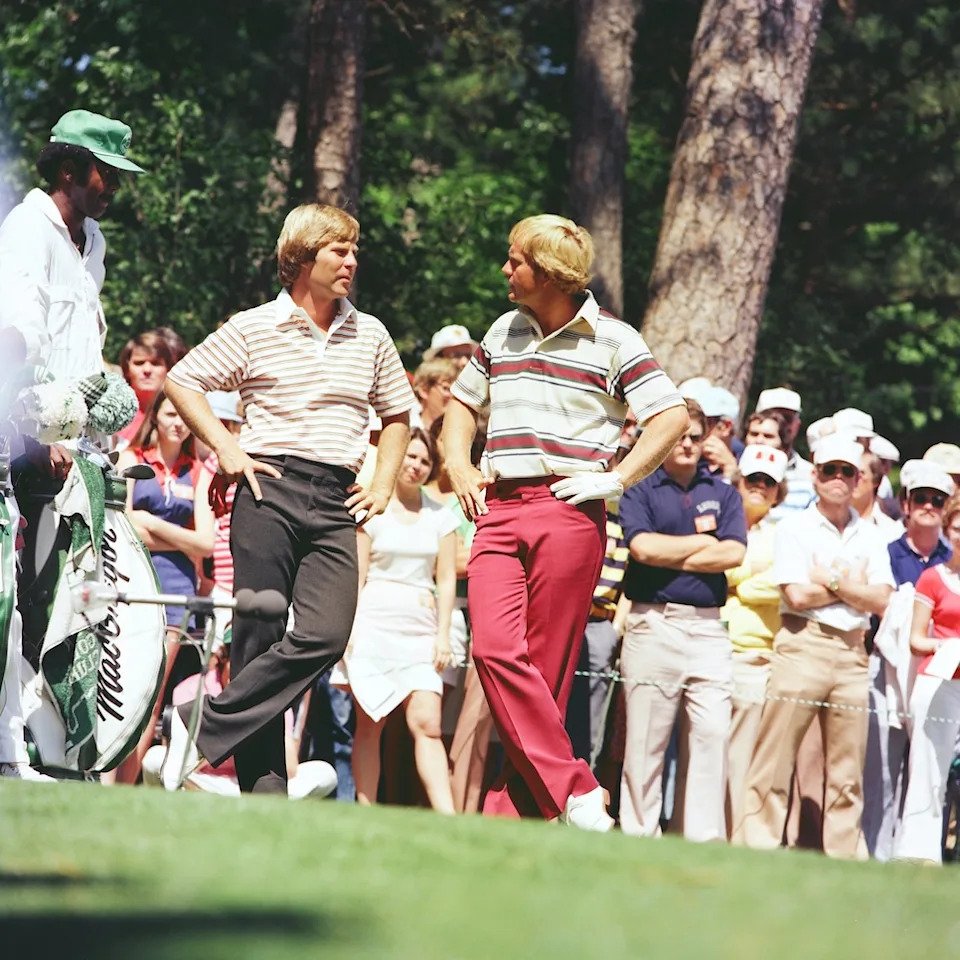
I need to shout-out Kevin Van Valkenburg over at The Fried Egg for pointing me to an article from the Pensacola Journal in 1977, a year when Ben Crenshaw and Tom Watson stood tied atop the leaderboard after 54 holes. Per the 1-3 2-4 system, though, they didn’t play together; Crenshaw ended up paired with Nicklaus and shot a 76, while Watson cruised to the win in his pairing with Rik Massengale. In the article, Crenshaw said it was “not a factor” and that the pairing “did not bother me at all.”
As for Nicklaus …
Did Nicklaus go off?
Nicklaus went off. In the parlance of today’s youth, you could even say he crashed out. His quotes:
Advertisement
“Ben has every right to be upset with the pairing. This tournament is the only one that makes such pairings on the final day … we’re all used to pairings falling to the way they do on the board. It’s harder for some young kid to win his first major championship if he’s paired with me. I felt sorry for Ben. I’m not saying there should be any reason for anybody to be afraid of me. But if you see some guy who’s already won a major start making a move, people are going to take note coming down the homestretch.”
Wow, that got a little egotistical.
Oh yeah. Even weirder, Nicklaus acted like Crenshaw should have been paired with Jim Colbert, who was also T-4, but had shot a 69 the day prior to Nicklaus’ 70. Which means that Nicklaus was not referencing how things worked elsewhere, but the Masters’ own system, in which Colbert should have been ahead of Nicklaus because he finished earlier the day before (the first-in-last-out system that by then had been established on the PGA Tour).
83120627
Augusta National
Advertisement
In other words, Augusta juked its own system to get Nicklaus into the second-to-last group?
Yup.
Was that the end of the Nicklaus saga?
Oh no. It got worse. Fast forward to 1981, where the situation was much cleaner: Watson in the lead at seven under, Nicklaus a shot back, alone in second place. Keep in mind now that at every other major, the top two players were paired together for the final round. But instead of playing together, Watson went with Greg Norman (third), and Nicklaus with John Mahaffey (fourth). And that year, Nicklaus was pissed off even before the final round happened. Dave Anderson at the New York Times was all over it then, and here’s what Nicklaus said:
Advertisement
“I was geared up to play with Tom in the same pairing. I figured that’s the guy I have to beat … in every other tournament, they pair 1 with 2 and 3 with 4. But not here.”
Isn’t it weird that he was surprised by it, since it had affected him so much four years earlier?
Yes, and somebody reminded him of that original loss to Watson that Saturday night.
“I wish you hadn’t brought that up,” Nicklaus said. “I have been trying to forget about that.”
Nicklaus lost to Watson again the next day, but this time, the furor was enough to convince Augusta to conform to the rest of the golf world. That comes from Augusta, by the way—reached for comment, they cited the Times article as the inciting factor for the change.
Advertisement
Is Nicklaus the first person in world history to bully Augusta into changing?
Not necessarily, but it usually takes the bullier about 20 years.
How fast did this change take hold?
Hord Hardin, the Augusta Chairman, announced it the next year. It got almost no press, because he made a few other announcements with it, the biggest of which was that the tradition of local caddies at the Masters was ending, and players could now bring their own. That dominated headlines. It’s also not 100 percent clear if Hardin announced it in early 1982 or in November when he made the other announcements, and the final-round tee times in 1982 are ambiguous because of two players tied at T-2. (Although by the first-in-last-out rule, it was 1 v. 2 … but again, we don’t know that Augusta ever abided by that in the first place.)
Advertisement
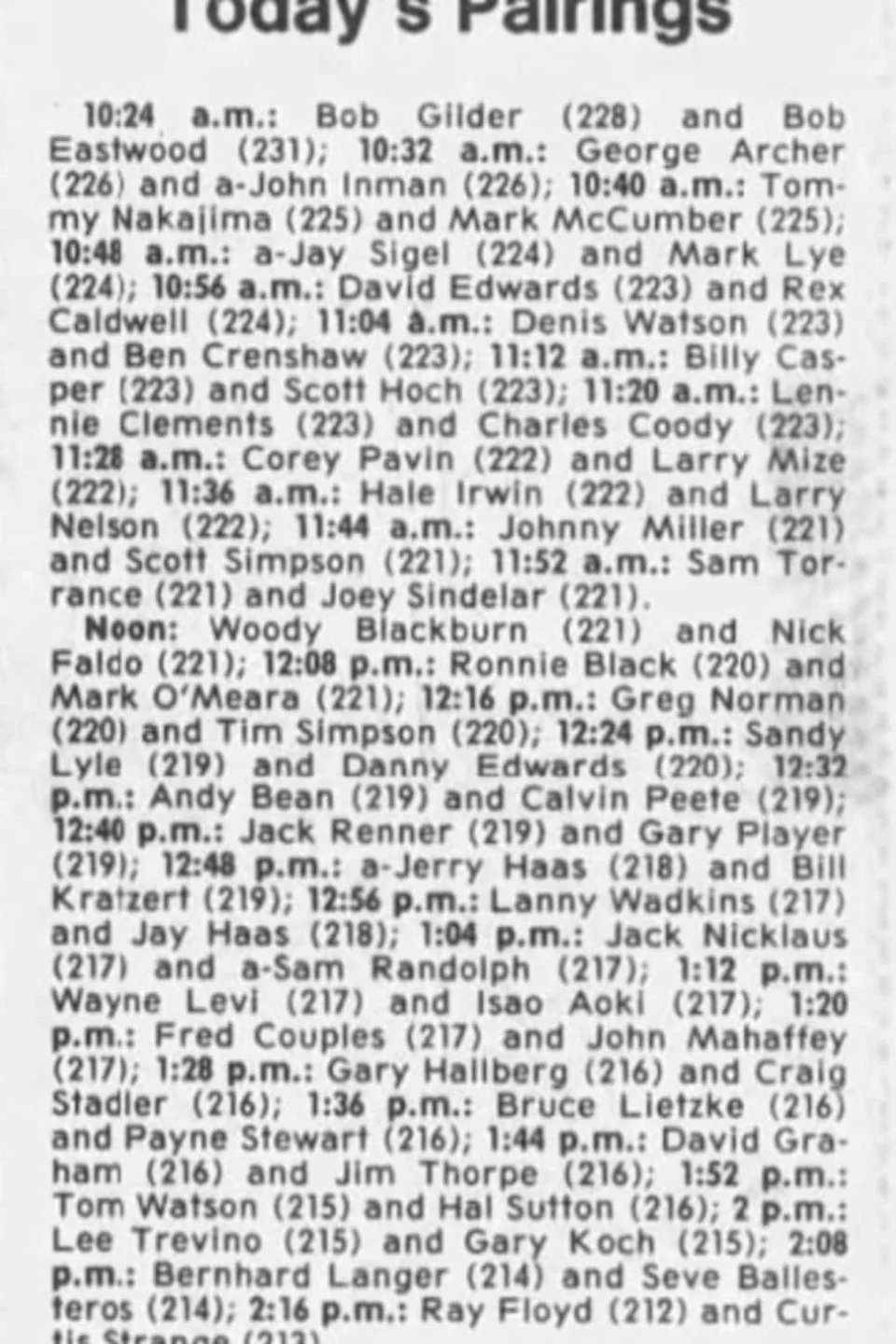
In 1983, the third round finished on Sunday due to weather, skewing tee times, and somewhat hilariously, the same thing happened in 1984. But by 1985, at last, Augusta had entered the modern era of final pairings, and there in all its glory was a listing of Raymond Floyd and Curtis Strange, solo first and solo second, playing together in the final tee time:
/content/dam/images/golfdigest/fullset/2026/4/masters-sunday-pairings-photo-6.jpg
So what’s the lesson here? What am I supposed to take away from this?
Well, we don’t know exactly why any of this happened, who was behind it or how it changed any outcomes, but we do know it’s an odd little slice of Augusta history, another small nugget of evidence that things just work a little bit different behind those gates, and a sliver of golf history that signifies very little but somehow says a lot about the place it came from. How’s that?
Advertisement
I would really like to just watch some golf now.
Yes, us too.
MORE FROM GOLF DIGEST @ THE MASTERS
Masters 101: Answering all your frequently asked questions
How to watch the 2026 Masters
Power Rankings: Every player in the Masters field, ranked
Tee times for Round 1 and Round 2
50 defining Masters Moments, ranked
The most memorable Rules issues in Masters history
Every course change ever made at Augusta National
A brief history of Masters prize money payouts
15 people who ended up in the Masters penalty box
The Champions Dinner Tell-All, from those inside the room
Read the full article here