
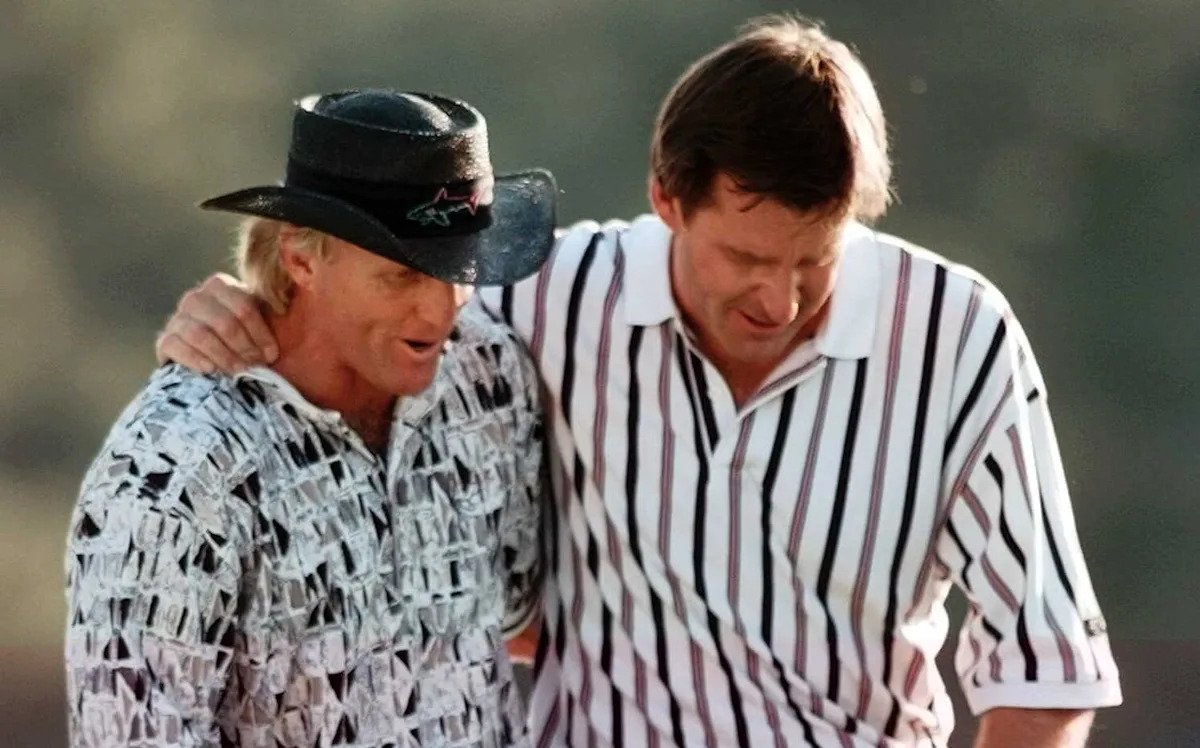
It was the hug to break a million hearts. Nick Faldo, golf’s most ruthless winner, grabbed Greg Norman in his arms, held him close and through his tears the Englishman consoled his victim and urged him to stay strong in the forthcoming inquest into his meltdown.
The ice guy had cracked, but yes, the nice guy had finished second. Again. And golf had another image to sum up how it can appear both merciless and beautiful simultaneously.
Advertisement
Except on the 30th anniversary of one of the most memorable Masters, Norman, 71, remains indifferent to that picture and claims that even in the midst of Faldo’s redemptive scene, the Australian realised this was to be but a fleeting moment of humanity.
“What I got in those moments was a very narrow window into the other side of Nick Faldo,” Norman tells Telegraph Sport. “There is something about Nick. It’s in him. There’s the public side of Nick.
“You know, he was the one who came up to me, he’s the one who hugged me. He’s the one who said, ‘don’t let those b——s get to you’. But it didn’t really mean much to me, because I knew he’d soon go back to being the way he was before. We never had any sort of relationship. We were chalk and cheese. He was a loner, I couldn’t be like him.”
If that seems callous, ungracious and unthankful, with the narrative flipped and Norman cast as Dr Evil, then when it comes to Faldo and his comments in recent, turbulent years, Norman believes he has every right to be. But more of that later.
Advertisement
For now, he is recalling April 14, 1996. It was the Sunday the golfing gods took off, the Sunday when Augusta was finally meant to hand its most desperate loser his hard-earned Green Jacket, but instead fitted him for one of the “strait” variety. It was the Sunday when Norman had a six-shot lead and shot a 78 to lose by five.
“People say I must have been able to move on so quickly because I managed to blank out what happened,” the Australian says. “But that’s not how you move on. You must accept it, take responsibility for it and understand it, because that’s what you owe the game. It teaches you that nobody is above golf. So I have no problem with talking about it. Even though I never won [a Green Jacket].
“You’ve got to take it on the chin and that’s the way I am. That resilience is in my DNA. That’s what got me there. You can’t be selective. Look, I can remember the sights and sounds of that Masters. Vividly. I remember on the Saturday evening when I was leaving the locker room and Peter Dobereiner [the late British golf writer] was standing at the corner of the bar you had to walk past. ‘Not even you can f— this up,’ he said to me. And I replied ‘Thanks, Peter’. I laughed. Peter was my friend. Because that’s part of it. That’s sport.
“Jack Nicklaus once told me how you act in defeat is as important as how you act in victory. So it unravelled and I fell behind and then I remember slumping on my club when I nearly chipped in on the 15th for an eagle. That would have given me a chance.
Norman nearly chipped in at the par-five 15th but the damage had already been done – Stephen Munday/Getty Images
“Yeah, there was the emotion but regardless of whatever Faldo said, I was always going into that press room. I think I described what happened pretty matter of factly [‘I played like s— today,’ he told the media corps] and made sure to praise Nick because his 67 was a great score. And then, that’s it. You do go forward. It was the same with the Larry [Mize] one. I can see it now, that ball dropping.”
Advertisement
If 1996 proved to be an excruciating slow-burner, 1987 was a flash fire. In the second hole of the play-off, playing the 11th, Norman was safely on the green, with Mize, the Augusta native, in trouble on the right, with his local fans begging for a spectacular up-and-down. He chipped in. The Green Jacket was gone in a puff of smoke.
“Of course, that embeds itself in your mind. But it’s not going to ruin your life – unless you let it,” Norman says. “Honestly, I was more affected by what happened on the hole before. Seve [Ballesteros, the third man in the play-off] had ducked out and I was walking off the 10th green towards the 11th tee, I watched Seve walking back up the fairway. He was on his own, with his head down. It was a very powerful moment and that got to me, more than perhaps any other sporting event. We were very, very close, we were like a team together. Even though we were massive competitors, we had this relationship, one that you never could have with Faldo.”
There is clearly a grudge, but not because of 1996 or because of anything in their rivalry on the fairways. “Too right, I’ll bear a grudge, if somebody crosses paths with me, says something derogatory, tries to screw me over,” Norman says. “Nick said some things about me during my time at LIV, some really nasty things. I don’t have any respect for someone who gives their opinion on something in that sort of manner when they don’t know both sides.
Advertisement
“Come on, we have a history, he could have called me and asked for the other side of the story and I’d have gladly given it. And if he still hadn’t agreed then fine – his opinion and as he knows the facts, he would have been entitled to say anything he likes. Happy days. But just to sound off? Like I said, no respect for him. He still comes out with stuff that’s interestingly stupid, to be honest with you.”
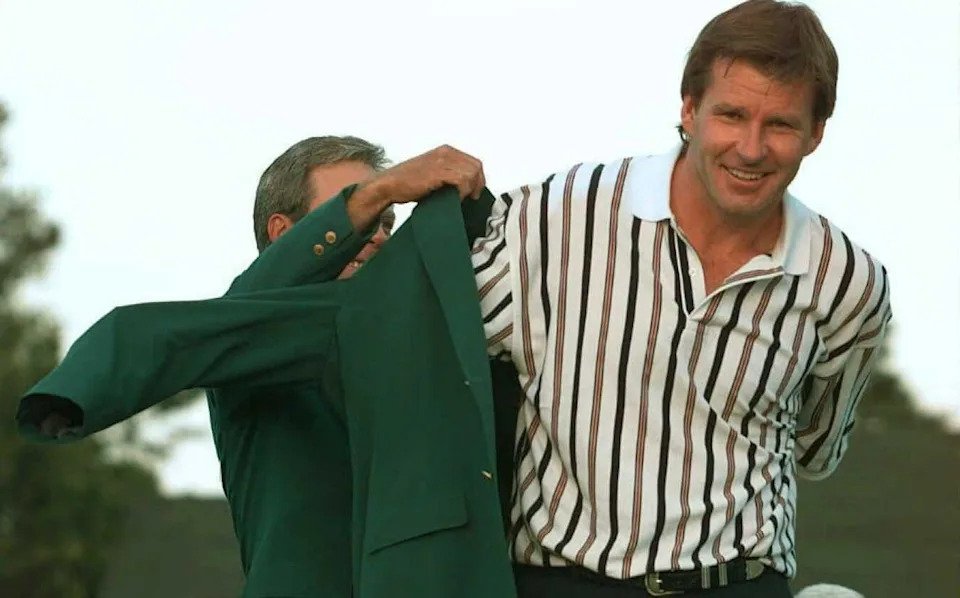
Faldo beat Norman to the Green Jacket in 1996 and, despite the kinds words on the 18th, there has been no love lost between the pair since – Jeff Haynes/AFP
Norman says it with a laugh and acknowledges that Faldo was far from the only one who sent pelters in his direction when he was the chief executive tasked with launching the Saudi-funded breakaway league. Now much has changed, he says. Not least because of LIV having world ranking points and his successor, Scott O’Neil, having a berth on the top table.
“Roll the clock back 4½ years ago, about all the anti-Saudi sentiment, and then you roll the clock to where we are today, where now the Americans and the Saudis are tight with what’s going on in the Middle East,” he says.
Advertisement
“There’s nothing, no negativity. To be involved with it then, and to see where it is today, and the same people then are 180 degrees different today. So you think, OK, what was it all really meant to be? All this hostility towards us. I’m smart enough to know to sit back, see that I was in the right place at the right time, doing the right thing, to be able to grow the game of golf. I’m not allowed to tell you everything that happened and what was against us. But one day, when I’m near the end, I might. It will be like the Watergate of golf.”
‘LIV did affect my business’
Norman insists he is delighted with how it has worked out since he left the role nearly 18 months ago. “It’s all I wanted, free agency and the players to be treated better,” he says. “Look at the money in the PGA Tour, the private equity and everything and how big the prize funds are. That is down to LIV and nobody can deny it.”
But it did come at a cost to Norman and his golf-course design business. Sometimes it is forgotten that Norman had built a multimillion-dollar business and was not exactly begging for a new role, never mind how huge the Saudi salary was. “Those early years with LIV did affect my business, especially here in the United States. There was definitely a huge stain put on top of me because of all that propaganda and that hatred and all that stuff that came with it.
Advertisement
“But, conversely, when I went overseas, in Asia and Australia and all those places, I was a hero. I go into places like Japan and Vietnam and I feel like I’m more popular and recognisable today than what I was back in my day of playing.
“As crazy as that sounds, it’s the validation of what the platform we took to the world, which was LIV. We were the ones who created that foundation, that bedrock of stability on a global footprint that allowed the rest of the world outside of America to see exactly the true value of golf, of team golf, of team sport.”
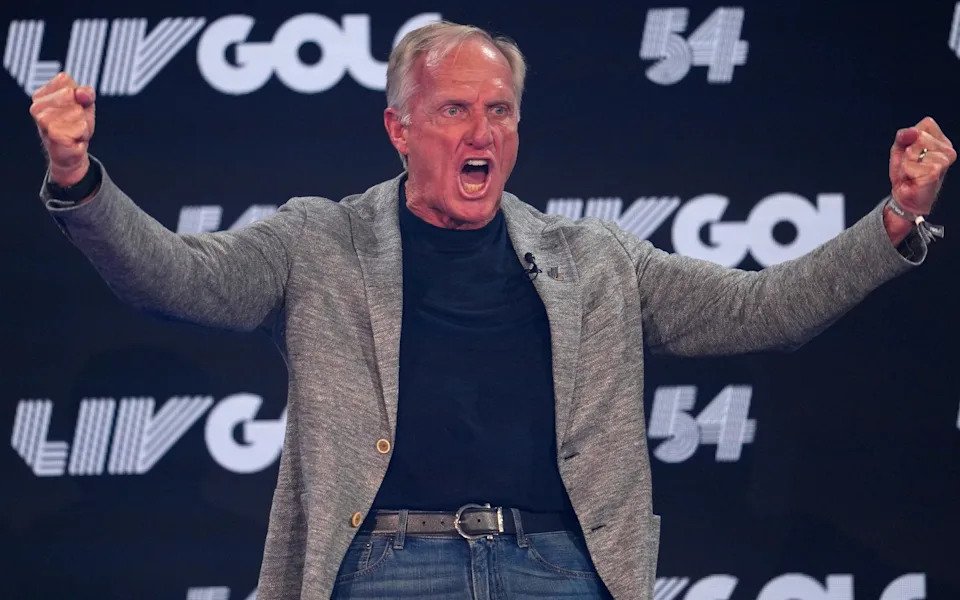
Norman says his stewardship of LIV meant he had to deal with ‘propaganda and hatred’ – Aitor Alcalde/Getty Images
He insists that interest in Norman Design has picked up again in the US, but reveals that he is busiest in Asia, with Vietnam a particular hotspot. “Fortunately about America, everybody’s got a short memory, and they move on, and obviously now it becomes a transactional business, and what our brand and what our reputation and expertise can deliver,” he says. “At the same time, the bulk of my golf-course design business has always been global.
Advertisement
“I love it. It’s the relationship and connectivity. You get off the call with a head of state and you go, ‘oh my gosh, that was a really powerful conversation’.
“Golf courses today can be anywhere between $10m [£7.6m] and $25m to build, depending on where they are. But you’re talking about maybe a quarter-of-a-billion dollar investment into a development. You’re talking about infrastructure, financing, power, water, everything that comes, which I really enjoy.
“And then, of course, sitting on the board for the Brisbane 2032 Olympics. Those are the type of things that I never thought I would enjoy doing, but I’m just very, very passionate. LIV opened a whole new world. It’s the contacts I have. I say, if I can’t reach somebody, anybody, in three phone calls anywhere in the world, there’s something wrong. I’m in my element.”
He has a hotline to Donald Trump, the US president, and tells an anecdote of another former president, Bill Clinton, phoning to ask him to help Tiger Woods, who he used to live near. “I told him I wasn’t his mate, so I couldn’t,” Norman says. It has taken time, however, for him to re-establish his name in certain quarters and is still waiting for Nicklaus to RSVP to a recent lunch invite. And then there was the period he spent away from the firm that bears his name.
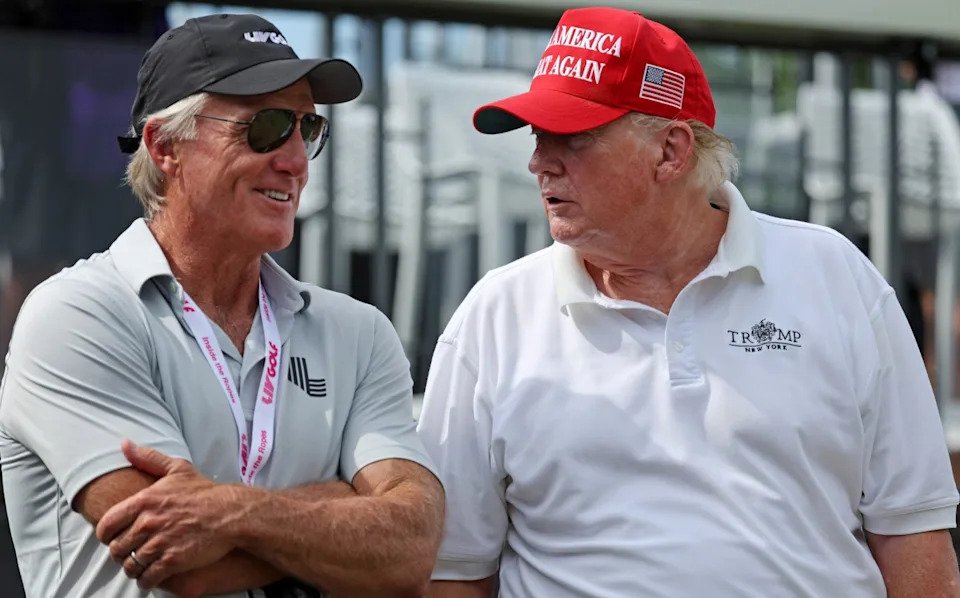
Norman is a friend of Donald Trump, the US president and golf fanatic – Jonathan Ferrey/Getty Images
“You entrust your business to other people that actually work for you for so long and you think they know how to do it,” he says. “But it’s just not the same. The people I engage with, leaders of nations and so forth… well, it’s amazing how much they require you to have a conversation with. And now that I’m back at it full time, it’s just such a joy to be back into it.”
Advertisement
Maybe, but in a different timeline, Norman would be at the Champions’ Dinner on Tuesday, breaking bread with Rory McIlroy and other legends. He will be elsewhere, perhaps in Vietnam, tying up a deal. Yet he does not sound fussed about missing what may be considered to be his birthright.
“Hey, I’ll probably have a look at the Masters on the Sunday,” he says. “We know what that back nine can throw up.” It threw up the Great White Shark, himself, on at least three occasions. “But I still love the place, regardless of all that’s gone on,” he adds. “Things just happen there.”
Try full access to The Telegraph free today. Unlock their award-winning website and essential news app, plus useful tools and expert guides for your money, health and holidays.
Read the full article here