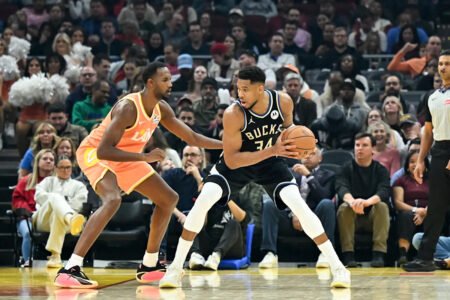

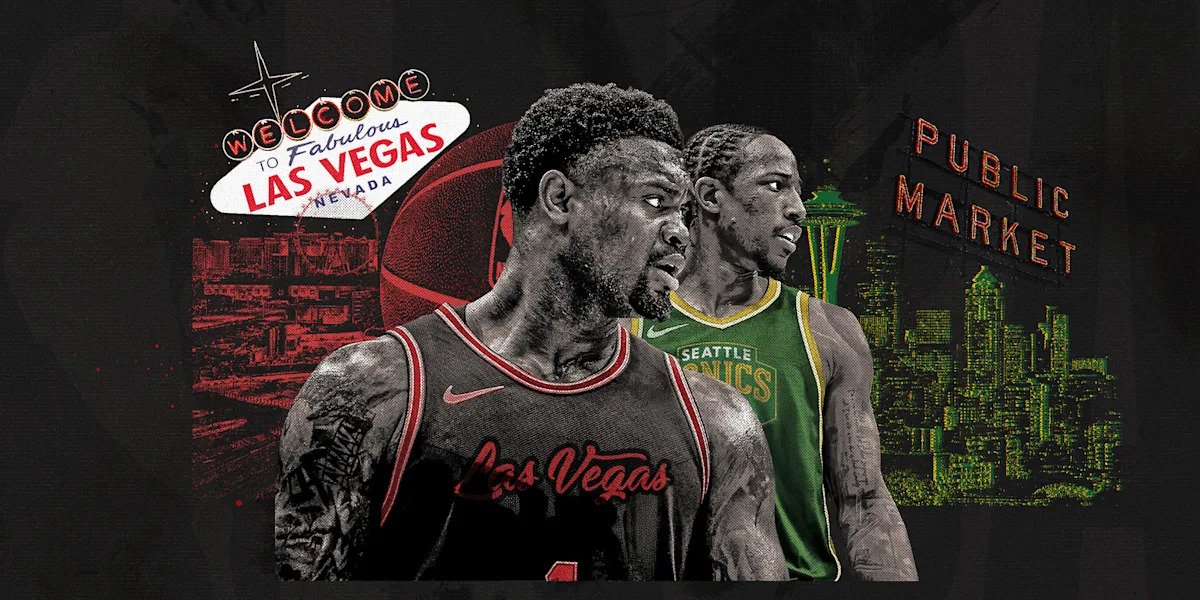
For the first time in more than two decades, the NBA appears to be on the verge of expansion, with the league’s Board of Governors voting to explore the potential addition of new franchises in Seattle and Las Vegas, reportedly in time for the 2028-29 NBA season.
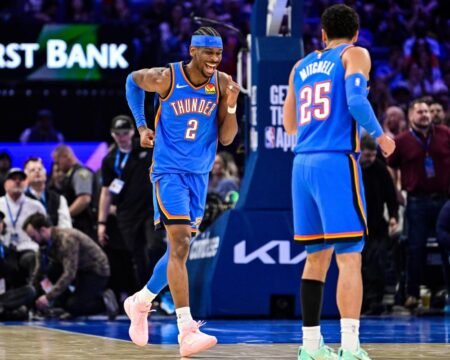
On one hand, there’s still an awful lot that needs to happen between now and then to arrive at a point where Teams No. 31 and 32 tip off an actual, honest-to-goodness NBA game. On the other … thinking about what those teams might look like seemed like it could be fun. And, as luck would have it, the fine folks at Spotrac recently launched an Expansion Draft tool to help facilitate said fun.
Advertisement
Draft your Yahoo Fantasy Baseball team for the 2026 MLB Season
So Ben Rohrbach and I decided to kill a little time this week — Lord knows there isn’t much else going on in the NBA at the moment! — by engaging in a mock draft to see what the rosters of the as-yet-still-theoretical teams in Seattle and Las Vegas might look like. Ben drafted for the Seattle team, which he creatively named “the SuperSonics.” I drafted for Las Vegas, and while there were just so many wonderful names to choose from …
… I decided to call my team the Las Vegas Neon, in honor of the spellbindingly gaudy lights that dominate the Strip, and also in recognition of the fact that — as you all surely already knew — neon is the official element of the state of Nevada. Hit the bricks, Strontium! This is Neon Country!
Advertisement
How exactly an expansion draft will work in real life remains, for the moment, unclear. The 2023 collective bargaining agreement between the NBA’s teams and its players doesn’t deal with the nuts and bolts of expansion in any great detail, beyond laying out that expansion teams will operate under lower salary cap, minimum salary, tax, first apron and second apron levels than other teams for their first two seasons in the league. (In Year 1, expansion teams can spend up to 66.6% of the full salary cap; in Year 2, that increases to 80%.)
Past that, though, specifics are scarce — and, potentially, outdated. The last expansion draft the NBA presided over happened in 2004, when the salary cap was just under $43.9 million; there are 24 individual players making more than that this season. Nearly a quarter-century later, in a league that has seen four new CBAs since then, it’s reasonable to presume that the stakeholders might want to take a fresh look at the rules, and perhaps tweak them a bit. In the absence of clarity on what those tweaks might be, though, we’ll conduct our exercise based on prior precedent.
(Bruno Rouby/Yahoo Sports Illustration)
How an expansion draft could work
Each of the NBA’s 30 teams gets to protect up to eight players; they can choose to protect less. They all have to leave at least one player unprotected; they can choose to leave more than one.
Advertisement
Players left unprotected, who are under contract for the 2026-27 NBA season or entering restricted free agency in the summer of 2026, will comprise the pool of players from which the expansion clubs will select. Players about to enter unrestricted free agency, and thus not under contract, are excluded from consideration.
The expansion clubs will select at least 14 players. Once they take a player from one team’s roster, the rest of that team’s unprotected players are off limits — meaning, for example, no raiding half the Thunder’s bench.
(Now, you may find yourself asking: If the expansion draft won’t happen until the summer of 2028 at the earliest, why do it based on today’s rosters? Well, trying to figure out which players teams might protect two years from now seemed like a fool’s errand, and since this is intended to be less a projection of how things will unfold and more a case study in how something like this could go, it seemed more reasonable to just base our decisions on the players, salaries, prospective development paths and overall ecosystem as it exists right now. Let’s take it as read that such decisions are very fluid, and that an incredible amount can change between now and the summer of 2028.)
The Spotrac tool allows you to go through and pick which eight players every NBA team would choose to protect; it also offers its own recommendations, which Ben and I — not super eager to make 240 discrete selections — decided to use. It also projects the Year 1 salary cap figure for our expansion SuperSonics and Neon at $132 million.
Advertisement
Some other notes:
-
An expansion team that drafts a restricted free agent receives control of his Bird rights. However, that player immediately becomes an unrestricted free agent, and is thus eligible to test the market and potentially walk for nothing. (Said player cannot just walk right back to his previous employer, though.)
-
An expansion team can choose to waive a player it selects in the draft; in that case, the player’s contract wouldn’t count toward the team’s salary cap figure, but it would count as part of the team’s effort to reach the salary floor, which requires the team to spend up to 90% of the cap line.
-
The other 30 teams are allowed to negotiate trades with the expansion teams, involving other players or picks, in order to entice the expansion teams to stay away from (or perhaps take on) a particular unprotected player. We decided not to do that, because it gave us a headache, but don’t be surprised if, y’know, Sam Presti or whoever decides to do a little pre-draft dealing to attempt to achieve a preferred roster outcome.
-
I gave Ben’s Seattle SuperSonics the first pick, because the Neon are an organization of gentlemen and scholars. (Also, because I’m pretty sure that gets me the higher of our two picks in the actual NBA Draft. I didn’t tell Ben that. In the Vegas biz, we call that a Mindfreak.)
Without further ado:
1. Seattle SuperSonics: Luguentz Dort, Oklahoma City Thunder
Contract: $18.2 million (2026-27) • 2027 UFA
Rohrbach: Welcome to the SuperSonics, Lu. As we bring basketball back to Seattle, why not take a page out of the Seattle Seahawks’ book and build with defense at top of mind?
My rationale: I figured the Oklahoma City Thunder for the deepest team in the league, practically without a hole on the roster, so they would have the largest crop of talented players to choose from, and I wanted to take one off the board before it was too late. Which is to say: Immediately. While Jaylin Williams was an enticing option, I went with an All-Defensive stalwart as a culture-setter for my locker room.
Advertisement
Spiritually, too, starting Seattle’s franchise by taking from Oklahoma City feels right.
2. Las Vegas Neon: Zion Williamson, New Orleans Pelicans
Contract: $42.2 million (2026-27) • $44.9 million (2027-28) • 2028 UFA
Devine: Stop me if you’ve heard this one before: Immediately upon arriving in Vegas, I make a preposterously dicey wager.
Is Zion under contract for more than $87 million over the next two seasons? Yes. Has he played 30 or fewer games in more than half of his professional seasons? Yes. Has his production dipped down to a comparatively quiet 21 points, 6 rebounds and 3 assists per game? Yes. Do I have at least some questions about Zion maintaining a rigorous commitment to physical excellence in Las Vegas? No comment.
Advertisement
But even after the years of injuries and up-and-down performance, Zion is, to my eyes, the highest-ceiling talent on the board here — a 25-year-old All-NBA-caliber performer and potential marquee attraction who’s quietly been healthier this season, and who is, even in a down year, second in the league in points in the paint per game, shooting 60% on 2s with a top-five free-throw attempt rate. Let’s roll the dice (topical) and see if our head coach can, once again, construct something devastating around a perpetual downhill threat.
Who is that head coach, you ask? Only the subject of one of my favorite basketball/wagering-related social media posts of all time:
What could possibli go wrong?
3. Seattle SuperSonics: Bennedict Mathurin, Los Angeles Clippers
Contract: RFA
Rohrbach: As with Dort, I wanted to identify guys who could fill roles on a competitive roster for years to come, and Mathurin fits that bill, even if he is a restricted free agent.
Advertisement
I think I can re-sign him, and I think he will be worth it.
For the Indiana Pacers, against Dort and the Thunder’s vaunted backcourt defense, Mathurin scored 27 points in a Game 3 victory on the NBA Finals stage. He added 24 points and 13 rebounds in Indiana’s Game 7 loss. Give me the 24-year-old, who nets 20 a night for the Clippers, and bank on his efficiency to become more consistent.
4. Las Vegas Neon: D’Angelo Russell, Washington Wizards
Contract: $6 million (2026-27, player option) • 2027 UFA
Devine: I’m going to be honest: After the Zion pick, I was kind of on tilt.
Yes, I know Russell hasn’t played since getting traded to D.C., and I’m aware that he wasn’t particularly good in Dallas before getting moved. But I knew I’d need a point guard to run some pick-and-roll and take some spot-up 3s, and I knew I’d need him to be relatively inexpensive, and when I thought, “Which point guard seems to make the most spiritual sense on an expansion team in Las Vegas?” … the first name that popped into my head was D’Lo. Let’s hope for the best!
5. Seattle SuperSonics: Julian Champagnie, San Antonio Spurs
Contract: $3 million (2026-27) • 2027 UFA
Rohrbach: I’m building from the middle out, and once again plucking from a roster rich with young talent. Champagnie is another rangy wing, switchable across positions, who has started 58 games for the 54-win San Antonio Spurs. Why project guys who could be role players on elite teams when there are proven ones from which to choose? Plus, at $3 million, he is among the best players available for near-minimum salary.
6. Las Vegas Neon: Mohamed Diawara, New York Knicks
Contract: 2026 RFA
Devine: Having spent my first couple of picks on a pair of established veterans, I decided to go with a scratch-off ticket here.
Advertisement
New York’s second-round pick in the 2025 NBA Draft, Diawara is a 6-foot-9, 225-pound swingman with a near-7-foot-4 wingspan who’s shooting 40.5% from 3-point range on more than 10 attempts per 100 possessions, and who’s shown some juice attacking off the dribble in limited doses, all as a 20-year-old rookie. He’s a restricted free agent, so I’ll have to re-sign him, but the combination of size, youth and toolkit make that an investment with some upside, whether as a 3-and-D wing or, if things break right, maybe even more.
7. Seattle SuperSonics: Day’Ron Sharpe, Brooklyn Nets
Contract: $6.25 million (2026-27) • 2027 UFA
Rohrbach: I want size, without sacrificing athleticism, and I could find no better value at center than Sharpe, who had his share of suitors at the deadline, though he never moved. He is averaging a 17-13-5, along with 2.9 combined steals and blocks, per 36 minutes, and I might just give them to him in Seattle, where we are now switching everything.
8. Las Vegas Neon: Ty Jerome, Memphis Grizzlies
Contract: $9.2 million (2026-27) • $9.7 million (2027-28, player option) • 2028 UFA
Devine: Another thematically appropriate dice-roll upside swing! Jerome has logged more than 1,000 minutes just once in seven NBA seasons. In that season, though, he was an integral part of a 64-win Cavs team that fielded one of the most fearsome offenses in NBA history and finished third in Sixth Man of the Year voting; since he got healthy in Memphis this season, all he’s done is average nearly a point per minute, shoot 42% from long distance and post a 3-to-1 assist-to-turnover ratio.
Advertisement
We’re trying to put on a show in Vegas. A healthy Zion and Jerome could make for one hell of a pick-and-roll partnership, and some highly entertaining high-scoring nights.
9. Seattle SuperSonics: Jrue Holiday, Portland Trail Blazers
Contract: $34.8 million (2026-27) • $37.2 million (2027-28 player option) • 2028 UFA
Rohrbach: Hey, I had to pay somebody, and I needed a floor general, so why not bring in the two-time Teammate of the Year, pair him with Dort in a ferocious backcourt, and see what happens. Even at age 35, Holiday can still man both guard positions, organizing an offense or playing most anywhere within it, and he can defend with the best of them.
Advertisement
It is a short trip up to Seattle from Portland. Maybe he won’t mind stamping himself as one of the league’s great culture-setters by developing ours on the SuperSonics.
10. Las Vegas Neon: Al Horford, Golden State Warriors
Contract: $6 million (2026-27, player option) • 2027 UFA
Devine: Two can play this “former Celtic veteran leader” game, Benjamin.
While it feels almost unseemly to send the sainted Horford to Sin City, he’s still an exemplary worker who can hold his own defensively in limited minutes, and he still shoots it well enough (36% on nearly five attempts per game) to space the floor and give Zion room to maneuver on those pell-mell drives to the rim. Combine that with the salutary impact he can have on the younger dudes with which we’ll be stocking the Neon roster, and it feels like $6 million well spent.
11. Seattle SuperSonics: Jordan Walsh, Boston Celtics
Contract: $2.4 million (2026-27) • 2027 UFA
Rohrbach: Another young guy who has proven his value by cracking the rotation of a deep team, even starting 20 games for the Celtics this season. He has shown the ability to defend an opposing team’s best player. Even if he lost his starting spot for a lack of offensive consistency, he is shooting 40.8% on a couple 3-point attempts per game.
Advertisement
It appears my go-to strategy is identifying the best front offices — the Thunder, Spurs and Celtics among them — and plucking depth off the end of their rosters.
12. Las Vegas Neon: Johnny Furphy, Indiana Pacers
Contract: $2.3 million (2026-27) • $2.5 million (2027-28, team option) • $3.1 million (2028-29) • 2029 UFA
Devine: Furphy joins Diawara in the Neon’s Long-Term Wing Investment Fund. The 21-year-old Aussie is rehabbing after surgery to repair a torn right ACL, but he’s an athletic 6-8 wing who made two-thirds of his shots at the rim this season before going down. Rick Carlisle has praised the Kansas product’s toughness, physicality and competitiveness; there’s room for dudes like that in Vegas. Especially when they’ve also got some bounce:
13. Seattle SuperSonics: Tidjane Salaün, Charlotte Hornets
Contract: $8.2 million (2026-27) • $10.4 million (2027-28 club option) • 2028 RFA
Rohrbach: I’m not even sure I still believe in Tidjane Salaün, and I just picked him. But he is only 20 years old. He was the No. 6 overall pick in 2024. He is 6-10 and shooting 43.4% on multiple 3-point attempts per game. Small sample size? Sure. But give me that potential. Somewhere around the seventh pick felt like a place to take that risk.
14. Las Vegas Neon: Fred VanVleet, Houston Rockets
Contract: $25 million (2026-27, player option) • 2027 UFA
Devine: Remember earlier, when I said the point guard in the player pool who felt most spiritually appropriate in Las Vegas was D’Lo? Like five minutes after that I remembered that there was another one whose whole bit is betting on himself.
VanVleet, like Furphy, is working his way back from a torn ACL; it remains to be seen how much the injury and extended absence will impact the 32-year-old’s game. When healthy, though, he’s an ace pick-and-roll operator who doesn’t turn the ball over, a stalwart defender at the point of attack who disrupts possessions off the ball, a high-volume 3-point threat, and a proven veteran leader who helped turn the Rockets from an also-ran into a serious outfit. We’ll trust him to do the same in Vegas.
Advertisement
Also, we’re building a starting lineup that can really spread the floor around Zion. Getting pretty excited, Ben!
15. Seattle SuperSonics: Sandro Mamukelashvili, Toronto Raptors
Contract: $2.8 million (2026-27) • 2027 UFA
Rohrbach: Mamu! I told you I wanted competitors, and Mamukelashvili is that, scrapping as my small-ball center. When he mans that position for the Raptors, they are outscoring opponents by 7.3 points per 100 non-garbage possessions, according to Cleaning the Glass, stout on both sides of the ball. That’s what I want this team to be, and that is Mamu.
16. Las Vegas Neon: Paul Reed, Detroit Pistons
Contract: $5.6 million (2026-27) • 2027 UFA
Devine: Dangit. I kind of wanted Mamu. Oh, well.
Advertisement
I’ll pivot to another backup center I like. BBall Paul’s overqualified to be a third center in Detroit, capable of making an impact on both ends of the court in reserve minutes. He’s also available for the low, low price of less than 4% of the salary cap, and his game and personality are both delightfully off-beat in a way that feels perfectly in keeping with the entertainment-oriented vibe we’re trying to foster in Vegas.
17. Seattle SuperSonics: Marcus Smart, Los Angeles Lakers
Contract: $5.4 million (2026-27 player option)
Rohrbach: Please pick up your player option, Marcus. Because I don’t want anyone scoring on my backcourt, and at the law offices of Dort, Holiday and Smart, I don’t think they will.
Advertisement
I also don’t think anyone is stepping out of line in my locker room, for fear of being wrestled by Dort or Smart. My only concern: They end up wrestling each other. But the collective spirit of this group, it’s going to be hard to beat. Just pray for the coach …
18. Las Vegas Neon: Cody Williams, Utah Jazz
Contract: $6 million (2026-27) • $7.7 million (2027-28, club option) • 2028 RFA
Devine: Let’s keep racking up those lottery tickets! Williams marks our third 21-and-under, 6-8-and-over wing prospect — one who underwhelmed in a major way during his rookie season, but who’s perked up a bit in the second half of his second season, averaging just under 10 points per game on 50% shooting with more steals-and-blocks than turnovers since the calendar flipped to 2026. We’ll give him a chance to compete for rotation minutes in the backcourt, and see if the arrow keeps pointing north toward what the Jazz hoped he’d be when they took him 10th overall.
19. Seattle SuperSonics: Jonathan Kuminga, Atlanta Hawks
Contract: $24.3 million (2026-27) • 2027 UFA
Rohrbach: You know what this team needs? Someone who is willing to get up a ton of shots. And you know who Kuminga is? Someone who is willing to get up a ton of shots.
Advertisement
Steve Kerr didn’t believe in you, but I do. I’ve seen you put up 24.3 points on 55/39/72 shooting splits over the final four games of a second-round playoff series with the Minnesota Timberwolves, even if all in losses. I’ve seen you find ways to contribute to winning in Atlanta, where the Hawks have taken 13 of their last 14 games. I’ve seen you, and I’m not sure you fit this competitive culture, but I’m hoping it rubs off on you.
He is, after all, still a 23-year-old former No. 7 overall pick. Between him and Salaün, someone has to live up to their potential, right? That is how I figured it in my head.
20. Las Vegas Neon: Max Strus, Cleveland Cavaliers
Contract: $16.7 million (2026-27) • 2027 UFA
Devine: I don’t love that Strus has missed significant time in each of the last two seasons, first with a severe right ankle sprain and then with a Jones fracture in his left foot. But I do love that, when he’s on the floor, he’s been a high-volume, high-efficiency movement shooter for the last half-decade — and one who defends and rebounds bigger than his 6-foot-5 frame, which helps him hold up as a smaller small forward.
Advertisement
Strus gives me another established serious vet (shouts to Heat Culture) to help set a professional tone in Vegas — and, just as importantly, he gives me another shooter to spread the floor for Zion. Right now, we’re looking at a Horford-Zion-Strus-Jerome-FVV starting five. We might give up 120 points a night, but we might score 125. (Health-permitting, of course. But that is the ethos of our organization: big bets, scared money don’t make money, etc.)
21. Seattle SuperSonics: Spencer Jones, Denver Nuggets
Contract: RFA
I like Jones as a connective player who understands his role. Maybe Nikola Jokić makes him look better than he is in Denver. That is always a concern. But give me a guy who doesn’t seem to mind taking only four shots per game, and is efficient on those few opportunities. Jones is shooting 63.2% inside the arc and 40.1% beyond it. He doesn’t hurt the team. He’s only additive, and that’s a quality our Sonics demand.
22. Las Vegas Neon: Royce O’Neale, Phoenix Suns
Contract: $10.9 million (2026-27) • $11.6 million (2027-28) • 2028 UFA
Devine: Along the same lines as Strus — a steady vet and proven pro who’s able to defend and rebound at the 3, and who’s shot 39% from 3 on more than nine attempts per 100 possessions over the last half-dozen years. A credible complementary player in the short term, and a mentor for our core of young wings moving forward.
23. Seattle SuperSonics: Jaden Ivey, Chicago Bulls
Contract: RFA
Rohrbach: The guard group on this team is a bunch of bulls. And thankfully not a bunch of Bulls.
Advertisement
With Dort, Holiday and Smart on the roster, I could use a jolt of ball dominance at the guard position, and Ivey could be that. He has some creativity to him, too. Let him run the second unit with some offensive punch. He was averaging an 18-4-4 on rock-solid efficiency for a good Detroit Pistons team when last we saw him at full strength.
Is he an injury risk? Sure, a series of leg injuries is a concern, but pickings are starting to get slim around here, and you know who sounds good at this point: A No. 5 overall pick who is the 24-year-old son of Notre Dame women’s basketball coach Niele Ivey.
24. Las Vegas Neon: Ryan Nembhard, Dallas Mavericks
Contract: $2.2 million (2026-27, club option) • 2027 UFA
Devine: I’m not going to sugarcoat it: The Neon are getting pretty pricey. (Almost like using our first pick on a guy making $42 million wasn’t the most fiscally sound strategy!) We’ll round out our ball-handling crew by bringing in Nembhard, a reserve who’s both cost-effective on the deal he signed with the Mavs to move off a two-way, and a potential contributor who’s shot 38% from deep with a 3.5-to-1 assist-to-turnover ratio in his rookie season. Him and D’Lo can reminisce about Dallas! Good times.
25. Seattle SuperSonics: Goga Bitadze, Orlando Magic
Contract: $7.6 million (2026-27)
Advertisement
Rohrbach: We’re going to need somebody to bang bodies with Jokic in the playoffs, am I right? Here are six more fouls at the center position. But Bitadze is more than that, certainly worth this one-year deal. (Notice how financially flexible our SuperSonics are going forward. Only Holiday is on the hook for big money beyond 2026-27, and he comes off the books in 2028, when we are going to be big players in free agency. I swear.)
Bitadze fits into our outfit as a rough-and-tumble big who just cares about setting screens, grabbing rebounds, blocking shots, occasionally dunking and generally getting under everyone’s skin. It’s a vibe around here. Ask Dort and Smart. My center rotation of Sharpe, Mamukelashvili and Bitadze is starting to match their strength.
(Plus, Mamu and Goga, two Star Wars-ian names, how could I resist.)
26. Las Vegas Neon: Ousmane Dieng, Milwaukee Bucks
Contract: 2026 RFA
Devine: Dieng fits with the lottery-ticket build of our second unit: a 6-9 22-year-old with a 7-foot wingspan who has flashed a 3-point stroke since getting some consistent minutes in Milwaukee after being stuck on the outside of a title-winning rotation in OKC. And we’re right up against the cap, so we take a flyer on an RFA-to-be who we can either A) use Bird rights to go over the cap to re-sign or B) let walk and not keep on our books.
27. Seattle SuperSonics: Cam Payne, Philadelphia 76ers
Contract: RFA
I’m really running out of options now. You know what I could use? Someone who doesn’t give a care in the world about being on the end of the bench. Someone who is just happy to be here, contributing. Enter The Cam Payne, who will join his ninth team in almost as many seasons. The man has 72 playoff games under his belt.
Advertisement
Did you know that Cam Payne — and, yes, we use his first and last name every time — is only 31 years old? Didn’t you think he was, like, 41? He’s been around. He loves his wacky-footed 3-pointers and generally doing a lot in a little amount of time, for better or worse. Sometimes better. And that’s what we’re banking on in Seattle.
28. Las Vegas Neon: Keshad Johnson, Miami Heat
Contract: 2026 RFA
Devine: Another “either we keep him for cheap or we let him go” RFA swing here as we get near the end of the line. Johnson’s an athletic wing defender who’s earned minutes for Erik Spoelstra, which ain’t nothing. He also won the Dunk Contest, which, y’know: showmanship!
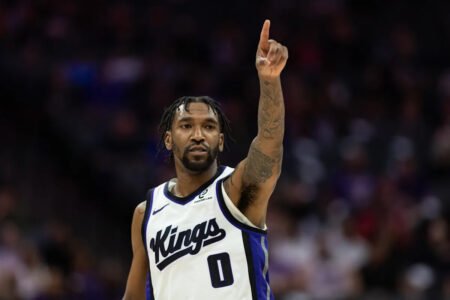
29. Seattle SuperSonics: DeMar DeRozan, Sacramento Kings
Contract: $25.7 million (2026-27)
Advertisement
I’m staring at Julian Phillips, who can’t get on the floor for the Minnesota Timberwolves, and Devin Carter, who is shooting a cool 25% from 3 for his career on the Sacramento Kings, and I’m not liking my plan to stay under the salary cap.
So, I’m pivoting. Screw it. I can go over the salary cap! The Spotrac tool — and, more importantly, the NBA — allows me to do it. We’ve got deep pockets in Seattle. And you know who I’ve always liked? DeMar DeRozan. He’s cool as hell, and still smooth with the ball. He knows what he is, and that is a midrange maestro. He used to do some pretty sweet dunks, too, but now he’s mostly a midrange maestro, and he’s cool with that. I’m cool with that. Do you, DeMar. He’ll get to his 20 points somehow.
Besides, you know what this organization needs right off the bat? A 20,000-point scorer. He is the yin on offense to Holiday’s yang on defense. They are my co-leaders, a pair of 30-somethings who command nothing but respect from every one of their teammates. They set the culture, where competition is fierce, the rotation is deep, and we’re just waiting on a superstar. For now, DeRozan isn’t such a bad substitute.
30. Las Vegas Neon: Rudy Gobert, Minnesota Timberwolves
Devine: I’m not going to lie: When we got down to the final two picks, and we learned that Spotrac’s draft tool would allow us to go over the cap, I was kind of perplexed. I didn’t think we could do that!
I later checked in with Keith Smith, Spotrac’s resident NBA cap guru, to make sure we hadn’t inadvertently broken the system. As he patiently explained to me, expansion teams are allowed to exceed the cap, just like any other team; it’s just that, since the expansion teams’ salary cap line would be lower than the rest of the league, so too would their luxury tax, first apron and second apron thresholds.
I did some back-of-the-envelope math based on the $132 million figure in the expansion draft tool used, and came up with a luxury tax line of about $160.4 million, with the first apron set at about $167.3 million and the second at $177.4 million — all of which “sounds about right” based on the projections, according to Smith.
With that in mind: If I don’t have to take Julian Phillips, the other unprotected player on the Wolves roster, and can instead take Gobert, who’s still patrolling the paint at a First Team All-Defense level — and who would go a long way toward establishing a serious infrastructure around and behind Zion. And if the only problem’s going to be that our scrappy little start-up expansion team actually enters its first season of existence not only over the cap, but over the first apron … well, why not? Maybe our ownership is committed to trying to compete right away! Maybe I’m a visionary!
|
Seattle SuperSonics |
Las Vegas Neon |
|
|
Round 1 |
Lu Dort |
Zion Williamson |
|
Round 2 |
Bennedict Mathurin |
D’Angelo Russell |
|
Round 3 |
Julian Champagnie |
Mo Diawara |
|
Round 4 |
Day’Ron Sharpe |
Ty Jerome |
|
Round 5 |
Jrue Holiday |
Al Horford |
|
Round 6 |
Jordan Walsh |
Johnny Furphy |
|
Round 7 |
Tidjane Salaun |
Fred VanVleet |
|
Round 8 |
Sandro Mamukelashvili |
Paul Reed |
|
Round 9 |
Marcus Smart |
Cody Williams |
|
Round 10 |
Jonathan Kuminga |
Max Strus |
|
Round 11 |
Spencer Jones |
Royce O’Neale |
|
Round 12 |
Jaden Ivey |
Ryan Nembhard |
|
Round 13 |
Goga Bitadze |
Ousmane Dieng |
|
Round 14 |
Cam Payne |
Keshad Johnson |
|
Round 15 |
DeMar DeRozan |
Rudy Gobert |
Or, y’know, maybe not. Maybe building a team around a bunch of injury risks, salty 30-somethings and unproven 21-year-olds wasn’t the best plan. If nothing else, though, my first (and perhaps final) draft in charge of the Neon was thematically appropriate: I arrived in Sin City with a budget in place … and promptly spent way more money than I was supposed to. Sounds like a pretty standard trip to Vegas to me.
Read the full article here