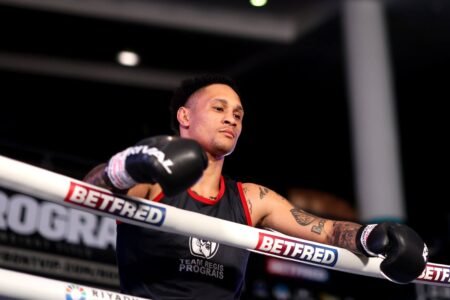

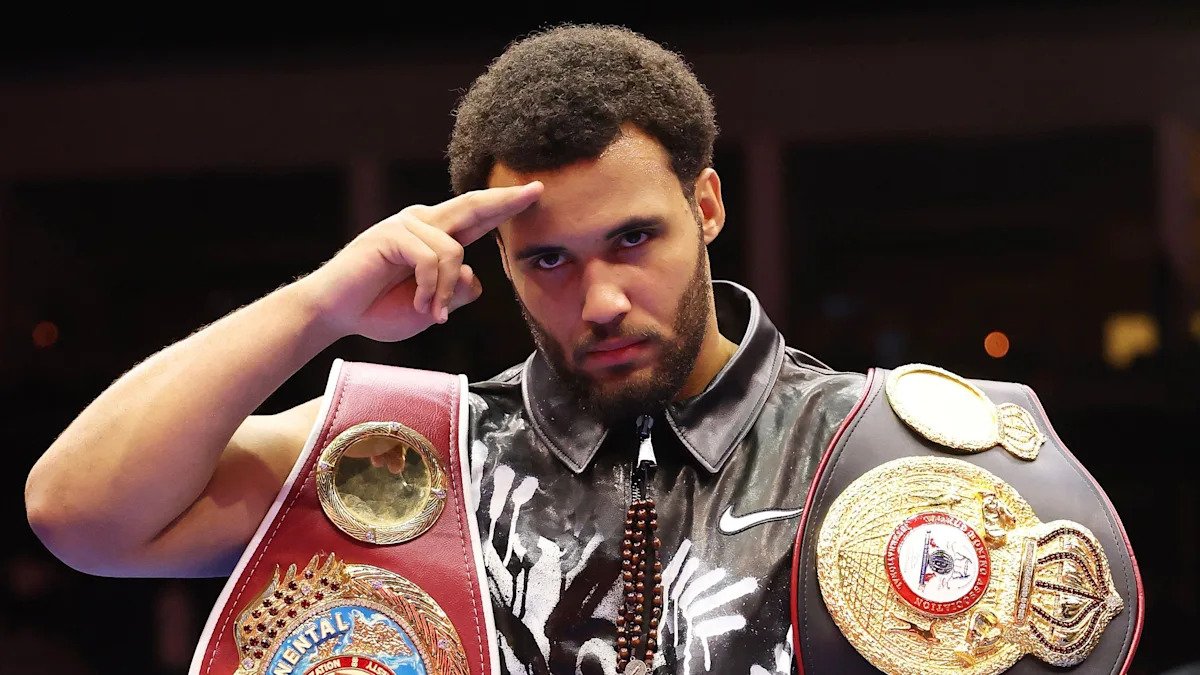
For Moses Itauma, success in the ring has come quickly.
But for the heavyweight prodigy, who only turned 21 in December, the search for identity lasted longer. That is until a trip towards the end of last year to Nigeria, his father’s homeland, where he realised the importance of his African heritage.
Advertisement
“This isn’t just my boxing, this is kind of my personal life,” he told BBC Sport Africa shortly after the visit to Akwa Ibom state in the south-east of the country.
“Some of the questions that I want to be answered are in my dad’s village. Why am I this type of way? Why do I look this type of way? Or why do I think this type of way?”
While Itauma fights under a British flag, he has a Slovakian mother and was also born in the East European nation. He has previously talked about the racist abuse he and his family suffered there when he was a child.
As he prepares for his delayed fight against American Jermaine Franklin in Manchester on 28 March, he says his first trip to Nigeria in well over a decade gave him a sense of belonging which he finds hard to fully articulate.
Advertisement
“I don’t know how to describe it. Something made me grateful just to be there.”
Love affair takes flight at Lagos Airport
It is easy to forget Itauma’s age. He is not overly tall for a heavyweight, but his hulking figure exudes power.
He has punched his way to a perfect record in 13 professional fights since January 2023, winning 11 by knockout, including most recently his first-round stoppage of Dillian Whyte in Saudi Arabia last August.
The way he speaks can sometimes be as blunt as the blows he delivers with his fists, but there is an underlying pride – and even a sense of surprise – as he recounts the tale of his recent arrival on Nigerian soil.
Advertisement
It seems the security staff at Lagos’ Murtala Muhammed Airport were keen to make friends with the self-described “modern-day gladiator”, asking him if he was a native after spotting his belts
“I said, yeah, my father is,” recalled Itauma. “[They said] ‘we’re proud of you’.
“They didn’t know my story, they don’t know what I’ve gone through, they don’t know what my mum’s been through, they don’t know nothing about me.
“But they said just because I’m Nigerian, I’m doing well, that they’re proud of me. That’s something I’ve never had anywhere else.”
Advertisement
Indeed, the contrast with Slovakia is stark.
“I was saying to my mum, nobody even shook my hand in Slovakia and said congratulations.
“I go to Nigeria as the same person and they treat me very well. And then my mum was like, ‘yeah, but that’s true Nigerians, they’re naturally happy, they’re naturally grateful’.”
British-Nigerian fighters look to their roots
Itauma is far from the only British-Nigerian fighter to return to his roots.
Anthony Joshua, who has an outline of the African continent tattooed on his arm, had made numerous trips to the home of his parents before the most recent ended in tragedy when two members of his coaching team died in the car crash in which the former world heavyweight champion was also injured.
Advertisement
Another former Team GB Olympian, Lawrence Okolie, promoted and headlined his own bill in Lagos in December, stating that he believes more Brits will follow his lead by stepping into the ring in Nigeria.
Itauma “100%” agrees, revealing he was “very surprised” by how good the production was when he visited a fight night there.
But could there be a more obvious commercial incentives?
Not according to Remi Aboderin, general secretary of the Nigeria Boxing Board of Control and president of the West Africa Boxing Union, who accompanied Itauma on his visit.
“There’s really no money to be made here in Nigeria,” he claimed.
Advertisement
“Rather, they are coming in and helping to propagate, broadening the Nigerian professional boxing scene, and then help bring in money through their sponsors to promote us and their Nigerian counterparts.
“And also connect to their Nigerian roots and get to know their cultural heritage.”
The fact that Itauma’s homecoming was promoted and filmed by a Nigerian betting firm suggests it might not all be altruistic.
Itauma fights for Great Britain but has a Nigerian father and was born in Slovakia to a Slovak mother [BBC]
Whatever the truth, the country’s “energy” certainly left its mark on the young fighter.
“I’m not saying it’s a competition because every country is unique, but when I came back from Nigeria I needed a rest for four or five days, just stayed in bed,” said the Commonwealth champion.
Advertisement
And the man who one day hopes to be world champion has a final story to tell to highlight his identity struggle, one linked to his time growing up in Chatham in south-east England following his move from Slovakia.
“I asked my secondary school teacher, what is it like to be black in Kent?
“He said, the thing is that being in this country (United Kingdom), take Anthony Joshua for example.
“When he’s doing well, when he won the Olympic gold medal, when he won the world titles, he was British. He was ours. As soon as he lost that fight, he’s the Nigerian boxer.
“Whereas, if you go to Nigeria, he’s loved. No matter if he won, lost, drew, whatever, he’s still loved.
Advertisement
“I think Nigerian boxers are seeing that and they want to reconnect or rekindle back with the motherland.”
Beat Jermaine Franklin this month and a world title shot will not be far away. Win that and Moses Itauma will likely find plenty of Nigerian support in his corner.
With additional reporting from Isaiah Akinremi in Lagos.

Read the full article here