


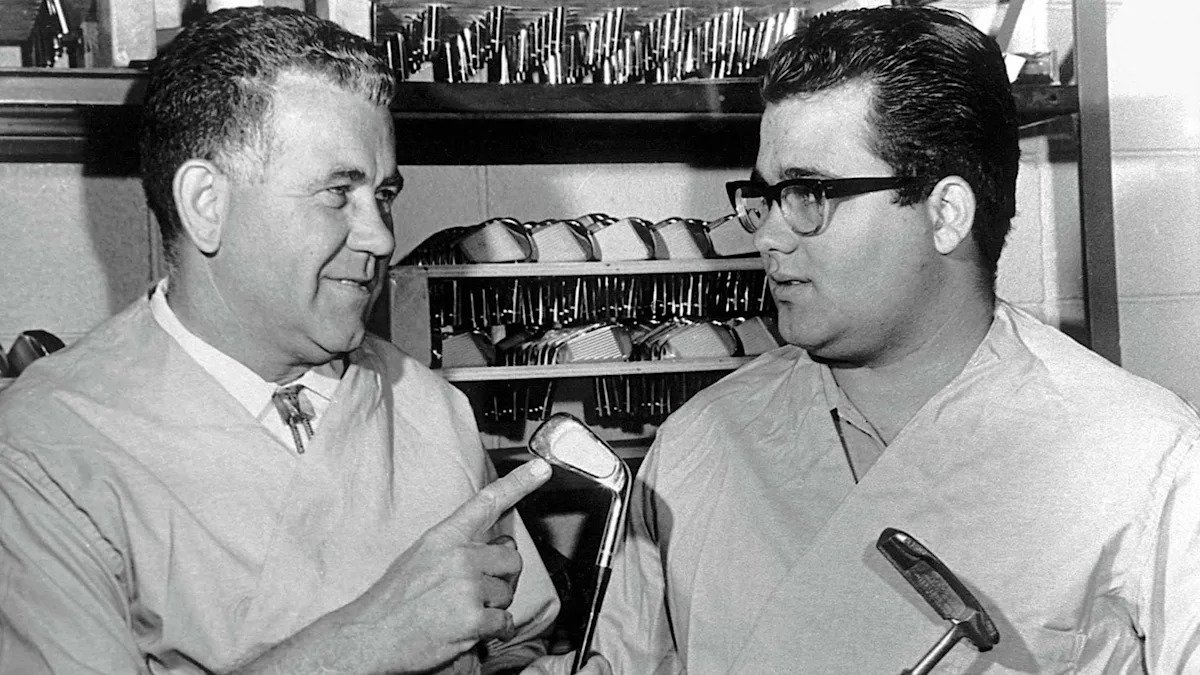
Karsten Solheim and a young John A., master clubmaker and extremely apt pupil.Courtesy Ping
Be careful with first love, my father once told me. It only comes once. That has to be true but I’m here to tell you: I got it right my third time around.
My first serious relationship was with a set of Wilson Staff irons, stamped Dynapower on their backs, with red dots on their soles, along with the words Fluid Feel. Wilson Staff was the crown prince of elite irons in the mid-1970s, and I saved up for months to buy this secondhand set for $100.
Advertisement
Later, I replaced them with a set of made-in-Japan PRGRs, blade irons with a dull matte finish, as handsome as a club could be, though part of the attraction was their space-age shafts, black graphite and chosen to match the player’s swing speed. These PRGRs cost a fortune but I was a bachelor and what else would I spend my disposable income on?
And then I fell for Ping. It wasn’t love at first sight. The courtship unfolded over time, during an extended honeymoon of a kind. (It had no ending date.) Christine and I were married in the fall of 1990, and in February 1991 we flew to France, where I had a one-week caddie tryout with an American journeyman on the European Tour, Peter Teravainen, a Yale grad with an economics degree and a mind that ran to numbers and logic.
It was a period of heightened awareness for me: Chris Isaak’s “Wicked Game” was playing in the cab we took to JFK; our Pan Am flight to Paris was choking in cigarette smoke. On our first morning in Saint-Raphaël, Christine gave me a ride from our sagging hotel to the course on the back of moped and through a misting rain. Breakfast was a chocolate croissant, out of a bag and still warm. Etc.
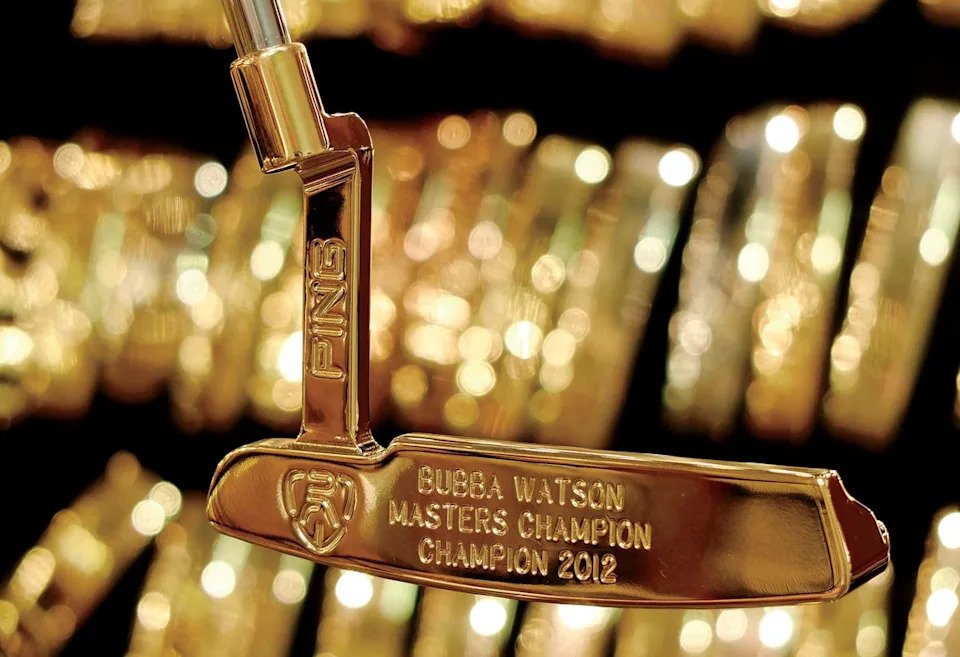
One of the flatsticks that glitters most in Ping’s Gold Putter Vault. Courtesy Ping
I met Peter. He had tiny teeth, a wide forehead and his pants were shiny with wear. His bag was filled with Ping irons, along with a Ping putter. His bag itself was a white staff bag with a single strap, stamped with his name on one side and Ping on the other. By my second week carrying it (got through the tryout with some adventure) the bag had a little dent on its side where my left hip nestled into it.
Advertisement
I caddied for Peter straight through summer, when the tour reached Scotland and Christine and I got off the bus. In those days, the European Tour still wintered on the Continent, in the southern parts of France, Spain, Portugal and Italy. Somewhere in those weeks I started leaving my toothbrush in the House of Ping. Part of the appeal was seeing Peter use his Ping clubs so effectively. (He was making cuts.) I’ve been playing Ping Eye2s, the model Peter played, pretty much since then.
The design of Ping’s irons and putters (the Ping Anser, the Ping Pal) were once considered radical. For decades, the clubs themselves were a testimony to the vision of Karsten Solheim, the company founder, who prized function over everything else. His irons had a wide sole, a high toe, a stubby hosel and a wild amount of offset. The company’s putters, its first product, were considered freakishly different when they made their debut. But Tom Watson made his Ping Pal putter look beautiful, simply by winning with it again and again. Tiger Woods did the same with his Anser 2, going back to his amateur days. In terms of shape and utility, the early Scotty Cameron putter line is a direct descendant of the early Ping putter line. You know what they say about imitation.
I met Karsten Solheim only once, on a tour of the Ping (Karsten Manufacturing) factory in Phoenix 30 years ago. Karsten was 84 and had recently handed the company keys to the youngest of his three sons, John A. Solheim. A small group of us entered Karsten’s office, with John as our tour guide. Karsten was bent over a drafting table like a doctor looking at an X-ray. I mentioned to Karsten my affection for the Eye2 and he said, “We never made a better iron.” The others were less than thrilled but that’s what he said. Karsten, per Forbes magazine, was one of the 400 richest Americans then but his motivation in business was not primarily money. It was the pursuit of better tools for golf. His super wealth flowed from that. He lived like the GE engineer he once was.
Some months ago, I shared Karsten’s long-ago comment about the Eye2 with Robin McCool, a retired Ping sales rep and an accomplished amateur golfer. Robin, while readily acknowledging Karsten’s devotion to the Eye2, offered this addendum: “But he also said this: ‘We’ve just started to scratch the surface.’”
Advertisement
Enter John A., scratching. He was 50 the day of that Ping factory tour, when the company was trying to promote an iron with John’s fingerprints all over it, the ISI. That club was never a top-40 superhit, but a year or two later John’s TiSI driver was. Now he’s 80 and Ping’s chairman.
For 30 years — from 1996 to 2026, from age 50 to age 80 — John has been a steward of what his father began and then some. The business is still family-owned. The company has steadily kept its number of employees at about 1,000 with low turnover. Intensely personal customer service is still a hallmark of the company.
But there has been notable change too. In the Karsten years, there were players who left Ping after winning majors, John Daly, Mark Calcavecchia and Bob Tway among them. They wanted the guaranteed payday that comes from being a star golfer, and Karsten, a stubborn Norwegian and a child of the Depression, despised the notion of pay-to-play. His system was a bonus pool, based on what you earned on the course. John changed that policy and thereby has kept Louis Oosthuizen, Bubba Watson and others in the Ping fold. John A.’s son, John K., now the company’s president and CEO, ran with a stunning realization: Visual and tactile elements of club design — the feel of it, its finish — does in fact influence performance. Somewhere, Karsten is stroking his little Col. Sanders beard in contemplative confusion, but this third-generation Solheim is surely correct. You do have to feel good about your club in every regard. To like a club, you have to like its look and feel.
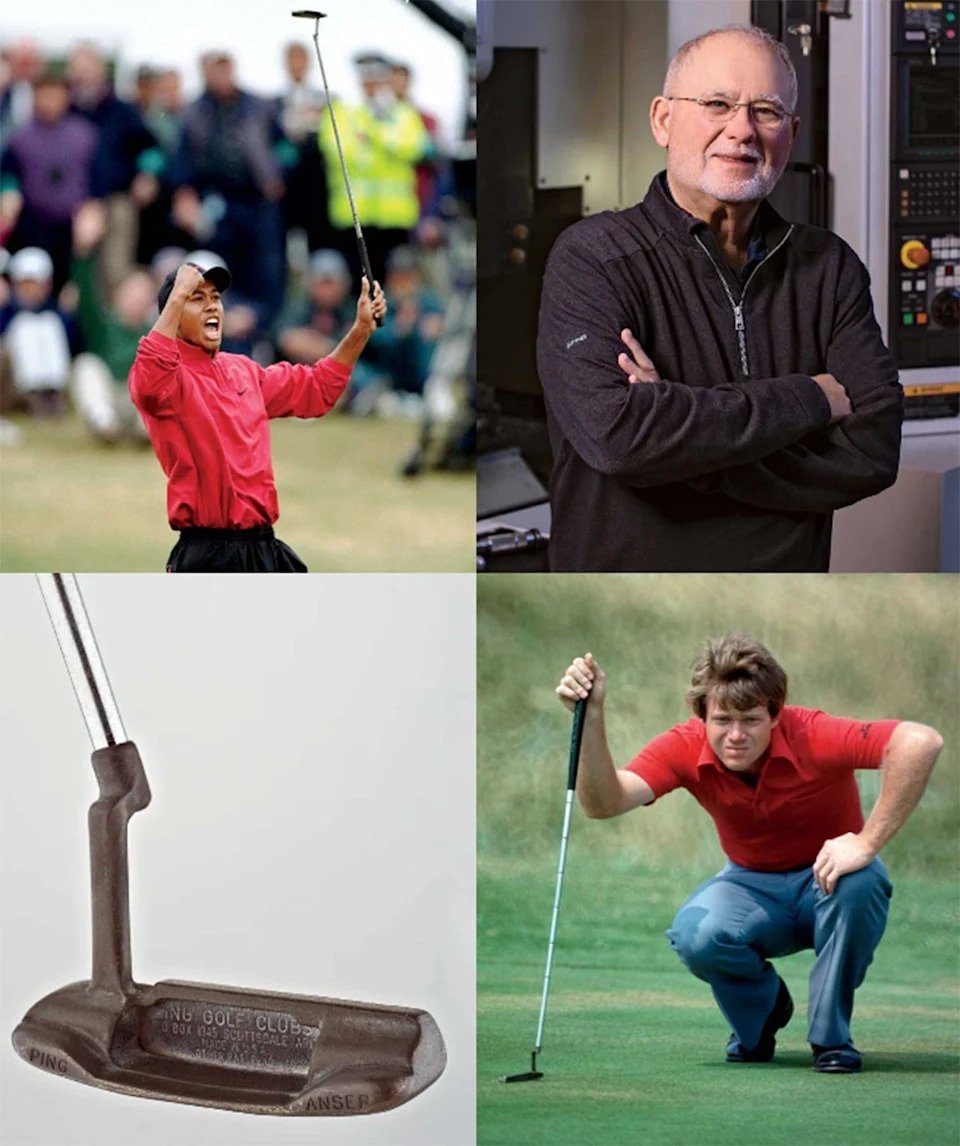
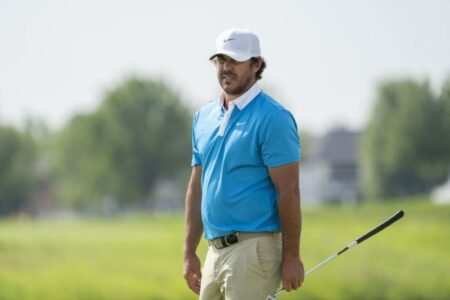
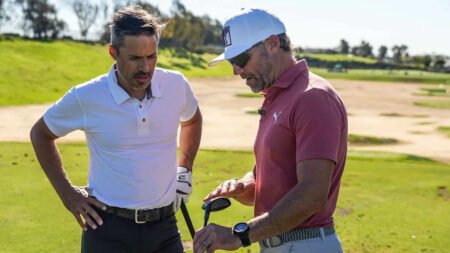
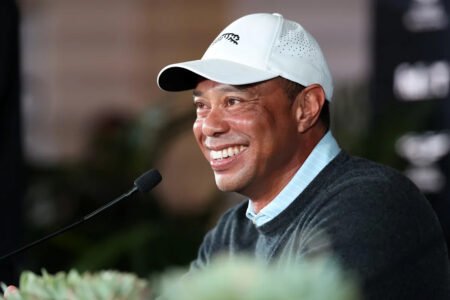
Clockwise from top right: John A. in 2022; Tom Watson and his trusty Ping Pal; an original Scottsdale Anser, circa 1966; and a pumped Tiger, Anser 2 in hand, in 1998. Getty Images (2); Mark Peterman; Courtesy Ping
I’m drawn to Eye2s because they work, because I know what I can do with them — and because I like their look and feel. The throwback Thursday statement they make appeals to me. I like the memories they stir: discovering Europe off the tourist trail; marriage in its early stages; Peter’s tendencies under tourney pressure. These things came later: the decent shots I have played with my Eye2s; the response of playing partners to these shots; the courses on which they were played.
Advertisement
I have a backup set, and a backup to the backup. There actually might be one more set somewhere. Steel and beryllium copper models, with black dots, for my fellow Ping-heads. (The black dot represents standard lie on the Ping fitting system with its color-coded chart.) Don’t tell me I’d shoot lower scores with other irons, because I don’t believe it and I don’t care.
Ping’s footprint is gigantic. You can see it in women’s professional golf. (The Solheim Cup, for starters.) Collegiate golf. (The Karsten course at Oklahoma State.) Left-handed golf. (Ping has always catered to lefties.) Senior golf. (Perimeter-weighted clubs make it easier to launch the ball.) Etc.
But my goal here is to offer a more personal tribute to Ping, and to John Solheim at 80. His family business (you’re tempted to say) is not a business at all, not in the conventional sense. Its ROI is commingled with our joy. As the company has gone from its Karsten era to John A. and now John K., it has held that notion close.
I have seen John A. Solheim, representing the second generation, dozens of times over the past 30 years, at Ryder Cups, British Opens, LPGA events, merchandise shows, in restaurants and hotel lobbies and at World Golf Hall of Fame inductions. (Karsten is a member.) He’s more fit at 80 than he was at 50. He’s out on the course at these events, strolling, watching carefully, typically with a friend or a family member or an employee. He’s always soft-spoken, unrushed, warm in his own austere way. On one occasion, I asked John if he was optimistic about the future of golf and he offered an unqualified yes.
Advertisement
“Golf is such a wonderful game,” he said. “It teaches you so much about life. There’s no game like it. To be able to play with friends, in beautiful conditions — this game has to grow.”
Michael Bamberger welcomes your comments at Michael.Bamberger@Golf.com
The post At Ping, it’s personal. That’s also true for those who play the clubs appeared first on Golf.
Read the full article here