


Every year around the time of the AT&T Pebble Beach Pro-Am, pictures of the course from the 1929 U.S. Amateur make the internet rounds, causing architecture buffs to swoon.
The photos show the greens—primarily those along the cliffs like four, six, seven and 17—buffeted by swaths of open sand and dunes-like vegetation as if they were transported from Ireland, or from the new Cypress Point Club just up the coast. They represent a tantalizing “what if,” and even though the look quickly faded out during the Great Depression the pictures tease the possibility of a restoration back to this weathered, links version of Pebble Beach that stands in contrast to the current program of holes rimmed in traditional rough and formal bunkers.
Advertisement
More from Golf Digest
Golf Digest Logo The award for Best Renovation of the Year has never been tighter. These were the best of 2025
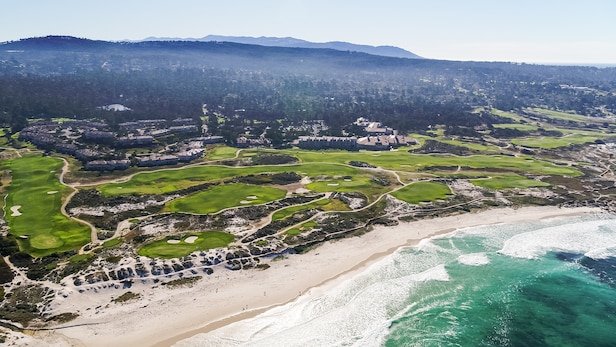
For a host of economic, environmental and practical reasons, that isn’t going to happen. But Pebble Beach Company is announcing perhaps the next best thing: A comprehensive remodel of The Links at Spanish Bay by Gil Hanse and Jim Wagner that will transform it into a more plausible sand-and-dunes links course that, along with Spyglass Hill, rounds out one of the country’s premier trifectas of public resort golf. Work will begin March 18 with plans for the new course to open in April 2027, a few months before Pebble Beach hosts its seventh U.S. Open.

/content/dam/images/golfdigest/fullset/course-photos-for-places-to-play/spanish-bay-pebblebeach.jpg
Opened in 1987, Spanish Bay has represented a different kind of “what if.”
Advertisement
It was built on roughly 200 acres of the Monterey Peninsula’s last available golf land. The setting, encompassing nearly a mile of Pacific Ocean frontage, puts it in a rare class of true seaside golf courses. Few people, however, believe the original design matched the site’s potential.
RELATED: The 18 best holes on the Monterey Peninsula
The sand-based property had been mined since the early 1900s for a glass manufacturing operation, depleting the natural resource. Ironically, over half a million cubic yards of sand had to be transported back onto the site to construct the course. The designers—Robert Trent Jones, Jr., seven-time major champion Tom Watson and the late former USGA president Sandy Tatum—conceived Spanish Bay as a Scottish links and their contractors used the imported sand to build up moguls, mounds, fairways, greens and dunes that laced through the property.
It was a laudable attempt to manufacture a coastal British links considering nothing like it had been attempted in the United States in 70 years, at least not to that degree. In one way they were manufacturing a concept, and a course, from scratch.
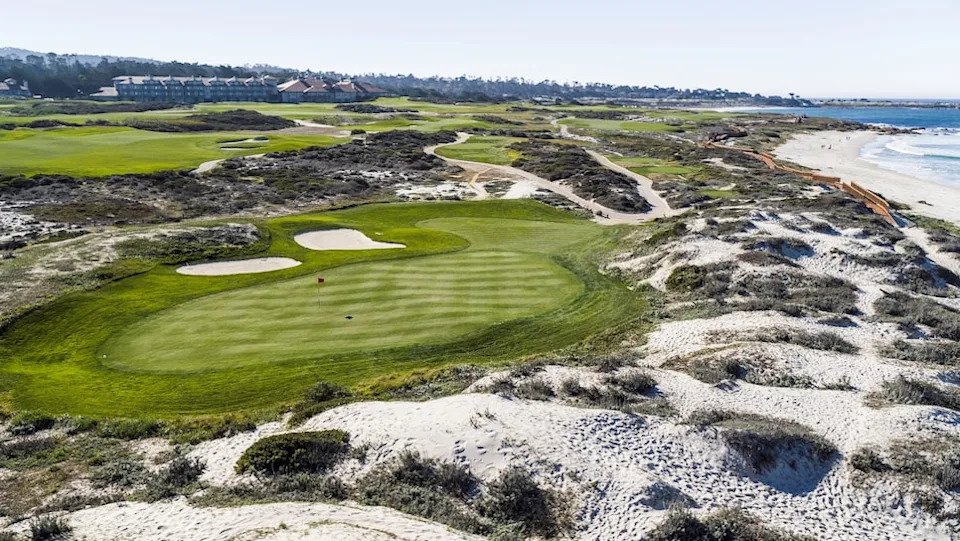
/content/dam/images/golfdigest/fullset/course-photos-for-places-to-play/spanish-bay-pebble-beach-sixteenth-hole.jpg
The playing surfaces, however, generally sat above the natural grade and often fought against the dunes and other landforms rather than blending into them. The fairways were narrow for such a windy site, and the green edges plunged into deep hollows and bunkers. Cart paths ribboned across the property, and it could be extremely difficult for regular golfers.
Advertisement
According to Pebble Beach Company CEO David Stivers, “Everybody liked playing Spanish Bay, but the problem for us was that it was an 1980s style golf course where harder was better.”
“The golf course is ‘of its time,’ ” says Hanse. “There was an era in golf architecture 40 years ago when this kind of design was the model and the standard for what they were trying to achieve. But we feel we have an opportunity to present a different vision for the land, something more natural that sits into the landscape softer.”
More from Golf Digest

Golf Digest Logo Why do so many new courses look the same?
The need for a total overhaul of its outdated infrastructure convinced the Pebble Beach Company that now was the time to reinvent Spanish Bay, presenting the best chance to maximize the phenomenal coastal piece of land it inhabits.
Advertisement
The Hanse/Wagner plan maintains most of the current routing, which Hanse believes utilizes the property well. The exception is the removal of the short par-3 13th, which will be incorporated into a new 500-yard par-4 13th playing through the same corridor toward a new greensite. The eliminated short hole will be replaced by a new par-3, the 185-yard 14th, with a green set in the same location as the former 14th.
The entire property will be reshaped between the dune lines with more gentle tie-ins, so that the fairways and greens sit closer to grade in the low, carpet-like manner of most British links. The greens and entrances will also be broadened and reshaped, many with supportive contours to help running shots bounce onto the putting surfaces. Overall, golfers will find much more space and forgiveness, and more opportunity to be creative with their shots.
Hanse says the current hole corridors already have enough width but play constrictively. “The way the course was shaped on the perimeter, there are all these mounds that are five to 10 yards wide that actually don’t help. If you hit on the outside of them, they repel the ball off the course,” he says. “So what are maybe 50-yard-wide corridors are effectively much narrower because there are these mounds on either side.”
More from Golf Digest

Golf Digest Logo America’s 100 Greatest Public Courses
Advertisement
Some of the course’s highlights will remain similar, including the risk-reward, corner-cut tee shot on the par-4 third and the lovely greensite of the 12th, set in a wooded glen across a barranca.
And the dunescapes of the original design, Hanse says, “are spectacular. If we can figure out a way to plug the golf holes into them, I feel pretty excited about the potential.”

/content/dam/images/golfdigest/fullset/course-photos-for-places-to-play/spanish-bay-pebble-beach-eighth-hole.jpg
Because the routing is tight and the property is relatively level, it would make sense for the resort to designate Spanish Bay as walking-only in the manner of Bandon Dunes. That would help create a distinctive identity among the resort’s other two courses and play directly into its links aspirations. But carts are in demand for Pebble Beach guests, so the best Hanse and Wagner can do is to reduce the cart-path footprint and convert the concrete ribbons to more organic, less visible materials.
Advertisement
One curious decision is the use of rye grass in the fairways (the greens and surrounds will be bent). Rye, the grass used at Pebble Beach and Spyglass Hill, typically thirsts for water and is a deeper color of green than the fescues or bent/fescue blends typically associated with coastal links.
In fact, the course opened with fescue-mix fairways, but 1980s golfers weren’t ready to accept the brownish hues and tight lies, and they were soon converted to rye. That choice of grass would seem at odds with the intent of maintaining fast, running surfaces.
Hanse thinks it can work. “We’re hopeful we can get the soil structure right so we can get them to play ‘droughty,’ ” he says, “and the irrigation and water restrictions should help with that.”
RELATED: 6 new courses on our bucket list for 2026
Advertisement
When Spanish Bay was built, the development had to run through a gauntlet of environmental protections and oversight put in place by the California Coastal Commission. The Commission has also worked closely with the Pebble Beach Company on the remodel, though the success of those original guidelines that helped create a sanctuary for wildlife and native coastal plants (the resort planted over 100,000 native species annually in the early years) has streamlined the process.
In addition to preserving what exists away from the golf, the remodel will reduce the overall amount of irrigated turf by 12 percent, and a modernized irrigation system will also allow the club to more closely monitor and control water usage.
“We’re actually giving more land back to the environmentally sensitive areas through turf reduction and other means than we’re taking away,” Stivers says.
More from Golf Digest
Golf Digest Logo The Fall Line is golf’s next great exclusive club—and our experts got a first look
Advertisement
The ultimate goal is for Spanish Bay to approach the level of acclaim Pebble Beach and Spyglass Hill enjoy, both stalwarts on the America’s 100 Greatest Courses ranking.
“If we’re successful, our guests will want to play Spanish Bay as much as they do our other two golf courses,” Stivers says, noting that the course’s utility rate (percentage of tee times filled) is in the low to mid-80s compared to the mid-90s for Spyglass and near 100-percent for Pebble Beach. “And if they feel that way, they’ll stay longer and eat in our restaurants more often. The revenue potential for that is significant.”
Hanse, who has placed three courses on the 100 Greatest ranking this decade (Ohoopee Match Club, CapRock Ranch and Ladera), sees similar potential at Spanish Bay. Stivers also believes rankings matter.
“We want Spanish Bay to be in the conversation,” Stivers says. “We want it to be in the conversation about the better public golf courses on the West Coast and in the United States. So, if we’re in that mix and people are talking about it the same way they talk about Spyglass, or Pasatiempo, or the Bandon Dunes courses, then that will be a success for us.”
Advertisement
More from Golf Digest

Golf Digest Logo The 50 greatest courses built since 2000
Explore Golf Digest’s new Course Reviews section where you can submit a star rating and evaluation on all the courses you’ve played. We’ve collected tens of thousands of reviews from our course-ranking panelists to deliver a premium experience, which includes course rankings, experts’ opinions, bonus course photography, videos and much more. Check it out here!
Read the full article here