


Two weeks ago, it would have been easy to write off the Senators.
After blowing multi-goal leads to the Montreal Canadiens and Nashville Predators within a few days, the prospect of reaching the postseason seemed far gone.
Advertisement
Now, after the Senators won five of their last six games, beating Vegas, Colorado, New Jersey, Pittsburgh, and Philadelphia, their postseason hopes do not feel as fleeting, even after the Senators’ disappointing loss to the Carolina Hurricanes earlier this week.
By beating the Philadelphia Flyers on Thursday night, the Senators now sit six points back of the Boston Bruins and the Eastern Conference’s second wild card seed.
Moneypuck currently lists the Senators’ postseason odds at 40.4 percent, but what is really encouraging is that, for all of the talk about the strength of schedule and the Senators’ difficult slate of games to conclude the season, the Bruins have it worse.
According to Tankathon, only the Pittsburgh Penguins have a more difficult schedule than the Bruins. Their remaining opponents have a combined points percentage of .586, while the Senators have the ninth hardest schedule (.573).
Advertisement
There is still ground to cover, and the team will obviously need to win the majority of the games, regardless of opponent quality, but all that matters is that the Senators are within striking distance.
With just four games left before the NHL’s trade deadline on Friday, March 6th, general manager Steve Staios is in an intriguing predicament.
So, what will he do?
Sportsnet’s Elliotte Friedman had a “theory.”
“I have a theory about what they’ve been trying to do, but it’s something I have to check because they were mad at me a couple of weeks ago,” Friedman explained. “I’ll just let them calm down before I make them mad at me again.
Advertisement
“I don’t want to make any wild guesses, but I have a theory about what they’re looking at. We have talked about this. Remember Alex Anthopoulos going out to get David Price because their run differential was good, even if their record wasn’t.
“(The Senators’ goal differential is) plus seven. You look at the teams that are out of the playoffs right now, as we wake up on Tuesday morning in the Eastern Conference, the third-best team, Columbus, has made a great run of it under (Rick) Bowness. They’re minus five. Washington’s plus 12, and they’re right there. Ottawa’s plus seven. Everybody else, Florida, Toronto, Philly devils, Rangers, they’re in the double digits. Minuses, I think they are trying to do something there in Ottawa and a couple of other things.”
The Blue Jays analogy is interesting because of the commonality. The Senators’ record is not indicative of their greater play.
Staios has assembled a competitive team that has posted some incredibly strong underlying numbers.
Advertisement
Heading into Thursday night’s game in Philadelphia, only the Colorado Avalanche, Tampa Bay Lightning, and Carolina Hurricanes have posted a higher five-on-five expected goals percentage (xGF%) than the Senators’ 54.41 xGF%. And, according to Natural Stat Trick, the Senators are one of the best teams in the league when it comes to suppressing the shots and chances the opposition creates.
-
51.37 shots allowed per 60 (CA/60), 2nd
-
23.55 shots on goal allowed per 60 (SA/60), 3rd
-
2.25 expected goals allowed per 60 (xGA/60), 1st
Unfortunately, Ottawa’s shortcomings have undone what has been a collectively strong defensive effort. Recognizing that and wanting to give his players an opportunity, if the Senators can address their shortcomings and get some saves, they could push for a playoff berth and be an undesirable opponent if they get in.
The difficulty for Staios is that the Senators’ farm system is not exactly laden with safely projectable blue-chip prospects beyond Carter Yakemchuk. It is a problem compounded by the lack of a 2026 first-round pick.
This lack of surplus prospect capital puts Staios in a delicate position. There is absolutely something to be said about the quality of the Senators’ young core and the complications that stem from the fact that Drake Batherson (UFA in 2027), Brady Tkachuk and Thomas Chabot (UFAs in 2028) are eligible to test unrestricted free agency within the next two years.
Advertisement
This is not intended to instill fear in the fan base that any of these players will leave. They could, but they could just as easily sign extensions in belief of what the organization is building here. The problem is that their next contracts will likely be more expensive, and despite the cap ceiling going up, the more money spent on players already in the fold, the more challenging it becomes to insulate them with higher-quality, and often more expensive, talent.
As loath as Steve Staios may be to move considerable draft capital to push this group forward while some of his better players are on relatively cheap deals, he may look at this window and decide to push his chips in as Anthopoulos did with the Blue Jays at the 2015 trade deadline.
If Friedman’s “theory” holds true, Staios will look to address this team’s weaknesses.
The Senators’ goaltending has put their season in jeopardy.
Advertisement
Through 57 games played, the Senators’ all situations .868 save percentage is the worst in the NHL. Leevi Merilainen has the second-worst goals saved above expected metric (-14.22 GSAx) in the league behind Jordan Binnington, while Linus Ullmark has the fourth-lowest (-7.50 GSAx).
The Minnesota Wild have spurred rumours by reportedly dangling the highly regarded Jesper Wallstedt as a trade chip. With former Senator Filip Gustavsson inked to an inexpensive long-term deal, it makes sense for the Wild to use this young asset to address a position of weakness on their roster: the centre position.
The presence of Dylan Cozens, Ridly Greig and Shane Pinto as depth options behind Tim Stützle certainly gives the organization the flexibility to consider making a move, but admittedly, making a trade of that magnitude feels like something the Senators would be better served to do in the offseason. Similarly, if the Senators were to acquire a future number one in Wallstedt while Ullmark is signed for another three seasons, it would inevitably raise questions about the veteran’s long-term future in Ottawa.
What would make more sense for the Senators right now is to address the right defence position.
Advertisement
After undergoing a hip resurfacing procedure during the offseason, the hope was that Nick Jensen could eventually resemble the player he was for the first three months of the 2024-25 season.
Even though he returned faster than anyone anticipated, it may have been naive to believe that the 35-year-old defenceman could get back to that level.
The 2025-26 season has been a struggle for the defenceman.
In 54 games, Jensen has compiled four goals and 15 points. In the 844 minutes that Jensen has played at five-on-five, the Senators have generated 47.52 percent of the shots (CF%), 49.32 percent of the shots on goal (SF%), 44.09 percent of the total goals (GF%), and 49.39 percent of the expected goals (xGF%) per Natural Stat Trick.
Advertisement
HockeyViz’s isolated impacts for Jensen are not particularly flattering either.
Hockeyviz.com
Evolving-Hockey’s data shows that of all the defensive pairings in the league that have logged more than 400 minutes together at five-on-five, Chabot and Jensen have the fifth-highest goals allowed per 60 rate.
Ottawa’s goaltending certainly impacts those numbers, but in smaller sample sizes, the metrics when Jensen has played with Tyler Kleven and Jake Sanderson have not been strong either.
Of the 404 defensive combinations around the league that have two defencemen log 50 or more minutes of ice time together, no pairing has allowed a higher rate of goals allowed per 60 than Sanderson and Jensen. Kleven and Jensen? They have the eighth-highest rate.
Advertisement
Considering the strength of the Senators’ underlying metrics and their staunch structural play, Jensen’s metrics reflect a significant departure from the rest of the defencemen. And, with 25 games left in the season, the organization may simply have to come to terms with the likelihood that this is the post-surgery version of the player.
If the Senators are serious about improving the roster, the easiest way to do it would be to find an upgrade on right defence.
A pipe dream target would be a staunch defensive defenceman like Colton Parayko, but the Senators have been linked to MacKenzie Weegar. The return of Dylan DeMelo would also make sense on several levels, but if the Senators are looking for an inexpensive option, impending unrestricted free agent defenceman Connor Murphy might be a strong fit.
There will be no shortage of names on Staios’ wish list before March 6th, but the list of NHL sellers is short, and the price for a right-shot defenceman may be steep. So finding a sensible deal that meaningfully improves the Senators’ playoff chances is far easier said than done.
Advertisement
By Graeme Nichols
The Hockey News
Senators Head Coach Travis Green Has Changed The Conversation In Ottawa
Stutzle’s Overtime Goal Gives Senators 2-1 Win At Philadelphia In Pre-Olympic Finale
Senators Trade Deadline History: Key Deals of the Last Decade
NHL Insider Says Senators Aren’t Happy With Him
The Hardest Shot In The NHL This Season Belongs To An Ottawa Senator
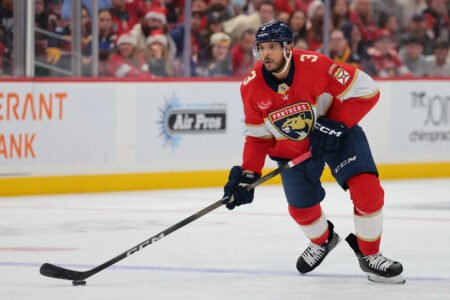
Imagn Images photo montage: Left to right, Colton Parayko, MacKenzie Weegar, Dylan DeMelo, and Connor Murphy.
Read the full article here