


Spring training is just around the corner, and fantasy baseball drafts are kicking into gear. That means it’s time to start diving into our positional rankings for the 2026 fantasy baseball season. We’re going to kick things off with the big boppers over at first base.
Last season, there were 17 first basemen who earned at least $10 of value, according to Fangraphs’ Player Rater. That was the most for any infield position, which hints at the depth we have at first base. Some of that is the old stalwarts like Freddie Freeman, Matt Olson, Bryce Harper, Vladimir Guerrero, Pete Alonso, and Yandy Diaz. However, we also had young players like Nick Kurtz, Vinnie Pasquantino, Michael Busch, and Tyler Soderstrom emerge as consistent producers this season.
Advertisement
When you add to that, players like Rafael Devers and Willson Contreras gaining first base eligibility, this is probably the deepest the position has ever been, and we haven’t yet talked about Christian Walker, who is coming off of a down year, Spencer Torkelson, who made the most of his second chance, and Ben Rice, who figures to get a chance to be the everyday first baseman for the Yankees now that they have moved on from Paul Goldschmidt.
As it stands, all is well with the first base landscape, and while it’s tempting to try and lock in one of the elite bats at the position, this might be the best position to wait on in drafts and still find value with a middle-round starter. So, who could some of those options be?
Coming soon: MLB returns to NBC and Peacock in 2026! In addition to becoming the exclusive home of Sunday Night Baseball, NBC Sports will broadcast MLB Sunday Leadoff, “Opening Day” and Labor Day primetime games, the first round of the MLB Draft, the entire Wild Card round of the postseason, and much more.
⚾ 2026 Fantasy Baseball First Base Rankings
** Rotoworld staff consensus rankings **
|
Rank |
Player |
Pouliot |
Samulski |
Schiano |
Short |
Montanez |
Bissell |
Shovein |
Crawford |
Consensus Avg |
|---|---|---|---|---|---|---|---|---|---|---|
|
1 |
Guerrero Jr., Vladimir |
1 |
3 |
2 |
1 |
1 |
1 |
4 |
1 |
1.75 |
|
2 |
Kurtz, Nick |
2 |
1 |
1 |
3 |
3 |
2 |
1 |
2 |
1.875 |
|
3 |
Alonso, Pete |
3 |
2 |
3 |
2 |
2 |
3 |
6 |
5 |
3.25 |
|
4 |
Harper, Bryce |
4 |
5 |
5 |
4 |
4 |
5 |
7 |
6 |
5 |
|
5 |
Freeman, Freddie |
5 |
6 |
7 |
7 |
6 |
7 |
3 |
3 |
5.5 |
|
6 |
Olson, Matt |
8 |
4 |
6 |
5 |
5 |
6 |
5 |
8 |
5.875 |
|
7 |
Devers, Rafael |
12 |
7 |
4 |
6 |
7 |
4 |
8 |
4 |
6.5 |
|
8 |
Naylor, Josh |
10 |
9 |
12 |
9 |
9 |
9 |
2 |
7 |
8.375 |
|
9 |
Pasquantino, Vinnie |
7 |
8 |
8 |
12 |
8 |
10 |
9 |
9 |
8.875 |
|
10 |
Soderstrom, Tyler |
9 |
11 |
9 |
11 |
10 |
11 |
11 |
10 |
10.25 |
|
11 |
Rice, Ben |
11 |
10 |
11 |
8 |
11 |
8 |
19 |
12 |
11.25 |
|
12 |
Busch, Michael |
16 |
12 |
14 |
10 |
12 |
13 |
14 |
11 |
12.75 |
|
13 |
Diaz, Yandy |
15 |
13 |
10 |
14 |
13 |
14 |
12 |
16 |
13.375 |
|
14 |
Stewart, Sal |
6 |
17 |
15 |
17 |
19 |
15 |
10 |
18 |
14.625 |
|
15 |
Perez, Salvador |
17 |
15 |
16 |
13 |
16 |
12 |
24 |
13 |
15.75 |
|
16 |
Contreras, Willson |
14 |
14 |
13 |
15 |
17 |
16 |
23 |
15 |
15.875 |
|
17 |
Torkelson, Spencer |
19 |
19 |
20 |
18 |
18 |
18 |
17 |
14 |
17.875 |
|
18 |
Aranda, Jonathan |
25 |
18 |
17 |
16 |
15 |
17 |
20 |
17 |
18.125 |
|
19 |
Walker, Christian |
25 |
25 |
18 |
19 |
14 |
19 |
13 |
19 |
19 |
|
20 |
Burleson, Alec |
13 |
16 |
19 |
20 |
25 |
25 |
16 |
20 |
19.25 |
ALL THE PROJECTIONS YOU SEE BELOW ARE COURTESY OF OUR OWN MATTHEW POULIOT
Advertisement
⚾ 2026 First Base Projections and Previews
1) Vladimir Guerrero Jr – Toronto Blue Jays
2026 Outlook: Vladimir Guerrero Jr. is an elite hitter, but he finished as the 5th-ranked first baseman in 2025, behind Pete Alonso, Josh Naylor, Nick Kurtz, and Rafael Devers. Most of that can be attributed to a step back in power. Vlad hit .292 and continues to hit the ball incredibly hard, but his fly ball rate remains under 33%, which has always made it hard for him to reach his power ceiling. At this point, he probably isn’t changing who he is as a hitter. He’s going to push a .300 average with around 25 home runs and has the potential to top both 90 runs and RBI in a good lineup. However, he’s not going to steal many bases, and the power ceiling is something you need to plan around with the rest of your roster. Getting only 25 home runs from your 1B means you have to prioritize power in other places in your draft, but that’s a plan that can work.
2026 projection: (Mixed $38): 602 AB, 104 R, 30 HR, 101 RBI, 7 SB, 35 2B, 1 3B, .304/.388/.515
Advertisement
2) Nick Kurtz – Athletics
2026 Outlook: Nick Kurtz was the fourth pick in the 2024 MLB Draft and had played just 12 minor league games before the Athletics sent him to Triple-A to begin the 2025 season. It seemed like an incredibly aggressive promotion, but Kurtz responded by crushing Triple-A pitching for 20 games and forcing his way into a promotion. In his first 28 MLB games, he hit .245/.315/.447 with five home runs and a 33.3% strikeout rate. It wasn’t a terrible start, but it certainly didn’t indicate that he would catch fire as quickly as he did. From June 1st on, Kurtz hit .304/.403/.669 with 31 home runs and 71 RBI in 89 games. He did strike out 30% of the time, but that’s always going to be a part of his game. He doesn’t chase outside of the zone, so he’s not going to get himself out, which will help to mitigate some of his swing-and-miss risk. He’s still just 22 years old and will play another season in hitter-friendly Sacramento with a young and improving lineup around him. It’s hard not to get excited about his future.
2026 projection: (Mixed $35): 555 AB, 103 R, 41 HR, 99 RBI, 4 SB, 32 2B, 2 3B, .270/.370/.557
3) Pete Alonso – Baltimore Orioles
2026 Outlook: Pete Alonso had his best season yet in 2025, setting career highs in batting average, plate appearances, and barrel rate while posting his sixth straight full season with at least 34 home runs. In non-COVID seasons, Alonso averages 41.3 home runs per season, which is tremendous consistency and value from a power standpoint. The big reason why his fantasy value jumped last year, in addition to hitting behind Juan Soto and driving in 126 runs, was that Alonso went to a more all-fields approach and trusted his power to play regardless. He had the lowest pull rate of his career and the lowest fly ball rate of his career, instead focusing on hard line drives. That approach should help him in his move to Camden Yards, where he will hit in the middle of an order that lacks a Juan Soto but is deeper than what the Mets put out last year. The new park may also help him from a base hit perspective and stave off some batting average regression.
Advertisement
2026 projection: (Mixed $34): 594 AB, 92 R, 40 HR, 119 RBI, 2 SB, 30 2B, 1 3B, .261/.340/.517
4) Bryce Harper – Philadelphia Phillies
2026 Outlook: Are we seeing a moderate decline from Bryce Harper? He will be 33, and his batting average has fallen each of the last three years. His batting average and OPS have dropped for three years in a row, with his OPS falling to .844, which was his worst mark since 2016. His barrel rate rebounded slightly from 2024 but is still below his peak, and his line drive rate was the second-lowest of his career. This doesn’t mean Harper will be bad, but his swinging strike rates are up, and his raw power numbers are down, with last year also being his lowest maxEV since 2016. This may be who Bryce Harper is right now, a .270 hitter with 25+ home runs and 10 steals in a pretty good lineup, but unlikely to play over 145 games. You’re fine with that production on your team, but you don’t need to reach for it.
2026 projection: (Mixed $18): 533 AB, 88 R, 30 HR, 84 RBI, 12 SB, 31 2B, 1 3B, .270/.366/.501
Advertisement
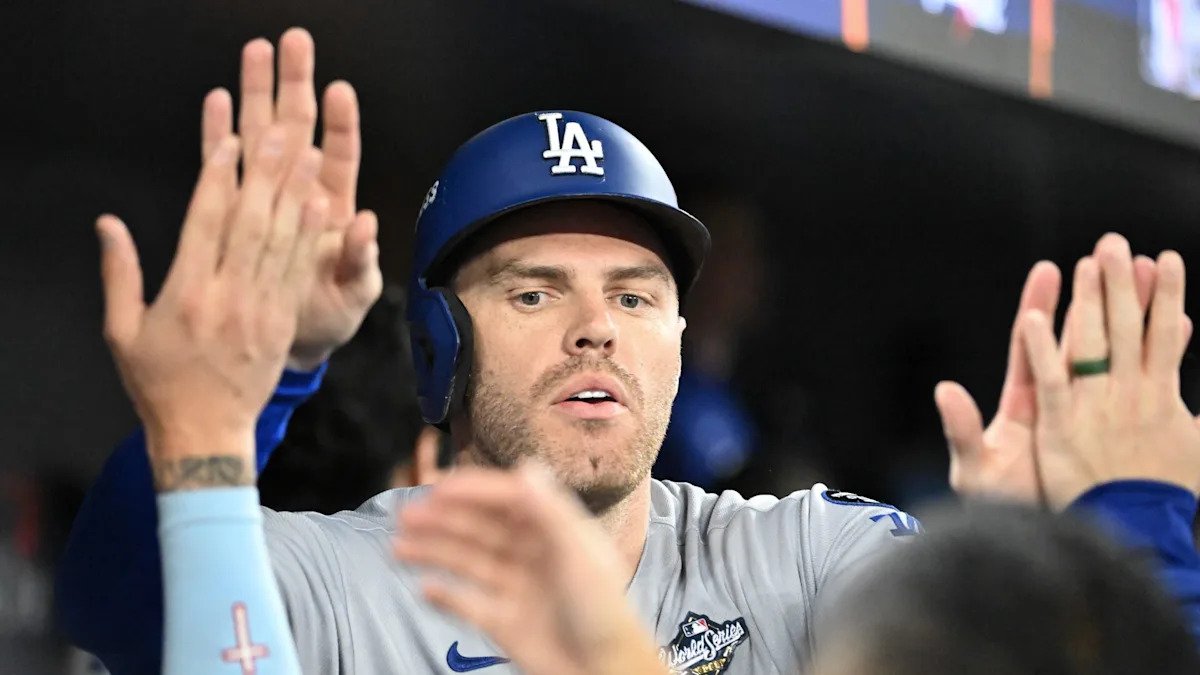
5) Freddie Freeman – Los Angeles Dodgers
2026 Outlook: Will age ever catch up with Freddie Freeman? The team context is great, and the results have been there. Last year, he basically gave you the same production as Vladimir Guerrero Jr. for far less of a draft cost. The 36-year-old played in 147 games last year, marking the seventh straight non-COVID season that he has played in at least that many. He also has nine straight years with at least 20 home runs and at least a .282 batting average. Freeman also posted his second-highest barrel rate since 2021 and his highest maxEV since 2016, so the raw power numbers are still there. I know people want to get off the train before it stalls and don’t want to draft Freeman when he finally craters, but I don’t see any signs that it’s going to happen next season. He should continue to hit in the middle of the order of perhaps the best lineup in baseball, and that provides a lot of value.
2026 projection: (Mixed $15): 572 AB, 89 R, 24 HR, 91 RBI, 6 SB, 34 2B, 1 3B, .281/.368/.470
6) Matt Olson – Atlanta Braves
2026 Outlook: Our consensus rankings may be a bit low on Matt Olson. Yes, we’re now three years removed from the last time Olson topped 30 home runs, but he just posted his second-best exit velocity ever and registered a 14.3% barrel rate that’s his second-best mark since 2019. His fly ball rate dropped, and groundball rate increased, which may have impacted the home run totals, but we’re talking about just 3%, so it’s not a major change. He chased less outside of the zone and had his second-lowest swinging strike rate ever, so I don’t think the batting average was a major fluke. This Braves offense is going to be better in 2026, and Olson could push for a .260 average while hitting in the middle of it (I know our projections disagree). He won’t steal bases, but you could get 30 home runs and 90+ runs and RBI, so I’m not entirely sure why that’s a profile people aren’t more interested in drafting.
Advertisement
2026 projection: (Mixed $10): 588 AB, 95 R, 31 HR, 89 RBI, 1 SB, 32 2B, 1 3B, .248/.351/.464
7) Rafael Devers – San Francisco Giants
2026 Outlook: After all that drama in Boston, Rafael Devers is now first base eligible, which is the role he figures to occupy for much of the 2026 season. The bigger question is what impact Oracle Park will have on him. Devers was somebody who often went to the opposite field in Boston, using the Green Monster to his advantage, so he struggled initially when he had to change his approach in San Francisco. Overall, Devers hit .236/.347/.460 with 20 home runs in 90 games with the Giants, striking out 29.4% of the time and pulling the ball 45% of the time, which is 8% higher than his career average. He did make tons of hard contact, so the power and counting stats should remain solid, but there are legitimate questions about whether or not the 29-year-old can shift his approach so drastically and still maintain his .276 career batting average while playing in San Francisco.
2026 projection: (Mixed $8): 574 AB, 86 R, 28 HR, 88 RBI, 2 SB, 30 2B, 1 3B, .256/.348/.458
Advertisement
8) Josh Naylor – Seattle Mariners
2026 Outlook: What a wild season for Josh Naylor. We knew his 31 home run season in 2024 was fluky, but he found new ways to produce fantasy value by improving his batting average and shattering his career-high in stolen bases. Without making a drastic change in approach, Naylor saw a huge increase in his batting average, which sounded a few alarm bells. He was a bit more aggressive outside of the zone, but his contact rate was identical to 2024. He did see more pitches in the zone, so perhaps being in a deeper lineup helped him, but his pull rates and fly ball rates were all pretty similar to 2024, while he also posted his lowest full-season barrel rate since his rookie year. It’s hard to see Naylor keeping up this .290-plus batting average, and his previous career-high in steals was 10, so stealing 19 bases in just 54 games with the Mariners is doing a lot of heavy lifting with his fantasy value this year. He seems like a clear regression candidate, but could still provide top ten value at the position.
2026 projection: (Mixed $9): 568 AB, 73 R, 24 HR, 91 RBI, 14 SB, 30 2B, 0 3B, .259/.321/.438
9) Vinnie Pasquantino – Kansas City Royals
2026 Outlook: We finally saw some high-end power from Vinnie Pasquantino to pair with his typically strong batting average. Even before we knew that the Royals were going to be moving the fences in at Kauffman Stadium, I was buying into that being repeatable. Pasquantino has always had an elite approach at the plate with strong contact rates and few whiffs. On the surface, little changed with his approach. His chase rates, overall swing rates, pull rates, and fly ball rates all seem almost identical. However, there were a few minor changes that allowed him to increase his barrel rate by nearly 4% and his HR/FB% by over 4%. For starters, Pasquantino was more aggressive early in the count, falling behind in the count less. He also raised his launch angle slightly and meaningfully increased his Pull Air%, meaning that even if he didn’t put the ball in the air much more often, he did pull it more often when he got it in the air. Pair that with an increase in bat speed, and you start to see how the power gains were real. Maybe 32 home runs isn’t in the cards in 2026, but he should at least push for 25 while hitting in the middle of a solid lineup that could see him top 100 RBI again. That’s a profile that works in all leagues.
Advertisement
2026 projection: (Mixed $12): 598 AB, 81 R, 30 HR, 96 RBI, 1 SB, 30 2B, 1 3B, .264/.324/.468
10) Tyler Soderstrom – Athletics
2026 Outlook: Tyler Soderstrom started the season on fire, and the perception is that he cooled off after April, but that’s not entirely true. Yes, most of his power came in the first 30 games of the season, when he hit .284 with nine home runs and 24 RBI, and, yes, his next two months were a struggle, but from July 1st on, Soderstrom hit .305/.351/.530 with 11 home runs and 46 RBI in 72 games. That’s not somebody who just had one strong month or one hot stretch. Soderstrom also showed real gains with his plate discipline, not becoming more passive but being more intentional about what he swung at. His overall swing rate remained the same, but he improved his contact rate by over 6% and cut his swinging strike rate by 3%, down to just 10.8%. Yes, it would be nice to see him lift the ball more regularly, but he posted an 11.4% barrel rate and has the bat speed to do real damage. Given that he’s going to play another season in Sacramento, we should expect his power to play even without an approach change, but there’s a real chance he can surpass 30 home runs if he pulls the ball in the air a bit more. Another way to look at it is that he has slightly more raw power than Vinnie Pasquantino and slightly worse plate discipline, but plays in one of the best home parks in baseball.
2026 projection: (Mixed $10): 544 AB, 79 R, 28 HR, 89 RBI, 6 SB, 28 2B, 1 3B, .267/.339/.476
Syndication: Detroit Free Press
2026 Fantasy Baseball Top 300 Rankings: Judge and Ohtani at the top; Skenes and Skubal in Top 10
Advertisement
Michael Harris II, Sal Stewart and Luis Robert Jr. are on the rise in our 5×5 player rankings for 2026.
11) Ben Rice – New York Yankees
2026 Outlook: Covered by Matthew Pouliot in the catcher preview
Many expect Rice to bust out as the Yankees’ primary first baseman this season, but the breakthrough already took place, and Rice was just really unlucky it didn’t materialize more obviously. Of last year’s 145 batting-title qualifiers, Rice ranked 15th in barrel rate, seventh in hard-hit rate, seventh with a .557 xSLG and sixth with a .394 xwOBA. He did this with just an 18.9% strikeout rate. Of the six guys ahead of him on the hard-hit rate list, Aaron Judge had the next best strikeout rate at 23.6%. Pretty much everything beyond the fine-but-unspectacular .255/.337/.499 line painted him as one of baseball’s best hitters.
Advertisement
Of course, Rice didn’t face many lefties along the way, and it remains to be seen if he’ll be platooned this year. Rice had seven homers and a .752 OPS in his 119 plate appearances against lefties last season, but that came with a .208 average and a 27.7% strikeout rate. He projects to be adequate but probably below average against lefties this year. Against righties, though, he should be simply outstanding, and that he probably won’t be catching much or at all makes him a better bet to stay off the IL than pretty much everyone else eligible there.
2026 Projections: (Mixed $12): 487 AB, 78 R, 28 HR, 81 RBI, 4 SB, 24 2B, 2 3B, .265/.351/.495
12) Michael Busch – Chicago Cubs
2026 Outlook: In his second season as a full-time starter, Michael Busch started to make good on his prospect pedigree, clubbing 34 home runs while driving in 90 runs for the Cubs. What’s more important, he cut his strikeout rate by over 5% while making small improvements to his overall contact rate. Busch didn’t have an alarming swinging strike rate last season, and also didn’t chase out of the zone that often, so there weren’t massive weaknesses to cover up, but the 28-year-old was more aggressive early in the count, jumping on his pitch and not letting himself get behind in the count. We also saw him increase his fly ball rate and pull rate, which helped him make more damaging contact. He posted a 17% barrel rate, while increasing his hard-hit rate by over 7% and cutting his Oppo Air%, which means he hit fewer balls in the air to the opposite field and started pulling them more often. Considering his raw power is very real, this approach change helped him unlock the power ceiling that we knew he had. His moderate swinging strike rate also means he should always be a good bet for a batting average around .250 to go along with his strong power production. That makes him a safe option if you wait on first base in your drafts.
Advertisement
2026 Projections: (Mixed $4): 518 AB, 78 R, 27 HR, 81 RBI, 3 SB, 26 2B, 3 3B, .251/.339/.469
13) Yandy Diaz – Tampa Bay Rays
2026 Outlook: Yandy Diaz finally hit 25 home runs. Yay! He also played in a minor league ballpark and will move back to Tropicana Field next season. Underneath that career high in home runs is a hitter with similar barrel rates and exit velocities to what he’s always shown. He also pulled the ball at his lowest full-season rate ever and had his lowest fly ball rate since 2018. That is not a recipe for power production. At this point, we know who Diaz is and probably need to stop expecting him to be somebody else. We should continue to expect him to hit around .300 and score a decent amount of runs while hitting near the top of the lineup, but he can’t be counted on to surpass 20 home runs again, which dampens his fantasy value.
2026 Projections: (Mixed $5): 573 AB, 81 R, 19 HR, 75 RBI, 2 SB, 31 2B, 1 3B, .283/.361/.440
Advertisement
14) Sal Stewart – Cincinnati Reds
2026 Outlook: No, the arrival of Eugenio Suarez doesn’t mean the end of Sal Stewart’s fantasy value. Stewart is part of the reason that the Reds began playing Marte in the outfield late in the 2025 season and could easily hold down the starting first base job for the entirety of the 2026 season. The 21-year-old hit .309/.383/.524 with 20 home runs, 80 RBI, and 17 steals across 118 games in Double-A and Triple-A last year. He posted elite exit velocities and showed a good feel for the barrel with just a 10% swinging strike rate and 80% contact rate overall. His approach has always been solid, and the power gains he made in 2025 seem real. He has played multiple positions on the infield, but with Ke’Bryan Hayes at third base and Eugenio Suarez at designated hitter, Stewart will need to perform in spring training to lock down the first base job and keep Spencer Steer in the outfield. He’s certainly capable of doing so and would likely hit in the middle of a solid lineup, and could also provide counting stats value. Yes, the playing time is a risk here, but the payoff could be special.
2026 Projections: (Mixed $13): 553 AB, 79 R, 28 HR, 87 RBI, 8 SB, 29 2B, 1 3B, .271/.333/.479
15) Salvador Perez – Kansas City Royals
2026 Outlook: Covered by Matthew Pouliot in the catcher preview
Advertisement
Perez slipped to .236/.284/.446 in his age-35 season after coming in at .268/.312/.484 over the previous five years, and given his age, it’d seem reasonable to project continued decline, and, yet, his age really seems to be the only reason to do that. Perez’s EV numbers last year were all better than his norms, especially his 14.7% barrel rate, which compares to 10.2% for his career. Just 43% of his barrels became homers, compared to 56% the previous three years. His strikeout rate was also down. That his BABIP plummeted to .251 from a .290 career mark (.295 the previous three years) just doesn’t make much sense.
Perez also has two significant new positives to consider here. First, the presence of Carter Jensen means that Perez should be doing more DHing than ever, keeping him healthy and strong. Second, the Royals have moved in their fences down the corners, something that’ll probably earn him a couple of extra homers over the course of 81 games. All things considered, he just might be the best value pick among the top 10 catchers.
2026 projections: (Mixed $5): 567 AB, 62 R, 32 HR, 95 RBI, 0 SB, 24 2B, 0 3B, .245/.292/.457
16) Willson Contreras – Boston Red Sox
2026 Outlook: Willson Contreras is aging but safe and a solid later-round gamble at this position. He has remained incredibly consistent over the years with his OPS+ numbers from the last four seasons ranging from 123 to 138. Despite being 33 years old last year, he still had 95th-percentile bat speed and is moving into a nice home ballpark for a player with a 41% career pull rate. Contreras also spiked the highest fly ball rate of his career last year and the highest barrel rate he’s ever posted. The Red Sox have already announced that he will likely hit clean-up for them, which means Contreras could be a 25 HR bat with a .270 average on a good team that will give him solid counting stats. The consistency he provides can’t be overlooked.
Advertisement
2026 Projections: (Mixed $6): 519 AB, 79 R, 25 HR, 87 RBI, 4 SB, 28 2B, 1 3B, .258/.349/.461
17) Spencer Torkelson – Detroit Tigers
2026 Outlook: After struggling so much in 2024 that he was sent to the minors, Spencer Torkelson was given another chance due to injuries to his teammates early in the 2025 season and rebounded in a big way, slashing .240/.333/.456 with 31 home runs and 78 RBI in 155 games for the Tigers. The former number one overall pick in the 2020 MLB Draft was a little more selective at the plate, cutting his chase rate and his overall swing rate, which led to an improved swinging strike rate and lower strikeout rate. Of course, he still only hit .240, and batting average will never be an asset of his. Still, he had a 13.5% barrel rate and has above-average bat speed, so power will likely always be a consistent part of his game. His max exit velocities are below those of other big power hitters in the league, but Torkelson has optimized his approach, with 72% of his batted balls being in the air and 32% of his batted balls being pulled in the air. That will allow him to continue to produce 25+ home runs despite not having elite exit velocities, but we should expect him to hit closer to .220 than the .240 mark he put up last year.
2026 Projections: (Mixed $1): 535 AB, 74 R, 26 HR, 81 RBI, 2 SB, 28 2B, 1 3B, .234/.321/.436
Advertisement
18) Jonathan Aranda – Tampa Bay Rays
2026 Outlook: Jonathan Aranda was a popular sleeper heading into the 2025 season, and he made good on that hype, posting a .316/.393/.489 slash line with 14 home runs and 59 RBI in 106 games. The Rays didn’t want to give him many at-bats against left-handed pitching, limiting him to just 98 plate appearances against southpaws on the season, but Aranda did hit .274/.378/.345 in those appearances, so perhaps he gets a bit more of an opportunity there in 2026. He would need to in order to pay off for fantasy managers because he’d otherwise be limited to around 450-500 plate appearances. Despite posting a 13% barrel rate and 93 mph average exit velocity while playing in a minor league ballpark, Aranda hit just 14 home runs. He did have a 24% Pull Air%, but he doesn’t put the ball in the air a lot, posting just a 27% fly ball rate. That kind of approach, when paired with his quality of contact, will enable him to post high batting averages, but will likely cap his power ceiling. Our projections have him for 20 home runs, but I’d feel more comfortable assuming 15 from him. That will also come with no speed, so that could make Aranda more of a corner infield option.
2026 Projections: (Mixed $1): 521 AB, 72 R, 20 HR, 75 RBI, 1 SB, 27 2B, 1 3B, .263/.341/.434
19) Christian Walker – Houston Astros
2026 Outlook: We may have just seen the cliff for Christian Walker. The 34-year-old is coming off a year in which he posted his worst batting average, strikeout rate, contact rate, and swinging strike rate since he became a full-time starter in 2019. He also had his second-worst OPS and ISO over that same time period. There are some concerns that he is struggling to catch up to fastballs as he gets older. He hit just .215 against four-seam fastballs last year with a 32% strikeout rate while producing his worst Run Value against that pitch since 2021. Those are all worrying signs. However, he also posted a nearly 13% barrel rate, had exit velocities in line with his normal production, and slugged 27 home runs. In fact, he posted a .799 OPS after the All-Star break, which was far and away the best mark on the Astros. What’s more, he continues to pull the ball in the air a lot, which will lead to home runs in his home park. At the end of the day, the batting average may only keep trending down, but Walker could still push for 30 home runs while hitting in the middle of a good lineup, so there is value there in the right builds.
Advertisement
2026 Projections: (Mixed $1): 531 AB, 71 R, 28 HR, 78 RBI, 2 SB, 22 2B, 1 3B, .230/.311/.433
20) Alec Burleson – St. Louis Cardinals
2026 Outlook: Alec Burleson figures to move to first base full-time next season after the Cardinals traded Willson Contreras to the Red Sox this offseason. The 27-year-old Burleson has hit .279/.328/.439 with 39 homers, 147 RBI, and 14 steals in 291 games over the past two seasons. He had a respectable 9.4% barrel rate and 91 mph average exit velocity in 2025, but he also increased his bat speed and increased his fly ball rate nearly 6%, which should allow him to continue to push for 20 home runs despite not having plus raw power. Burleson does have a strong approach at the plate and makes consistent quality contact, so he should produce strong batting averages with double-digit steals, but his counting stats will be hampered by a rebuilding lineup around him. The Cardinals also tend to sit him against left-handed pitching, which could cut into his overall plate appearances, but Burleson should remain a borderline mixed-league starter at first base and a great corner infield target in all formats.
2026 Projections: (Mixed $6): 576 AB, 74 R, 22 HR, 83 RBI, 5 SB, 30 2B, 1 3B, .280/.332/.450
Read the full article here